Small Garden Ideas: 25+ Smart Designs to Inspire You

Small Garden Ideas: 25+ Smart Designs to Maximize Your Outdoor Space

Having a small garden doesn’t mean settling for less. In fact, some of the most creative and genuinely beautiful outdoor spaces are compact ones. Small garden ideas force you to think intentionally — about every plant, every paving slab, every corner — and that intentionality almost always produces something more interesting than a sprawling yard that was never really thought through.
Whether you’re working with a narrow side passage, a tiny courtyard, a modest patio, or a postage-stamp backyard, this guide has something for you. We’ll cover layout strategies, plant choices, design styles, and the practical mistakes that trip most people up when they first tackle a small outdoor space.

Good design doesn’t require a lot of square footage. It requires a clear plan and a few smart ideas — which is exactly what you’ll find here.
Why Small Gardens Are Worth Designing Well
There’s a temptation with small outdoor spaces to not bother too much. Just throw down some paving, maybe a pot or two, done. But that approach produces spaces that feel incomplete — functional, maybe, but not enjoyable.

The truth is, a well-designed small garden gets used. A poorly designed one doesn’t.
When you think carefully about how you want to use the space — whether that’s growing food, relaxing outdoors, entertaining friends, or just having something beautiful to look at from inside — every design decision becomes easier and the result feels genuinely satisfying.
Small gardens also have real advantages that larger ones don’t. They’re cheaper to plant and maintain. They’re more manageable when you’re busy. They’re easier to keep looking tidy. And when you do invest in quality materials or statement plants, those investments go further because they don’t need to be repeated across a large area.
Small Garden Ideas That Actually Work
Vertical Gardening — Go Up When You Can’t Go Out
If floor space is your constraint, the answer is almost always to look up. Vertical gardening is one of the most powerful tools available for small outdoor spaces, and it comes in more forms than most people realize.
Trellis and Climbing Plants A simple timber or metal trellis fixed to a fence or wall, planted with a climbing rose, clematis, jasmine, or a fast-growing evergreen like star jasmine — this is one of the most cost-effective ways to turn a bare wall into something lush and beautiful. It adds privacy, softens hard surfaces, and creates a sense of enclosure that makes a small garden feel like a room.

Vertical Planter Systems Wall-mounted pocket planters, modular planting systems, and tiered metal frames allow you to grow herbs, strawberries, succulents, ferns, and flowering annuals in a fraction of the floor space. They’re ideal for patios and courtyard gardens where ground planting isn’t possible.
Espalier Trees and Shrubs Espalier is the practice of training trees or shrubs flat against a wall or fence. Fruit trees — apples, pears, figs — are particularly well-suited to this technique. You get the beauty and productivity of a tree without it taking over your garden. It’s a traditional approach that looks genuinely elegant in contemporary small garden settings too.
Stacked and Tiered Planters Simple stacked planter towers or tiered wooden stands let you grow a wide variety of plants in a small footprint. They add height variation, which is one of the key principles of good garden design regardless of scale.

Container and Raised Bed Gardening for Small Spaces
Containers and raised beds are small garden essentials — not just because they’re practical, but because they let you create structure and definition in a space that might otherwise feel formless.
Container Gardening Almost anything can be grown in a container with the right soil mix and watering routine. The real advantage for small gardens isn’t just about space — it’s about flexibility. Containers can be moved, rearranged seasonally, swapped out when a plant finishes, and grouped or spread depending on what’s looking good.

Choose containers that complement each other in material or color — terracotta with terracotta, glazed ceramic in complementary tones, or a mix of concrete and steel for a more contemporary look. Varying the heights of your pots (using plant stands or simply choosing taller vessels) adds the layering that makes a container display look designed rather than random.
Raised Beds A raised bed brings several benefits to a small garden. It gives you complete control over soil quality. It elevates planting to a more comfortable working height. It defines the growing space clearly. And it looks tidy in a way that in-ground beds in small spaces sometimes don’t.

Timber raised beds are the most popular choice — they’re affordable and warm-looking. Corten steel raised beds have become increasingly popular for contemporary gardens because they develop a rich rust patina over time that looks genuinely beautiful. Even galvanized metal troughs work well and last for decades.
Create Zones in a Small Garden
One of the most counterintuitive pieces of advice for small gardens is this: divide the space.

It feels wrong — surely dividing a small space makes it feel even smaller? In practice, the opposite is true. When a small garden is one undivided area, the eye takes it all in instantly and the limitations of the space become immediately apparent. When the space is divided into distinct zones — even subtly — the garden feels like it has more to explore.
How to Create Zones Without Walls:

- Different paving materials: Use decking for a seating area and gravel or stone for a planting area — the visual shift signals a zone change
- Low hedging or box balls: A low hedge of box (Buxus) or lavender between zones creates a soft boundary without blocking light or views
- Pergola or overhead structure: Even a simple timber pergola above a seating area defines that zone as distinct from the rest of the garden
- Level changes: A single step up or down creates a sense of separate spaces that feels almost architectural
- Planting density: Dense planting in one area and open space in another creates rhythm and variety

Small Garden Seating and Outdoor Living
A garden that doesn’t invite you to sit down and stay for a while isn’t doing its job. But seating in a small garden needs to earn its place — both functionally and visually.
Choosing the Right Furniture: Scale is critical. A full-sized patio dining set in a 4x4m garden leaves no room for anything else. Look for bistro sets, folding chairs, or built-in seating options that work with the space rather than fighting it.

Built-in bench seating along a wall or fence is one of the smartest investments in a small garden. It takes up almost no floor space, can incorporate storage underneath, and frames the garden in a way that movable furniture rarely achieves. Add cushions in a weather-resistant fabric and you’ve created a genuinely comfortable outdoor room.
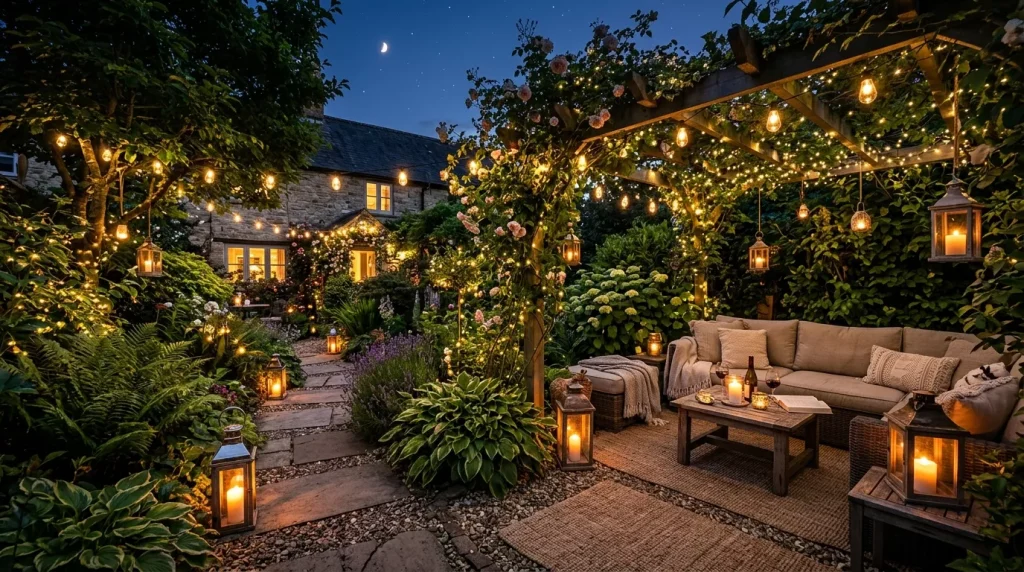
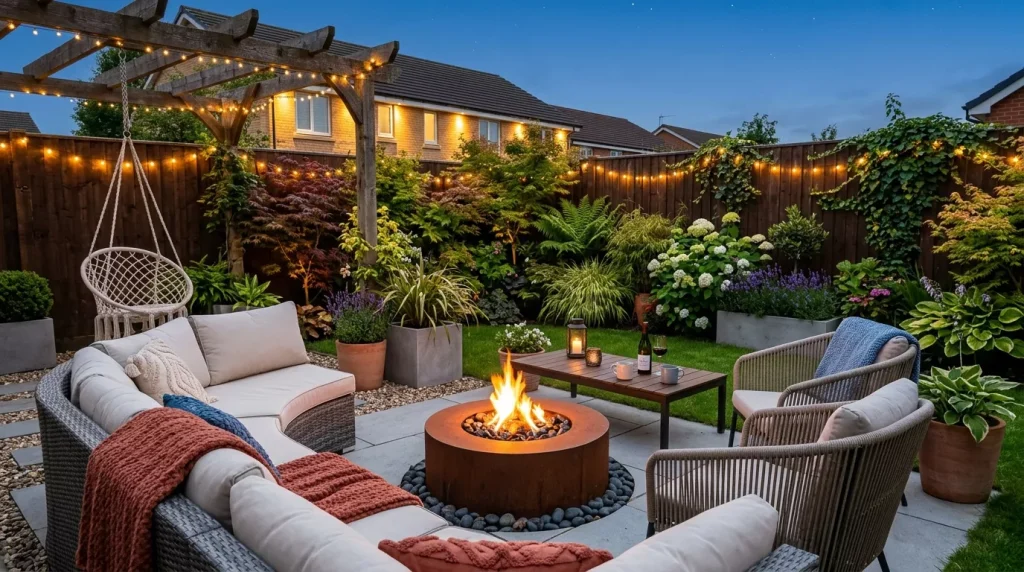
A Small Garden Can Still Entertain A compact folding table that seats four, a couple of well-chosen garden lanterns, a string of bistro lights overhead, and a planting scheme that smells as good as it looks — this is all you need for an outdoor entertaining space that genuinely impresses.
Small Garden Design Styles: Which One Fits Your Space?
Before buying a single plant or paving slab, it’s worth deciding on the overall feel you’re going for. Different styles suit different spaces, homes, and personalities.
| Style | Key Features | Best For |
|---|---|---|
| Modern / Minimalist | Clean lines, limited palette, structural plants, concrete or steel | Contemporary homes, low-maintenance preference |
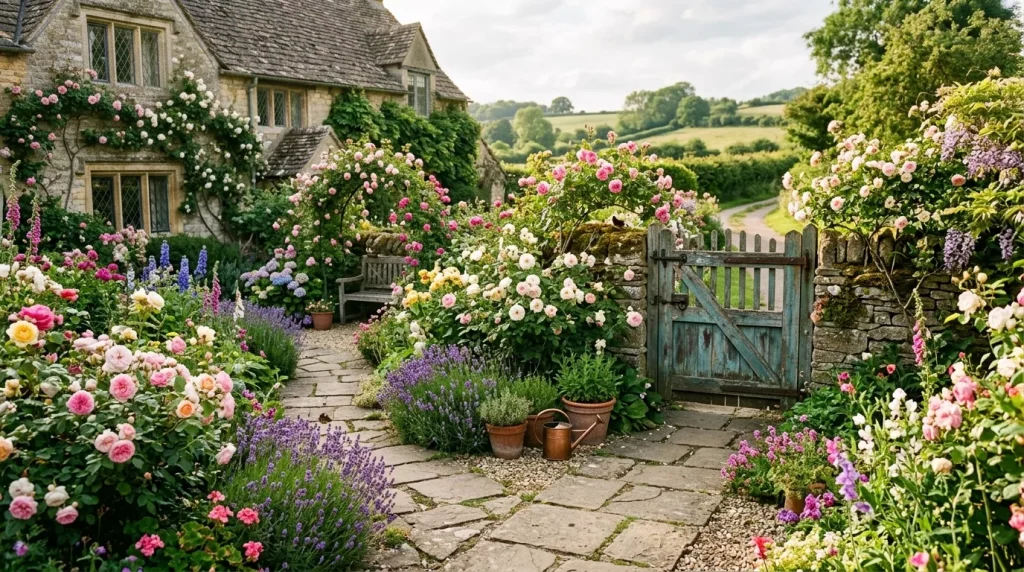
| Cottage Garden | Informal planting, mixed flowers, gravel paths, timber features | Older homes, relaxed aesthetic, nature lovers |
| Mediterranean | Terracotta pots, gravel, olive trees, lavender, drought-hardy plants | Sunny aspect, low rainfall areas |
| Japanese / Zen | Gravel, bamboo, moss, stone lanterns, asymmetry, deep calm | Contemplative spaces, shaded courtyards |
| Urban Jungle | Lush tropical foliage, bold textures, layered planting, large pots | City gardens, shaded spaces |
| Kitchen Garden | Raised beds, herbs, edible plants, structured but productive | Growing food, family gardens |
| Courtyard Garden | Hard landscaping, statement pots, wall planting, lighting | Enclosed urban spaces, no lawn |
Best Plants for Small Gardens: The A-List
Plant choice can make or break a small garden. You need plants that earn their place — visually interesting through multiple seasons, appropriately scaled, and ideally not requiring constant maintenance.

Structural Plants (the backbone):
- Buxus (Box): Clipped into balls or low hedges for structure and definition
- Pittosporum: Evergreen, compact, excellent in borders or containers
- Japanese Maple (Acer palmatum): Spectacular autumn color, elegant form, container-friendly
- Olive tree: Architectural, drought-tolerant, beautiful in large terracotta pots
- Cordyline: Bold, spiky form that adds drama in a small footprint
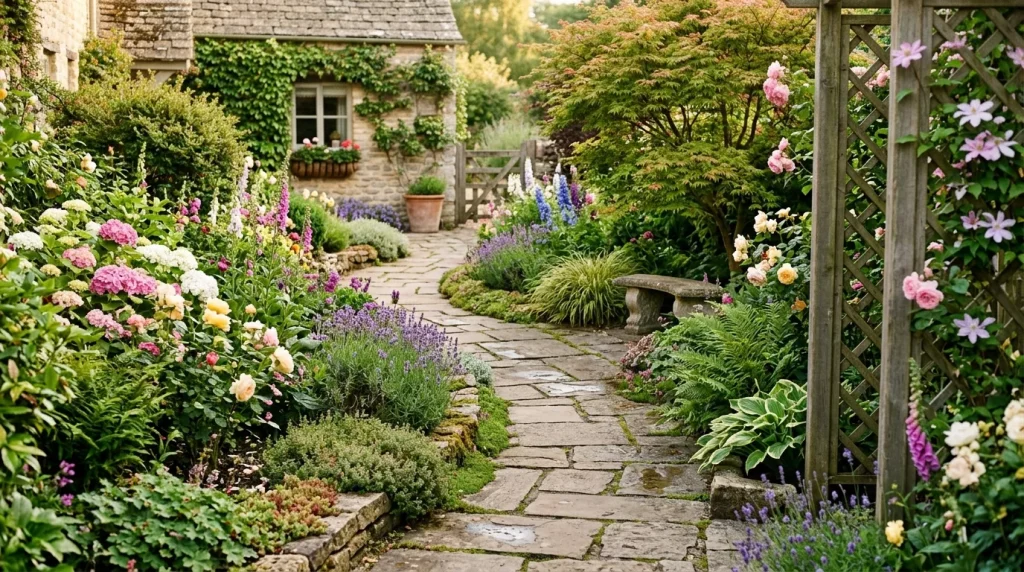
Flowering Plants that Work Hard:
- Lavender: Fragrant, drought-tolerant, loved by pollinators
- Salvia: Long-blooming, available in deep purples and reds, compact varieties available
- Echinacea: Upright, architectural flowering perennial
- Hydrangea: Reliable flowering shrub, container-friendly with the right variety
- Allium: Tall, architectural seed heads that look beautiful even when finished flowering

Climbers for Vertical Interest:
- Clematis, climbing roses, wisteria (managed), star jasmine, ivy
Herbs and Edibles for Small Spaces:
- Basil, rosemary, thyme, mint (in a pot — it spreads aggressively in ground), chives, compact tomatoes, strawberries

Pros and Cons of a Small Garden
Small gardens come with genuine advantages — and honest limitations. Here’s a clear-eyed view of both.
✅ Pros
- Lower maintenance: Less area means less mowing, pruning, and watering — critical if your time is limited
- More affordable to design: Quality materials, plants, and features go further in a smaller space
- Easier to keep tidy: A small garden can look immaculate in 20 minutes; a large one can’t
- Encourages creativity: The constraints push you to find clever, interesting solutions
- More intimate feel: Small gardens often feel more like outdoor rooms — cozy and enclosed rather than open and exposed
- Faster results: A small space fills in with planting much quicker than a large one, which can take years to establish

❌ Cons
- Limited growing space: Fewer plants, smaller edible garden, less capacity for trees
- Mistakes are amplified: In a small space, one badly chosen element is hard to ignore
- Privacy can be harder: Smaller gardens are often more overlooked — screening takes more thought
- Less room for children to play: If you have young kids who need space to run, a small garden has obvious limits
- Can feel cramped if poorly designed: Without a clear plan, a small space quickly becomes cluttered rather than cozy
- Storage is a real challenge: Bins, bikes, garden tools — storage competes directly with design in tight spaces

Step-by-Step Guide: How to Design a Small Garden From Scratch
If you’re starting with an empty or neglected small outdoor space, here’s a practical process to follow:
Step 1: Measure Everything Start with accurate measurements. Draw a simple top-down sketch to scale, noting the position of doors, windows, drains, existing plants, and any structures. You can’t make good decisions without knowing the real dimensions.
Step 2: Identify the Conditions How much sun does the space get, and at what time of day? Is it sheltered or exposed? Is the soil heavy clay or free-draining? These conditions determine which plants will thrive and which will struggle regardless of how much you want them to work.
Step 3: List How You Want to Use It Write down your priorities. Seating and outdoor dining? Growing herbs and vegetables? Play space for children? Low-maintenance color? The clearer you are about use, the easier every design decision becomes.
Step 4: Choose Your Surfaces First Hard landscaping — paving, decking, gravel, or a combination — forms the foundation of any garden. Get this right before you think about plants. Choose materials that complement your home’s exterior and that suit the style you’re going for.
Step 5: Plan for Structure Before Softness Add the structural elements next — raised beds, planter positions, trellis panels, a pergola, seating. These are the bones of the garden and they shape everything else.
Step 6: Choose and Place Plants Work from large to small — trees or large shrubs first, then medium border plants, then smaller edging plants and ground cover. Think about what looks good in each season, not just at planting time.
Step 7: Add Lighting and Finishing Touches Garden lighting extends the usable hours of your outdoor space dramatically. Solar spike lights along a path, festoon lights overhead, and lanterns on a table cost very little and transform how the garden feels after dark.
Tips for Making a Small Garden Feel Bigger
These practical details can significantly change how a small space feels:
- Use large-format paving: Counterintuitively, bigger paving slabs make a small garden feel larger. Lots of small tiles create visual noise and emphasize the limited area
- Keep the palette cohesive: Too many different colors, materials, and styles make a small space feel chaotic. Stick to two or three complementary materials throughout
- Use mirrors: A well-placed outdoor mirror on a fence or wall can double the perceived depth of a garden — particularly effective in enclosed courtyards
- Choose furniture that floats: Legs rather than solid bases on furniture create a sense of lightness that keeps the space from feeling heavy
- Plant at the edges: Keep central paving open and plant generously at the boundaries — this creates the illusion of a larger open area in the center
- Use a focal point: A single statement element — a sculpture, a beautiful tree, a water feature — gives the eye something to travel toward, which makes the space feel deeper
Common Mistakes to Avoid in a Small Garden
Even experienced gardeners stumble on these in smaller spaces:
❌ Planting too many different things: A small garden with twenty different plant species looks busy and unresolved. Choose five to eight plants and repeat them for cohesion.
❌ Choosing plants that outgrow the space: A tree or shrub that seems perfectly sized when planted can dominate the whole garden in three years. Always check the mature size, not the size in the pot.
❌ Ignoring levels and height: A flat garden with everything at the same height reads as uninteresting. Even simple steps, raised planters, or tall climbers add the vertical variation that makes a small garden feel dynamic.
❌ Forgetting about winter: Many people plant for summer and end up with a bare, uninviting space for six months of the year. Choose evergreen structural plants and winter-flowering species to keep the garden looking alive year-round.
❌ Overcrowding from the start: It’s tempting to plant densely for immediate impact, but plants need room to grow. Overcrowding leads to competition, disease, and a garden that looks like it needs editing within eighteen months.
❌ Neglecting drainage: Water pooling on a patio or saturated raised beds is a common small garden problem. Make sure any hard surfaces have a slight fall for drainage, and use free-draining compost mixes in containers and raised beds.
Conclusion: Your Small Garden Has More Potential Than You Think
The best small garden ideas don’t try to hide the fact that the space is limited — they work with it. They embrace intimacy. They focus on quality over quantity. They create spaces that genuinely get used and genuinely feel good to be in, regardless of how many square meters are involved.
You don’t need a large garden to grow food, to sit surrounded by plants on a summer evening, to create something that improves your daily life in a small but real way. You need a plan, a clear sense of how you want the space to feel, and the patience to build it thoughtfully.
Start with one good decision — a raised bed, a well-chosen climber, a comfortable seat in the right spot — and the rest will follow.
Ready to transform your outdoor space? Take your measurements today, pick one idea from this guide, and start turning your small garden into the space it’s always had the potential to be.
FAQs: Small Garden Ideas
Q1: What’s the best layout for a very small garden?
For gardens under 20 square meters, keep the layout simple. A single paved or decked area with planting around the perimeter works well because it maximizes usable floor space while still allowing generous planting. Avoid dividing a truly tiny space — save zoning strategies for gardens that have at least some room to work with. One focal point (a statement pot, a small water feature, or a specimen plant) gives the space a clear center of attention.
Q2: How do I add privacy to a small garden without making it feel even smaller?
Tall planting rather than solid fencing is the best privacy solution for small gardens. A hedge of Photinia, Portuguese laurel, or bamboo (in root barrier containers to control spread) screens effectively without the solid wall effect of close-board fencing. If you need to use fencing, add a trellis top panel and plant climbers on it — the combination of structure and planting feels softer and less enclosing than a solid fence alone.
Q3: What are the best low-maintenance plants for a small garden?
For low maintenance, focus on evergreen structural plants that hold their shape without constant pruning — Pittosporum, Buxus, Euonymus, and Phormium are reliable choices. For seasonal interest with minimal effort, ornamental grasses, lavender, and rudbeckia look after themselves well once established. Avoid plants that need staking, regular deadheading, or invasive spreaders that need constant management.
Q4: Can I have a lawn in a small garden?
You can, but it’s worth thinking carefully about whether it’s the right choice. A very small lawn (under 10 square meters) is often more trouble than it’s worth — difficult to mow neatly, quick to wear out in high-use areas, and not particularly comfortable to sit on. Alternatives like artificial grass, gravel with stepping stones, or a mix of paving and planting often look better and require far less maintenance. If you do want a lawn, choose a shade-tolerant, hard-wearing grass mix and keep it simple in shape.
Q5: How do I deal with a shaded small garden?
Shade is not the design limitation many people think it is — it just requires different plants. Ferns, hostas, astilbe, hellebores, and Japanese anemone all thrive in shade and look beautiful together. For structure, skimmia, fatsia japonica, and aucuba are reliable evergreen shade plants. Painting boundary walls or fences white or pale cream helps bounce available light around the space, and mirrors can amplify it further.
Q6: Is it worth hiring a garden designer for a small garden?
For a full redesign of even a small garden, a consultation with a garden designer — even a single paid hour — is often worth the investment. They can quickly identify opportunities and problems you might miss, suggest plants and materials suited to your specific conditions, and save you from costly mistakes. If a full design isn’t in budget, many designers offer phone or video consultations based on photos and measurements, which are affordable and genuinely useful.
Q7: What’s the best flooring for a small patio garden?
Large-format porcelain or natural stone pavers in a light color are the most popular choice for small patios — they reflect light, look clean, and the larger size creates fewer grout lines, which reduces visual noise. Decking works well too, particularly composite decking which doesn’t require the annual oiling that timber does. Gravel is the most affordable option and can look beautiful in Mediterranean or cottage-style gardens. Avoid very dark paving in small spaces as it absorbs light and can make the area feel smaller and more enclosed.