Industrial Bathroom Decor: Style Guide & Tips

Industrial Bathroom Decor: The Complete Guide to Nailing the Look in 2025

If you’ve ever walked into a bathroom that felt like a converted factory — exposed pipes, raw concrete walls, Edison bulbs glowing warmly overhead — and thought, I want that, you’re not alone. Industrial bathroom decor has moved well beyond a passing trend. It’s now one of the most sought-after interior design styles for homeowners who want something that feels raw, authentic, and genuinely different from the usual spa-white aesthetic.
But pulling it off without making your bathroom look like an unfinished construction site? That takes a bit of know-how.
This guide covers everything — from choosing the right materials and color palette to avoiding the most common mistakes people make when going for that factory-chic finish.

What Is Industrial Bathroom Decor, Exactly?
The industrial style draws its inspiration from old warehouses, factories, and urban loft spaces — buildings that were built for function, not beauty. Over time, designers started seeing the beauty in that rawness. Unfinished surfaces, utilitarian fixtures, and honest materials became design choices rather than budget constraints.
In a bathroom context, industrial decor typically means:
- Exposed plumbing pipes left visible and sometimes painted black or bronze
- Raw or polished concrete on floors, walls, or countertops
- Dark metal finishes on faucets, towel bars, and hardware
- Reclaimed or distressed wood for shelving, vanity tops, or accents
- Edison-style or filament bulbs in metal cage fixtures
- Neutral, muted color palettes — think charcoal, slate grey, warm white, and deep black

It’s a style that values texture over color, structure over ornamentation.
Industrial Bathroom Decor: Key Design Elements
1. Materials That Define the Look
The materials you choose carry the entire vibe. Get these right, and everything else falls into place.
Concrete: Either poured in place or applied as a microcement coating, concrete is the backbone of industrial bathroom design. It works on floors, vanity surfaces, and even walls. It’s durable, water-resistant when sealed, and has a naturally matte texture that catches light beautifully.
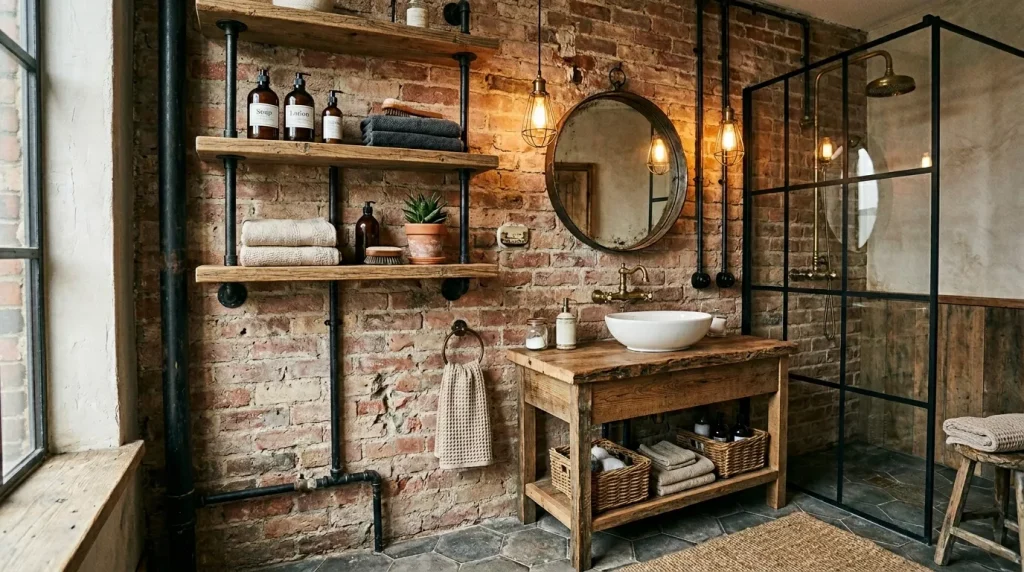
Metal: Black matte, brushed steel, and aged bronze are the go-to finishes. Use them on faucets, shower heads, towel rings, cabinet handles, and mirror frames. Consistency across your metal finishes makes the space look intentional rather than assembled from clearance items.
Reclaimed Wood: A plank shelf, a wood-topped vanity, or even a simple wooden stool adds warmth to what could otherwise be a cold, hard space. Look for wood with visible grain, knots, or even old nail holes — imperfections are the point.
Glass and Wire: Frosted or clear glass with wire mesh (chicken wire glass) in cabinet doors or window panes gives an old factory feel. It’s subtle but effective.
2. Industrial Bathroom Color Palette

You won’t find coral or sage green in a true industrial palette. The colors here are rooted in the factory floor:
| Color | Best Used For |
|---|---|
| Charcoal / Slate Grey | Walls, tile, concrete finishes |
| Matte Black | Fixtures, hardware, frames |
| Warm White / Off-White | Walls, ceiling, grout |
| Bronze / Aged Brass | Accent fixtures, light fittings |
| Raw Timber / Tan | Wood elements, open shelving |
| Deep Navy (accent) | Feature wall, accessories |

Keep the palette tight — three to four tones at most. Industrial design relies on restraint. The moment you introduce too many colors, you lose the cohesion that makes the style work.
3. Lighting in an Industrial Bathroom
Lighting is where industrial bathrooms really get their character. Forget recessed can lights and chrome pendants. Instead, think:
- Exposed bulb sconces mounted on either side of a mirror
- Pipe-style wall fixtures with Edison bulbs
- Cage pendant lights over a freestanding tub if you have one
- Industrial vanity strips in matte black or brushed nickel

The goal is warm, slightly moody light — not the sterile brightness of a hospital bathroom. Dimmer switches are worth every penny here.
4. Fixtures and Fittings That Seal the Deal
Your fixtures need to match the aesthetic hard. A polished chrome tap on a concrete vanity is like wearing sneakers with a tailored suit — technically fine, but something’s off.
Go for:
- Black matte faucets — they photograph beautifully and age gracefully
- Exposed pipe shower systems — wall-mounted with visible plumbing
- Cast iron or stone vessel sinks — especially ones that feel heavy and substantial
- Freestanding clawfoot tubs in matte white or painted black for a bold statement

Step-by-Step Guide: How to Transform Your Bathroom with Industrial Decor
You don’t need to gut your entire bathroom to achieve this look. Here’s a practical, phased approach.
Step 1 – Assess What You’re Working With Walk through your bathroom and note the bones: tile color, fixture finishes, storage, lighting. What stays? What has to go? You’re looking for what can be converted versus what needs replacing.
Step 2 – Commit to a Metal Finish Pick one metal finish — matte black is the most versatile — and plan to use it across every fixture and fitting. This is the single most unifying decision you’ll make.
Step 3 – Address the Walls You don’t need to pour concrete. A quality microcement plaster or industrial-look tile can achieve the same effect. Grey concrete-effect tiles are widely available and easy to install. For a quicker fix, limewash paint adds texture and depth without major work.

Step 4 – Upgrade Your Lighting First Lighting is one of the cheapest and highest-impact changes. Swap out your existing fixtures for pipe-style or cage-style sconces. Add Edison bulbs. Install a dimmer. This alone can shift the entire feel of the room.
Step 5 – Rethink Your Storage Replace closed vanity units with open black metal shelving or floating reclaimed wood shelves. Keep items visible but curated — glass jars for cotton pads, metal canisters for brushes, folded dark towels stacked simply.
Step 6 – Add Textures and Accessories Last A distressed leather soap holder, a concrete soap dish, a metal-framed mirror, a bare-bulb sconce. These are the finishing touches. Don’t rush this step — shop slowly and let the room tell you what it needs.
Industrial Bathroom Decor: Pros and Cons

Before you commit, it’s worth knowing both sides of this design choice.
Pros
- Timeless appeal — unlike trend-driven styles, industrial design has proven staying power
- Masculine and gender-neutral — works well in shared bathrooms without skewing too feminine or too stark
- Easy to mix — pairs beautifully with mid-century modern, Japandi, and minimalist styles
- Low-maintenance surfaces — concrete, metal, and stone are all durable and easy to clean
- Budget-flexible — you can go all-in with a full renovation or achieve the look with targeted swaps
Cons

- Can feel cold without warm wood or textile accents
- Hard surfaces everywhere — acoustics in the bathroom can get echoey
- Maintenance for real concrete — unsealed or improperly sealed concrete stains easily
- Dark finishes show water spots — black fixtures need regular wiping to look their best
- Not ideal for small bathrooms without natural light — the dark palette can close in a windowless space
Industrial vs. Modern Farmhouse vs. Minimalist Bathroom: How They Compare

These three styles often get confused because they share some overlapping elements. Here’s how they differ:
| Feature | Industrial | Modern Farmhouse | Minimalist |
|---|---|---|---|
| Color Palette | Charcoal, black, grey | White, cream, warm wood | White, off-white, nude |
| Materials | Concrete, metal, raw wood | Shiplap, ceramic, soft metals | Stone, glass, smooth surfaces |
| Fixtures | Black matte, exposed pipe | Brushed nickel, bridge faucets | Sleek chrome or matte white |
| Lighting | Edison, cage, exposed bulb | Lantern, linen shades | Hidden strip, recessed |
| Overall Vibe | Raw, urban, edgy | Cozy, nostalgic, soft | Clean, serene, uncluttered |
| Best For | Lofts, urban homes | Suburban homes, cottages | Modern apartments |
Tips for Getting Industrial Bathroom Decor Right

These are the details that separate a polished industrial bathroom from one that just looks unfinished:
- Layer your textures. Concrete and metal alone feel harsh. Add a woven jute bath mat, a stack of linen towels, or a weathered wood stool to break up the hard surfaces.
- Plants work surprisingly well. A pothos in a simple black planter or a succulent on a concrete shelf adds life without breaking the aesthetic.
- Don’t over-expose the pipes. Real exposed plumbing that’s actually functional looks great. Fake decorative pipe trim looks cheap. Keep it genuine.
- Mirrors matter more than you think. A large black-framed mirror or a repurposed factory window mirror is one of the most impactful elements you can add.
- Keep accessories minimal. Industrial design is about restraint. Three well-chosen items on a shelf look better than fifteen random ones.
- Choose grout wisely. Dark grout between lighter tiles looks more intentional and hides grout stains far better than white grout does.

Common Mistakes to Avoid
Even well-intentioned industrial bathrooms can go wrong. Watch out for these:
Mixing too many metal finishes. Black faucets, silver towel bars, brass handles, and chrome sconces — all in one bathroom — looks chaotic. Pick one or two complementary finishes and stick to them.
Forgetting warmth entirely. An all-grey, all-metal bathroom with no organic elements feels more like a parking structure than a home. Even one wood element changes everything.
Using low-quality “industrial” accessories. The market is flooded with cheap knockoffs — thin metal shelf brackets, plastic “concrete” accessories, laminate that pretends to be wood. They look fine in product photos and terrible in person. Invest in fewer, better pieces.

Ignoring the floor. Walls and fixtures get all the attention, but the floor anchors the whole room. Concrete-effect porcelain tile or actual polished concrete makes a massive difference.
Overloading on Edison bulbs. One or two is atmospheric. Six is a novelty shop. Use them where they count — at the vanity mirror — and keep the rest of your lighting more subtle.
Industrial Bathroom Decor on a Budget

You don’t need a renovation budget to get the look. Here’s where to invest and where to save:
Spend money on:
- Fixtures (faucets, showerhead, towel bars) — these are touched daily and bad ones show
- Lighting — a good sconce transforms a space
- The vanity or mirror — these are the focal points
Save money on:
- Accessories — thrift stores, vintage markets, and online secondhand sellers are goldmines
- Paint — limewash and specialty wall paints are affordable and high-impact
- Open shelving — basic black metal brackets with reclaimed wood planks cost very little
- Towels and textiles — go neutral and simple; you don’t need designer brands here
FAQs: Industrial Bathroom Decor
Q1: Can industrial bathroom decor work in a small bathroom?
Yes, but it takes more care. In a small space, lean toward lighter concrete tones and add a large mirror to bounce light around. Avoid too many dark surfaces competing for space. One bold industrial element — a black fixture set or a concrete vanity — can anchor the look without overwhelming the room.
Q2: Is real concrete practical in a bathroom?
Real poured or troweled concrete is practical when properly sealed. Unsealed concrete will absorb water, soap, and color and stain quickly. Many designers now prefer microcement — a thin-coat alternative that’s easier to apply, more water-resistant, and just as beautiful. Either way, professional application is strongly recommended.
Q3: What flooring works best for an industrial bathroom?
Concrete-effect porcelain tile is the most practical choice — it’s waterproof, durable, and widely available in large-format slabs that look very convincing. Actual polished concrete is great but requires sealing and maintenance. Hexagonal cement tiles in grey or black and white also work well and have an old-factory feel.
Q4: How do I add warmth to an industrial bathroom without losing the style?
Wood is your best friend here. A reclaimed wood shelf, a teak shower mat, or even a simple wooden stool introduces organic warmth. Plants help too. Textiles — a thick woven bath mat, dark linen towels — soften the hard edges. The key is to add warmth through texture and natural materials rather than through color.
Q5: Are black fixtures hard to keep clean?
Matte black fixtures do show water spots and soap residue more than you’d expect — especially in hard water areas. Wiping them down with a dry cloth after use keeps them looking sharp. Avoid abrasive cleaners. Some people find this extra step annoying; others think it’s a small trade-off for how good the fixtures look. Brushed bronze or aged brass is slightly more forgiving if that’s a concern.
Q6: Can I mix industrial with other design styles?
Absolutely. Industrial pairs particularly well with Japandi (Japanese-Scandinavian minimalism), mid-century modern, and even a softer bohemian aesthetic. The trick is to let industrial be the dominant language and introduce the other style as an accent. Don’t try to do two styles equally — one has to lead.
Q7: What’s the best mirror style for an industrial bathroom?
Large, simple, and dark-framed. An oversized black metal frame mirror is the classic choice. Vintage factory windows repurposed as mirrors work beautifully. Avoid ornate, gilded, or highly decorative frames — they clash with the utilitarian spirit of the style.
Conclusion
Industrial bathroom decor isn’t for everyone — and that’s exactly part of its appeal. It’s a deliberate choice, a design statement that says you value character over polish, texture over perfection, and substance over decoration.
The good news is that it’s more accessible than it looks. You don’t need to gut your bathroom or hire an architect. Start with your fixtures, invest in good lighting, bring in a wood element, and let the details develop over time. The best industrial spaces tend to feel like they’ve evolved naturally rather than been dropped in from a catalog.
Whether you’re doing a full renovation or a weekend refresh, this guide gives you the framework to make choices that hold up — not just for a season, but for years.
Ready to start? Pick one element — your mirror, your lighting, or your fixture finish — and make that change first. See how it shifts the room. Then build from there. That’s how the best industrial bathrooms actually get made.