Art Deco Bathroom Decor Ideas That Drip With Glamour

Art Deco Bathroom Decor Ideas That Drip With Glamour
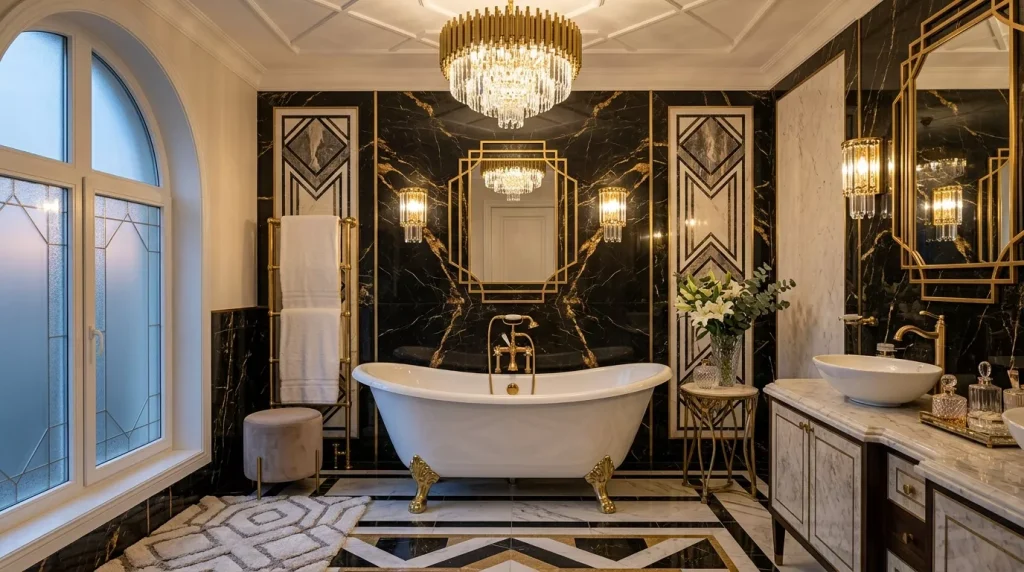
Walk into a well-executed Art Deco bathroom and you feel it immediately — that unmistakable blend of bold geometry, gleaming metallics, and an almost theatrical sense of luxury. It doesn’t whisper. It announces itself.
Art Deco bathroom decor ideas draw from one of history’s most distinctive design movements — born in 1920s Paris and swept across the world through the 1930s and 40s. Think Hollywood golden age, Jazz era glamour, and a fierce commitment to beauty through symmetry and craftsmanship. Today, that same aesthetic translates into some of the most striking bathrooms you’ll ever step into.
Whether you’re renovating from scratch or layering personality into a plain white space, this guide gives you the full picture — what Art Deco actually means, how to use it in a bathroom, and exactly how to make it work for your budget and space.
What Makes a Bathroom Truly Art Deco?
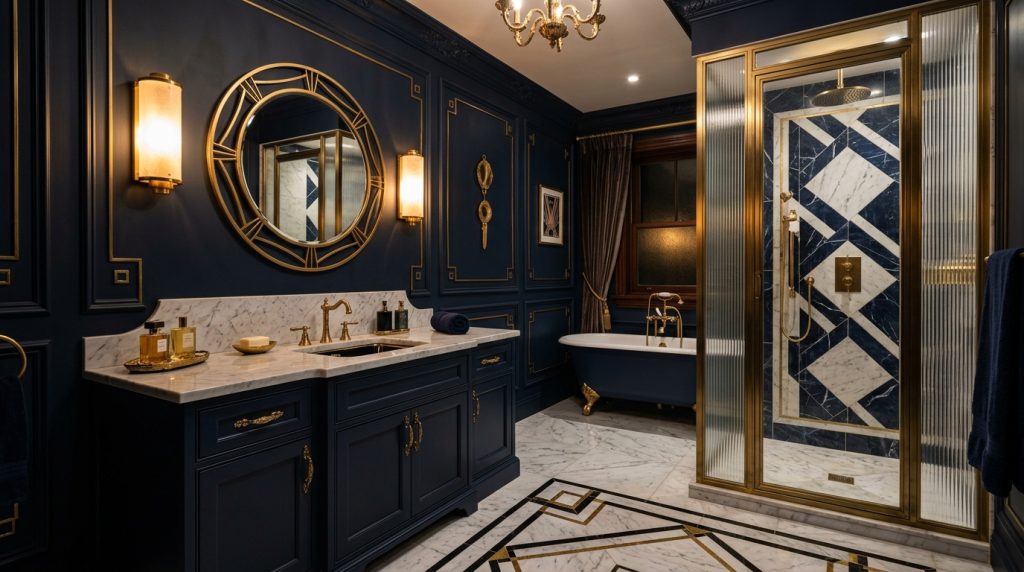
Before you spend a cent, it helps to understand what actually defines this style — because “Art Deco” gets thrown around loosely and often incorrectly.
Art Deco is built on a specific visual vocabulary. It’s not just black and gold. It’s not just geometric tiles. It’s the combination of certain elements working together in a deliberate, symmetrical, often theatrical way.
The core pillars of Art Deco design:
- Bold geometric patterns — chevrons, sunbursts, stepped shapes, fan motifs, and honeycomb arrangements
- Luxurious materials — marble, chrome, brass, lacquer, ebonized wood, and mirrored surfaces
- Strong contrast — black and white is the classic pairing, but deep navy or forest green against gold works equally well
- Symmetry — Art Deco loves a balanced composition; if something appears on one side, it appears on the other
- Ornamental metalwork — fixtures, towel rails, mirror frames, and hardware are treated as decorative objects, not just functional items
- Rich, saturated color accents — used sparingly but powerfully against neutral or monochrome backdrops
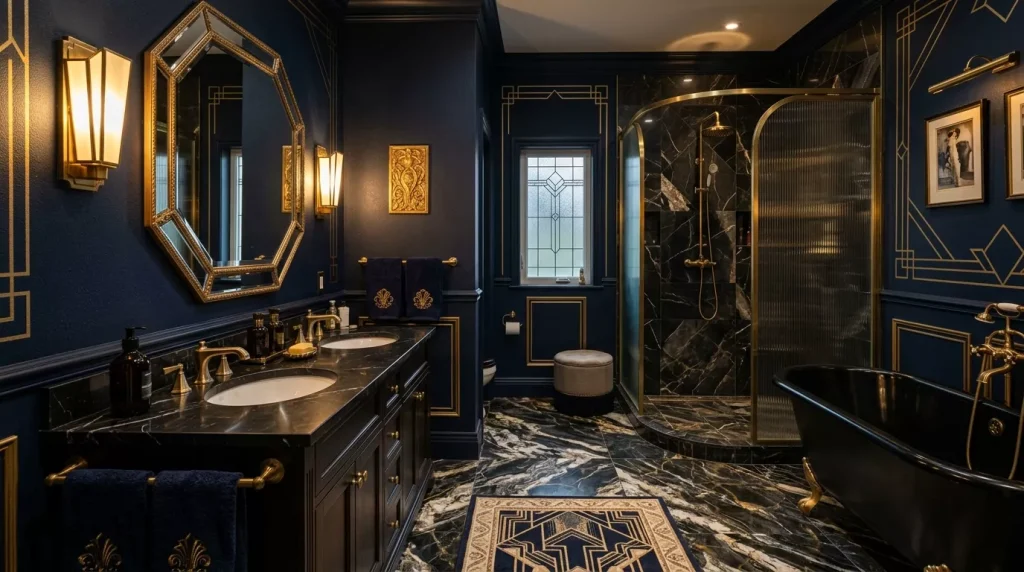
The key word is intentional. Nothing in an Art Deco bathroom is accidental. Every fixture, tile, and accessory is chosen to contribute to a unified visual story.
Art Deco Bathroom Decor Ideas: Where to Begin
Floors and Tiles — The Foundation of the Look
If there’s one non-negotiable in an Art Deco bathroom, it’s the tile work. Floors especially set the tone for everything else in the room.
Classic Art Deco tile choices:

| Tile Style | Pattern | Best Used On |
|---|---|---|
| Black and white hexagonal | Honeycomb grid | Floors |
| Chevron mosaic | V-shaped zigzag | Floors or feature walls |
| Sunburst fan tile | Semicircular radiating lines | Floor medallion or feature zone |
| Geometric encaustic | Interlocking shapes | Both floor and lower wall |
| Marble penny round | Small circular mosaic | Shower floors |
| Large format marble | Veined stone slab | Walls and surfaces |
The most authentically Art Deco flooring combines black and white — whether that’s a classic checkerboard, a herringbone in two contrasting shades, or a more complex geometric medallion as the centrepiece.

On the walls, consider running a tile dado (a band of tiles from floor to roughly waist height) with a contrasting upper wall in a saturated color or warm white. This was a hallmark of original 1920s bathroom design and it still reads beautifully today.
Colour Palette: Bold, Rich, and Unapologetic
Art Deco colour is one area where people often get cautious — and then end up with something that looks vaguely Art Deco rather than genuinely committed to the aesthetic.
Authentic Art Deco colour combinations for bathrooms:
- Black + gold — the most classic, theatrical, and impactful pairing
- White + chrome — cooler and more refined, with a clinical edge that still feels glamorous
- Navy + brass — rich, sophisticated, and slightly more contemporary in feel
- Ivory + black + gold — a softer three-tone version of the classic
- Deep emerald + gold — opulent and jewel-like, particularly effective in larger bathrooms
- Dusty rose + chrome — a warmer, feminine interpretation with genuine 1930s roots

If you’re nervous about going dark, start with fixtures and accessories in your chosen metallic, and choose a deep-toned tile for the floor only. This gives you a grounded, committed look without making the whole room feel heavy.
Gold and Chrome Fixtures — The Jewellery of the Bathroom
No Art Deco bathroom feels complete without deliberate, beautiful metalwork. Fixtures in this style aren’t an afterthought — they’re part of the design statement.
What to look for in Art Deco fixtures:

- Tap styles: Cross-head or lever handles with geometric detailing; exposed pipework in a polished finish
- Shower fittings: Rainfall shower heads with visible pipe columns (rather than concealed wall-mounted styles)
- Towel rails: Stepped or tiered designs in brushed gold or polished chrome
- Mirror frames: Sunburst mirrors, stepped rectangular frames, or octagonal shapes with bevelled glass
- Cabinet hardware: Geometric drawer pulls in brass or chrome — hexagonal, arrow-shaped, or fan-designed
Consistency matters here. Pick one metal finish and stick to it throughout the room. Mixing chrome and gold works in some design styles but in Art Deco it tends to dilute the polished intentionality of the look.
Vanity Units and Storage
The vanity is your bathroom’s statement piece and in an Art Deco scheme, it deserves real attention.
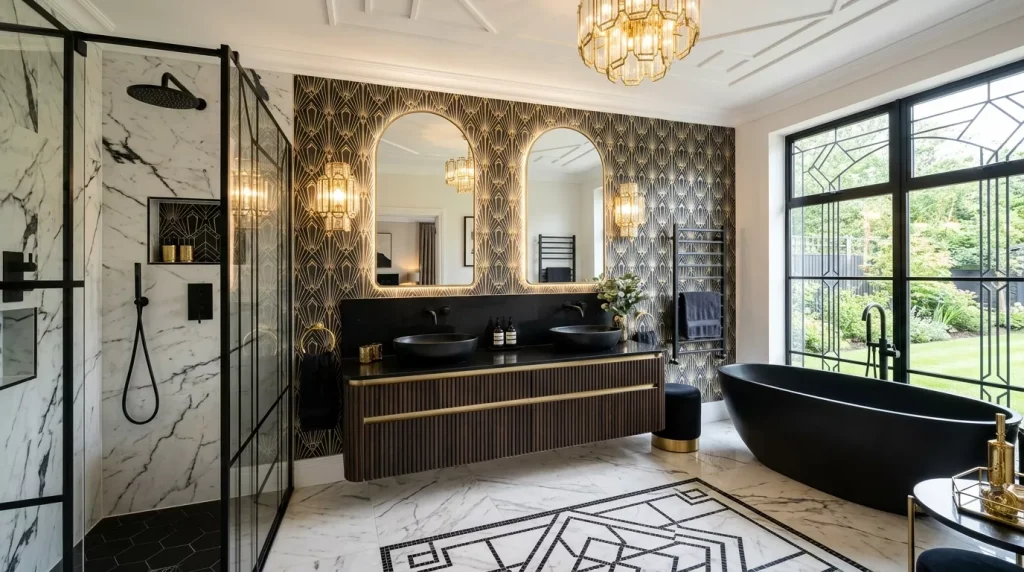
Look for a freestanding or floating vanity in a dark lacquered finish — ebonized oak, deep walnut, or a high-gloss painted surface in black or navy. Pair with a countertop in white marble or solid white stone, and finish with geometric hardware in your chosen metal.
If you’re working with an existing vanity you can’t replace, consider repainting it in a deep jewel tone, replacing the hardware with Art Deco-style pulls, and updating the mirror above it to a sunburst or stepped-frame design. That combination alone can completely transform the look.
Art Deco bathroom storage tips:
- Open shelving with symmetrical arrangements looks more intentional than overcrowded cabinets
- Mirrored surfaces on cabinet fronts add depth and reinforce the reflective quality of the style
- Decorative glass bottles, geometric soap dispensers, and black ceramic accessories on open shelves become part of the decor rather than clutter
Lighting: Glamour Overhead
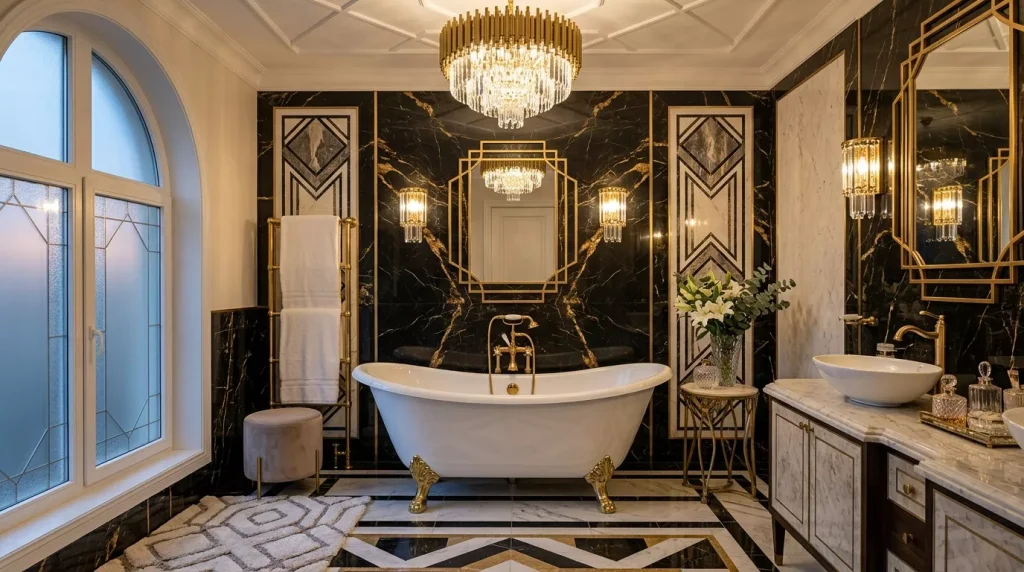
Art Deco lighting is perhaps its most distinctive feature — and in a bathroom, it’s also one of the quickest ways to transform the atmosphere.
The original era favoured bare bulb arrangements (Edison-style filament bulbs weren’t Art Deco, but their warm glow is compatible), geometric wall sconces flanking the mirror, and globe pendants in amber or frosted glass.
Best Art Deco lighting approaches for bathrooms:
- Wall sconces either side of the mirror — symmetrical placement is essential; they frame your face beautifully for practical use too
- A statement ceiling pendant — geometric, stepped, or globe-style in brass or chrome
- LED strip lighting behind a mirror — creates a dramatic illuminated halo effect that references the neon and backlit signage of the era
- Dimmer switches — absolutely worth installing; different light levels completely shift the mood
Avoid recessed can lighting as your primary source if you can help it — it’s too casual for the deliberate drama of Art Deco. If recessed lighting is fixed in your space, supplement it heavily with decorative wall or pendant fixtures.

Art Deco vs. Hollywood Regency Bathroom: What’s the Difference?
These two styles are closely related and often confused. Both love glamour, metallics, and drama. But they’re distinct in important ways.
| Feature | Art Deco | Hollywood Regency |
|---|---|---|
| Era | 1920s–1940s | 1930s–1960s |
| Geometry | Strong, angular, geometric | Softer curves, more flamboyant |
| Colour | Rich but restrained | Bolder, often includes saturated brights |
| Materials | Marble, chrome, brass, lacquer | Velvet, lacquer, chinoiserie, lucite |
| Mirror style | Sunburst, bevelled, stepped frame | Oversized, ornate, layered |
| Feel | Masculine, structured, precise | Maximalist, theatrical, camp |
If you want something tighter and more architectural, stay in Art Deco territory. If you want to push further into drama and maximalism, Hollywood Regency is the next step along the same road.

Step-by-Step Guide to Decorating an Art Deco Bathroom
Use this approach whether you’re starting fresh or working with an existing bathroom:
Step 1: Audit what you already have. Walk through your bathroom and identify what can stay, what needs replacing, and what can be updated cosmetically. Tiles, vanity, fixtures, lighting — rank them by how much they conflict with the direction you’re heading.
Step 2: Choose your metal finish. Decide between gold/brass and chrome early, because every fixture, accessory, and hardware piece needs to follow this decision. Write it down and don’t deviate.
Step 3: Commit to your floor. This is the biggest design commitment in the room. Even if you’re not retiling the entire bathroom, a tile feature — a border, a medallion, or a floor inset — signals Art Deco strongly.
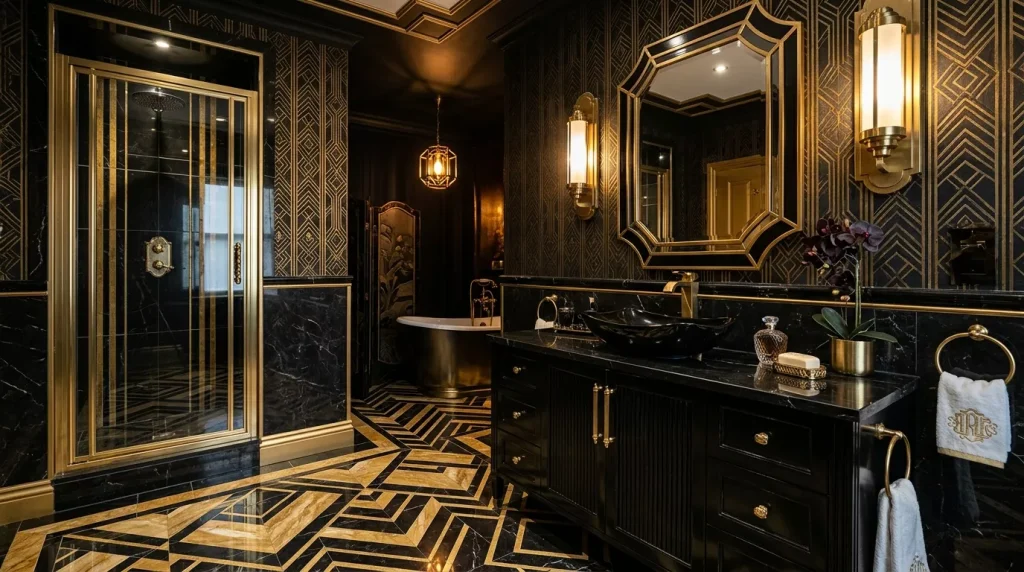
Step 4: Address your vanity. Update the mirror first (a sunburst or stepped frame is often surprisingly affordable), then the hardware. If budget allows, replace or repaint the vanity itself.
Step 5: Source your fixtures. Cross-head taps, exposed pipework shower columns, and a geometric towel rail make a dramatic collective impact. You don’t have to do all three at once — start with taps.
Step 6: Layer your lighting. Add at least one wall sconce beside the mirror. If there’s a pendant option, prioritize something geometric. Replace existing bulbs with warm-white (2700K) for a rich, flattering glow.
Step 7: Finish with accessories. Geometric soap dispensers, black ceramic trays, glass perfume bottles, a brass-framed print, or a single striking plant (aspidistra and ferns both have period-appropriate character) complete the look without overwhelming it.

Pros and Cons of an Art Deco Bathroom
Pros
- Visually stunning — few design styles make a bathroom feel as genuinely impressive
- Timeless appeal — unlike trend-driven styles, Art Deco has remained desirable for nearly a century
- Adds real property value — a beautifully executed themed bathroom is a genuine selling point
- Endlessly adaptable — works in large master bathrooms, small cloakrooms, and powder rooms alike
- Easy to layer in gradually — you can achieve the look incrementally without a full renovation
- Strong accessory market — Art Deco-inspired pieces are widely available at various price points
Cons
- Full renovation is expensive — authentic geometric tiling, marble surfaces, and quality fixtures aren’t cheap
- Demands commitment — half-hearted execution looks confused rather than glamorous
- Dark colours can shrink small spaces — needs thoughtful handling in compact bathrooms
- Cleaning intensity — grout lines in complex tile patterns and polished metal fixtures require regular upkeep
- Can feel dated if overdone — too many pattern elements in one room can tip into pastiche rather than sophistication
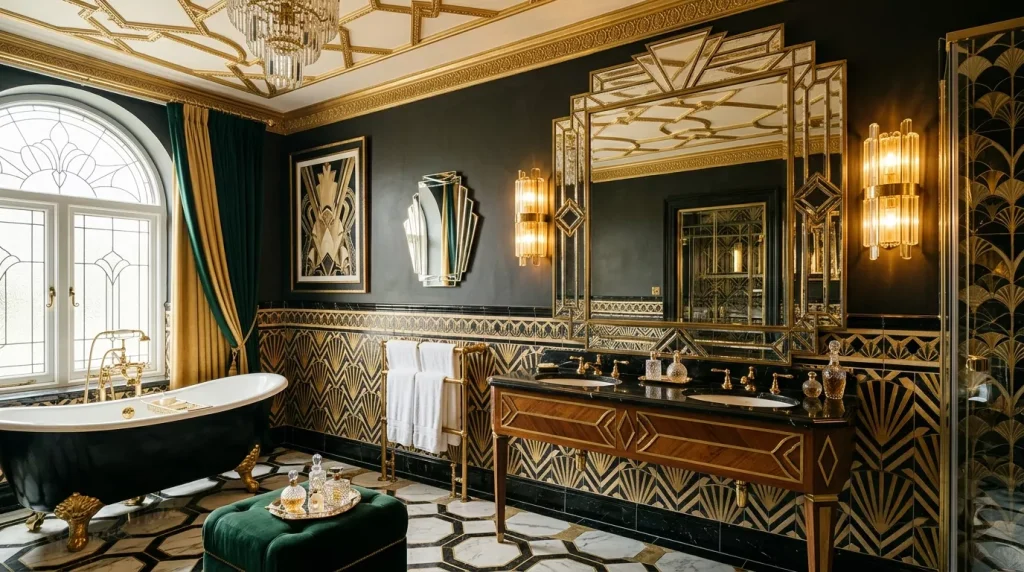
Tips for Nailing Art Deco Bathroom Decor
Tip 1: Start with one hero element. If a full renovation isn’t possible, invest everything in one statement piece — a sunburst mirror, a geometric floor tile, or a gold cross-head tap set. One excellent choice beats a room of mediocre ones.
Tip 2: Don’t underestimate the power of grout colour. In geometric tile work, dark grout (charcoal or black) makes patterns pop dramatically. White grout softens and can look tired quickly. The difference in visual impact is enormous.
Tip 3: Embrace symmetry deliberately. Hang two sconces at identical heights. Place matching accessories on either side of the basin. Centre your mirror precisely above the vanity. Symmetry is the backbone of Art Deco — treat it as a rule, not a suggestion.
Tip 4: Use black as a neutral, not a statement. In Art Deco bathrooms, black functions the way white does in minimalist spaces — it grounds everything else. Black grout, black fixtures, black towels, and black accessories create continuity without competing.

Tip 5: Layer metallics carefully. One primary metal finish plus a secondary tone used minimally (e.g., all brass fixtures with a chrome-framed print) is the limit. More than two metallic tones in a single bathroom reads as unresolved.
Tip 6: Consider a powder room for your boldest ideas. Small cloakrooms and powder rooms are the perfect testing ground for Art Deco drama. Dark walls, a statement mirror, and gold fittings feel absolutely correct in a small space — and since you’re not in there for long, the intensity works in your favour.
Common Mistakes to Avoid in an Art Deco Bathroom
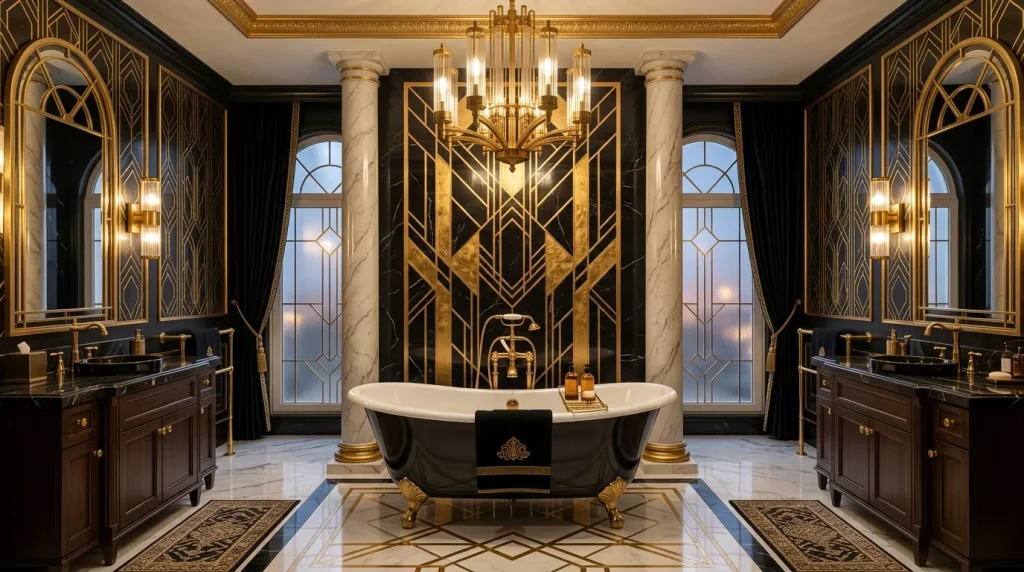
Mistake 1: Confusing “geometric” with “Art Deco.” Geometric shapes exist across many design styles. What makes a pattern Art Deco is the specific motifs — chevrons, sunbursts, fan shapes, stepped forms, and interlocking symmetrical designs. Generic diamond or triangular patterns don’t carry the same character.
Mistake 2: Mixing too many tile patterns. Art Deco tile work is bold but disciplined. Combining a geometric floor with a patterned wall tile and a mosaic feature strip is too much. Let one pattern dominate and keep everything else simple.
Mistake 3: Skimping on fixture quality. Cheap plastic taps with a gold-effect finish look immediately wrong in an Art Deco bathroom. The style depends on materials that have actual weight and lustre. Save up for real brass or chrome fixtures — they make the entire room.
Mistake 4: Ignoring the ceiling. Original Art Deco interiors treated the ceiling as a design surface — coffered details, stepped crown moulding, or even a contrasting paint colour. A plain flat white ceiling in an otherwise dramatic bathroom is a missed opportunity.
Mistake 5: Over-accessorising. It’s easy to think more is more in a maximalist-leaning style, but Art Deco’s glamour comes from restraint within opulence. A few perfectly chosen pieces — one statement mirror, two well-positioned sconces, a single geometric tray — outperform a surface crowded with decorative objects.
Conclusion: Make Your Bathroom a Statement Worth Walking Into
Art Deco bathrooms don’t happen by accident. They’re the result of deliberate choices — the right tile, the right metal, the right symmetry — stacked together until the room feels like something genuinely special.
The best Art Deco bathroom decor ideas aren’t about recreation of the past. They’re about borrowing the confidence of that era — its belief that even a functional space deserves to be beautiful, dramatic, and unmistakably itself.
You don’t need to do it all at once. One sunburst mirror. One set of cross-head brass taps. One geometric tile border. Each piece moves you further toward a bathroom that stops people in their tracks.
Your next step: Pick the single element that excites you most from this guide and make it happen this month. Not everything at once — just one thing. That’s how genuinely great rooms get built.
Frequently Asked Questions (FAQs)
Q1: Can Art Deco bathroom decor work in a small bathroom?
Absolutely — in fact, small bathrooms often benefit most from the Art Deco approach. A small powder room with dark lacquered walls, a sunburst mirror, and gold cross-head taps makes a far stronger impression than a small bathroom decorated neutrally. The key is choosing one dominant pattern (usually the floor) and keeping wall surfaces clean so the room doesn’t feel busy. Dramatic doesn’t have to mean large.
Q2: What tiles are most authentic to Art Deco bathroom design?
Black and white hexagonal mosaic tiles are the most iconic and widely used. Chevron patterns, geometric encaustic cement tiles, and fan-shaped tessellations are equally authentic. For walls, large-format marble tiles or a classic white subway tile with dark grout can provide a clean backdrop that lets patterned floors and statement fixtures take centre stage without competing.
Q3: Should I use gold or chrome fixtures in an Art Deco bathroom?
Both are period-correct, but they create different tones. Polished brass and satin gold lean warmer and are more closely associated with the opulent, theatrical side of the movement — think 1930s Hollywood. Chrome reads cooler, sharper, and slightly more modernist within the Art Deco tradition. Your choice should follow your colour palette: gold works beautifully with navy, black, and ivory; chrome pairs more naturally with white, grey, and black.
Q4: How do I add Art Deco style without a full renovation?
Focus on the four highest-impact, lowest-disruption changes: replace your mirror with a sunburst or stepped geometric frame, swap your tap set for a cross-head design in brass or chrome, change hardware on your vanity to geometric brass pulls, and add a pair of symmetrical wall sconces beside the mirror. These four changes alone can transform the character of a bathroom entirely — no tiles or plumbing relocation required.
Q5: Is Art Deco bathroom decor expensive to achieve?
It ranges widely depending on how far you take it. A full renovation with marble surfaces, custom geometric tiling, and bespoke fixtures is a significant investment. However, accessory-led approaches — a new mirror, quality hardware, Art Deco-inspired prints, and geometric soap dispensers — can create a convincing and beautiful result at a modest budget. The style rewards quality in the pieces that matter most (fixtures, tiles) and doesn’t require expensive furniture to succeed.
Q6: What colours go best with black and white Art Deco tiles?
Gold or brass is the most natural third tone — it brings warmth to the high-contrast black and white foundation. Deep jewel tones like emerald green, sapphire blue, or rich burgundy work beautifully as wall or accessory accents. If you prefer a softer look, warm ivory or cream instead of stark white, combined with brushed brass, maintains the Art Deco character without the starker theatrical contrast.
Q7: What plants suit an Art Deco bathroom?
Look for plants with architectural, sculptural presence — the aspidistra (cast iron plant), bird of paradise, snake plant, or large-leafed ferns all share the bold, deliberate quality of Art Deco design. Avoid fussy, delicate, or overly cottage-style plants. Display in ceramic pots in black, gold, or deep jewel tones for a cohesive finish.