Industrial Kitchen Decor: The Ultimate Style Guide

Industrial Kitchen Decor: Bold, Raw, and Surprisingly Livable

Walk into a kitchen with exposed pipes overhead, dark steel shelving, Edison bulbs casting amber light, and a concrete countertop that’s seen a few good dinner parties — and you immediately feel something different. That’s what industrial kitchen decor does. It’s unapologetically raw, deeply functional, and carries a character that polished, catalog-perfect kitchens rarely achieve.
What started as a design language borrowed from converted lofts and old factories has settled firmly into mainstream home design. And yet it still manages to feel edgy, intentional, and nothing like the next person’s kitchen.
This guide covers everything you need — from color palettes and materials to a step-by-step decorating plan and the mistakes most people make the first time around.

What Is Industrial Kitchen Decor, Really?
At its core, industrial style celebrates the bones of a space rather than hiding them. Where traditional kitchens cover up ductwork, pipes, and structural elements with drywall and trim, industrial design leaves them visible — even highlights them.
Think of old manufacturing buildings and warehouses converted into living spaces. The aesthetic kept what was already there: raw brick, steel beams, concrete floors, and utilitarian fittings. Over time, that “unfinished” look became a deliberate design choice.
In a kitchen context, this translates to:

- Exposed brick or textured plaster walls instead of tile-to-ceiling backsplashes
- Open steel or black iron shelving replacing upper cabinets
- Concrete, butcher block, or raw stone countertops over polished quartz
- Matte black or brushed steel hardware and fixtures instead of chrome or brass
- Edison-style pendant lighting in place of recessed LED panels
- Dark, moody tones balanced with natural wood warmth
It’s not about making your kitchen look unfinished. It’s about making it look intentionally unfussy.
Industrial Kitchen Decor Ideas That Actually Work
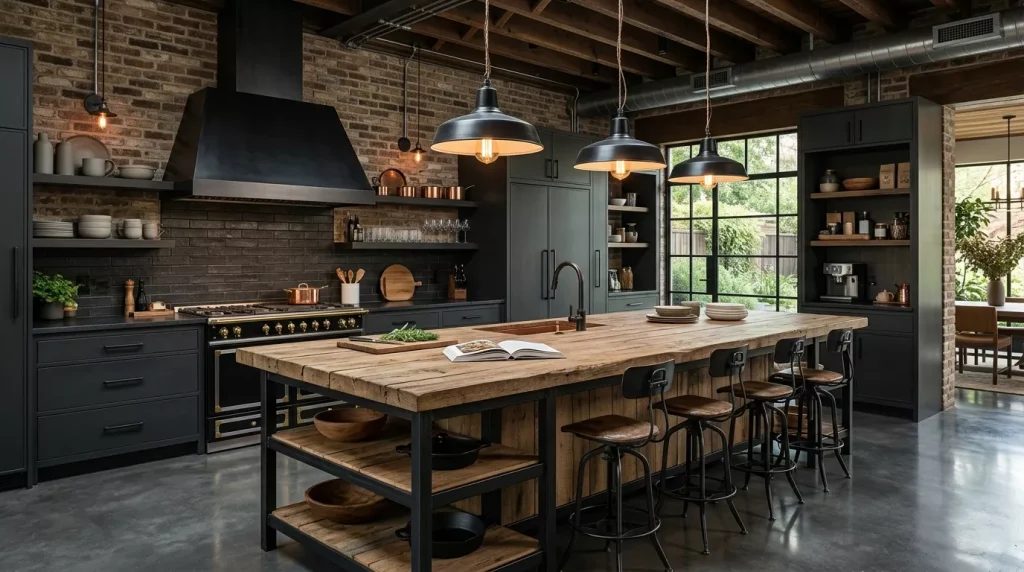
There are a hundred ways to introduce industrial style into a kitchen. Here are the approaches that deliver the most impact without requiring a full gut renovation.
1. Exposed Brick and Raw Wall Treatments
Nothing says industrial faster than a brick wall. If you’re lucky enough to have one hiding behind drywall, exposing it is worth the effort. Sealed exposed brick brings warmth, history, and texture that no wallpaper or tile can replicate.
No real brick available? Brick-effect tiles and thin brick veneers have improved dramatically and can look convincing when sealed properly. Rough plaster or a limewash finish in a dark or earthy tone also reads as industrial without the demolition project.
Keep the rest of the wall treatment simple — exposed brick works best when it’s the only loud element in the room.

2. Open Metal Shelving Instead of Upper Cabinets
This is one of the most popular industrial kitchen decor moves, and for good reason. Replacing upper cabinets with open steel or black iron pipe shelving immediately opens up the space visually and gives the room that warehouse-workshop feel.
Pair dark metal brackets with reclaimed or raw-edge timber shelves for contrast. The wood softens the metal’s hardness while keeping the overall look grounded.
Practical note: Open shelving means what’s on it is always on display, so organization matters. Keep items consistent and grouped — mismatched clutter undoes the look entirely.

3. Concrete Countertops and Surfaces
Concrete countertops are practically synonymous with industrial kitchen design. They’re raw, textural, one-of-a-kind (small variations and imperfections are part of the appeal), and incredibly durable when sealed correctly.
If poured concrete is beyond the budget, concrete-look porcelain tiles, laminate surfaces, and even certain composite materials get very close. The key is finding a surface with subtle variation — uniform, flawless finishes are the opposite of industrial.
Pair concrete with dark lower cabinets or natural wood to balance the coldness of the material.

4. Stainless Steel and Matte Black Hardware
Professional-grade stainless steel appliances are a natural fit for industrial kitchens — they carry the utilitarian, commercial-kitchen energy that defines the aesthetic. A range hood in brushed steel, a commercial-style faucet, and stainless shelving reinforces the working-kitchen feel.
Matte black hardware is equally on-brand and pairs beautifully with dark cabinetry or against raw brick. Black tap fixtures, cabinet pulls, light switch plates, and even exposed black pipe shelving brackets are small details that accumulate into a very coherent look.

Avoid polished chrome in an industrial kitchen — it’s too reflective and clean-lined to fit the raw, matte energy the style is built on.
5. Reclaimed Wood Accents
Industrial decor without warmth can feel cold and unwelcoming. Reclaimed wood is the antidote. A reclaimed timber dining table, butcher-block island top, wooden bar stools, or open wooden shelves introduce organic warmth that keeps the space from feeling like a machine room.
The more worn and characterful the wood, the better. Nail holes, grain variation, saw marks — these aren’t flaws in an industrial kitchen, they’re part of the story.

The Industrial Kitchen Color Palette
Getting the colors right is what separates a successful industrial kitchen from one that just feels dark and depressing.
| Color Role | Best Industrial Choices |
|---|---|
| Wall Color | Charcoal, warm graphite, slate grey, deep navy, off-black |
| Cabinet Color | Matte black, dark forest green, navy, raw concrete grey, deep burgundy |
| Accent/Pop | Rust orange, aged brass, warm amber, olive green |
| Neutral Balance | Warm white, raw timber, natural stone, aged brass |
| Metal Tones | Brushed steel, matte black iron, aged bronze, gunmetal |

The key principle: go dark on the statement surfaces, balance with warmth. A fully black kitchen with no wood, no warm lighting, and no textured elements will feel oppressive. Layer in natural materials and warm-toned lighting to keep it livable.
Lighting for an Industrial Kitchen
Lighting in an industrial kitchen is never an afterthought. It’s one of the most effective ways to set the mood — and one of the most affordable updates you can make.

Edison bulb pendants hanging on exposed wire or conduit are the signature industrial lighting choice. Over an island, a row of three metal-shaded pendants at slightly varying heights looks purposeful and striking.
What works well:
- Cage pendant lights in matte black or brushed steel
- Pipe-style wall sconces with Edison bulbs
- Track lighting on exposed ceiling rails
- Undercabinet LED strips in warm white (2700K) for task areas

What doesn’t: recessed pot lights as the primary source, crystal or glass chandeliers, and cold blue-white LED lighting. These belong in a different aesthetic entirely.
Bulb color temperature matters significantly here. Stick to warm white (2700K–3000K). It makes metals look richer and prevents the space from feeling like a hospital corridor.
Industrial Kitchen Decor: Furniture and Seating

Furniture in an industrial kitchen should feel purposeful, solid, and slightly over-engineered.
Island and dining seating: Metal-legged bar stools with wooden or leather seats are a staple. Look for hairpin legs, X-frame bases, or pipe-and-plank constructions. Avoid overstuffed upholstery or anything with delicate carved legs.
Kitchen island: A butcher-block top on a steel or black-painted base reads perfectly industrial. If you’re building custom, consider adding a lower shelf with metal pipe rails — functional and visually consistent.
Dining table: A reclaimed wood top with steel tube legs is the quintessential industrial dining table. Solid, heavy-looking, and built-to-last in appearance.

Shelving units: Freestanding steel shelving units (the kind you’d find in a commercial kitchen or factory) work brilliantly in an industrial kitchen and are significantly cheaper than built-in cabinetry.
Industrial vs. Modern vs. Rustic Kitchen — A Clear Comparison
These three styles often get confused or blended. Here’s how they actually differ:

| Feature | Industrial | Modern | Rustic |
|---|---|---|---|
| Primary Materials | Steel, concrete, brick, reclaimed wood | Lacquered cabinets, quartz, glass | Natural wood, stone, terracotta |
| Color Palette | Dark, moody, neutral greys | White, greige, monochrome | Earthy tones, creams, warm browns |
| Hardware | Matte black, brushed steel, iron | Brushed nickel, minimalist chrome | Antique brass, oil-rubbed bronze |
| Lighting | Cage pendants, Edison bulbs | Sleek recessed LEDs, track lighting | Lantern pendants, candle-style fixtures |
| Cabinet Style | Flat-front, dark-painted, open shelving | Handle-free, gloss or matte | Shaker-style, open display cabinets |
| Vibe | Raw, urban, utilitarian | Clean, minimal, refined | Warm, cozy, traditional |
| Best For | Lofts, urban homes, open-plan spaces | Contemporary homes, smaller kitchens | Country homes, farmhouses |
All three can overlap. Industrial-rustic and industrial-modern hybrids are both common and work well.

Step-by-Step Guide to Decorating Your Industrial Kitchen
You don’t need to rip out your entire kitchen to get the look. Follow these steps in order and you’ll make meaningful progress without blowing the budget.
Step 1: Audit what you already have Look at your existing cabinets, counters, appliances, and walls. Identify what can be painted, replaced with hardware swaps, or covered rather than ripped out.
Step 2: Commit to a base palette Choose your dominant neutral — charcoal, slate grey, dark navy, or warm black. This becomes the anchor for every decision that follows.
Step 3: Paint the cabinets (or just the lowers) Dark cabinet paint is the single highest-impact, cost-effective change you can make. Matte black or dark forest green lower cabinets transform a standard kitchen dramatically.

Step 4: Swap the hardware Replace every cabinet pull, knob, and tap with matte black or brushed steel alternatives. This is cheap, fast, and the difference is remarkable.
Step 5: Replace or add lighting Swap pendant lights for industrial-style cage or metal shaded fixtures. Change bulbs to warm Edison-style LEDs. If budget allows, add pipe-style wall sconces.
Step 6: Address the countertop if needed Concrete-look laminate or porcelain overlays can be installed over existing surfaces. A full replacement is ideal but not always necessary at this stage.
Step 7: Add open shelving to one wall Remove one section of upper cabinets if possible. Replace with black metal pipe brackets and reclaimed timber shelves. This single change opens up the space and introduces the signature industrial look.

Step 8: Layer in warmth with accessories Introduce reclaimed wood cutting boards, cast iron cookware on display, ceramic crockery in earthy tones, and a few trailing plants. These keep the industrial look from feeling cold.
Step 9: Final edit Remove anything shiny, pastel, or overly decorative. Industrial style is edited by nature — clutter kills it.
Pros and Cons of Industrial Kitchen Decor

Pros
- Highly durable materials — concrete, steel, and reclaimed wood stand up to heavy daily use
- Timeless aesthetic — industrial design doesn’t follow seasonal trends; it holds its look for years
- Unique and personal — no two industrial kitchens are identical thanks to raw materials and reclaimed elements
- Works with imperfections — aged surfaces, uneven textures, and worn materials look intentional, not shabby
- Easier to DIY — paint, hardware swaps, and open shelving are all achievable without tradespeople
- Open shelving saves money — eliminating upper cabinets actually reduces cabinetry costs
Cons

- Dark palettes can feel heavy in rooms with limited natural light
- Open shelving demands organization — messy shelves undermine the whole aesthetic
- Concrete and steel can feel cold without deliberate warming elements
- Harder to soften for families with young children — the look is sleek but not especially cozy
- Matte black hardware shows fingerprints and water spots more visibly than brushed finishes
- Not ideal for small kitchens with low ceilings — the scale of industrial elements can overwhelm
Common Mistakes to Avoid

Even enthusiastic converts to the industrial style get it wrong sometimes. These are the pitfalls that come up most often.
Going too dark without adding warmth A kitchen that’s all black and grey with no wood, no warm lighting, and no organic texture becomes a gloomy box. One part dark, one part natural material, one part warm light — that’s the balance.
Over-theming with “industrial props” Gear-shaped clock, typewriter on the shelf, factory signs on every wall — this tips from industrial style into industrial costume. Use the visual language of the aesthetic, not the literal props.
Ignoring the ceiling Industrial kitchens look best when the ceiling is treated as a design element — exposed beams, painted dark, or left as raw concrete. A plain white dropped ceiling with modern downlights undercuts everything happening below it.
Buying cheap matte black that chips Matte black hardware is only worth having if the quality is there. Cheap painted finishes chip within months. Pay for quality powder-coated or solid metal hardware.

Forgetting ventilation Industrial-style range hoods are central to the look — and they need to be functional, not just decorative. An undersized hood in a dark kitchen with heavy cooking creates a smoky, greasy environment fast.
Skipping the rug Concrete or stone-effect floors get cold underfoot. A flat-woven or natural-fiber rug in warm tones makes the kitchen dramatically more comfortable without softening the aesthetic.
Tips for a Better Industrial Kitchen

- Mix metals deliberately — using two or three metal tones (e.g., matte black plus aged brass) looks curated. Using five or six looks unplanned.
- Display your best cookware — cast iron skillets, copper pots, and stainless steel pans hanging from a ceiling-mounted rack are both functional and on-brand.
- Use plants to break the hardness — trailing pothos, a fiddle leaf fig, or bundles of eucalyptus on open shelves add organic life without disrupting the palette.
- Keep the backsplash minimal — a simple dark subway tile, a single slab of raw stone, or painted brick works far better than a mosaic or patterned tile.
- Concrete sealant is non-negotiable — unsealed concrete countertops absorb oils, acids, and stains almost immediately. Seal annually at minimum.
- Invest in one hero piece — a commercial-grade range, a statement range hood, or a custom steel-and-wood island can anchor the whole room and make everything else fall into place.
Frequently Asked Questions (FAQs)
Q1: Is industrial kitchen decor suitable for a small kitchen?
It can work, but it requires careful scaling. In a smaller kitchen, avoid going fully dark on every surface — opt for dark lower cabinets with lighter upper walls or open shelving to prevent the space from feeling enclosed. Use a single statement lighting piece rather than multiple large pendants. Wall-mounted pipe shelving, a concrete-look countertop, and matte black hardware can deliver the industrial look without overwhelming a compact space.
Q2: What countertop material works best in an industrial kitchen?
Concrete is the most authentic choice, though it demands proper sealing and regular maintenance. Honed (matte-finish) granite, dark soapstone, and raw-edge butcher block are excellent alternatives that carry similar raw, utilitarian energy. For budget-conscious renovations, concrete-effect porcelain slabs and industrial-look laminate surfaces have become genuinely convincing and are far more forgiving in day-to-day use.
Q3: How do I add warmth to an industrial kitchen without losing the aesthetic?
Natural wood is your most effective tool here. A butcher-block section of the countertop, reclaimed timber shelving, wooden bar stools, and a wooden cutting board collection on display all introduce warmth without softening the industrial character. Warm-toned lighting (2700K Edison-style bulbs) and a few earthy-toned ceramic pieces do the rest without compromising the palette.
Q4: Can I achieve an industrial kitchen look on a limited budget?
Yes — more than almost any other kitchen style. The highest-impact, lowest-cost moves are cabinet painting (matte black or dark grey paint is inexpensive), hardware replacement (a full set of matte black cabinet pulls costs very little), lighting swaps (industrial cage pendants are widely available at accessible price points), and open shelving installation using pipe brackets and timber boards. These four changes alone can dramatically shift a standard kitchen toward industrial style without touching the cabinets or countertops.
Q5: What flooring works best with industrial kitchen decor?
Polished concrete or concrete-effect porcelain tiles are the natural first choice. Dark hardwood or engineered wood in a matte finish also works well, especially for adding warmth. Herringbone-laid dark grey tiles give a more formal industrial feel, while large-format matte stone-effect porcelain reads as modern industrial. Avoid glossy tiles, light-colored grout, and anything overly decorative — the floor should feel substantial and purposeful.
Q6: Does industrial decor work with open-plan kitchen and living spaces?
Industrial style is arguably best suited to open-plan spaces, where the aesthetic can breathe and reference itself across a larger footprint. The challenge is maintaining visual consistency between zones. Use consistent metal tones, flooring, and a connected color palette across the kitchen and living area. Exposed beams or ceiling details that run through both zones tie the spaces together without needing identical furniture or identical finishes.
Q7: How do I prevent my industrial kitchen from feeling too masculine or cold?
The antidotes are warmth, texture, and a touch of organic life. Warm-toned Edison lighting, reclaimed wood surfaces, ceramic dishes in earthy tones, aged brass hardware (instead of purely matte black), linen or cotton textile accents, and plants make a significant difference. Industrial kitchens can absolutely feel inviting and warm — it comes down to balance. The structure and palette stay hard and raw; the accessories and lighting bring it back to human scale.
Conclusion: Make the Industrial Kitchen Decor Your Own
Industrial kitchen decor is one of those rare styles that rewards commitment. The more deliberately you apply it — the right materials, the right palette, the right lighting — the better it looks. It’s not forgiving of half measures, and that’s actually what makes it so compelling.
You don’t need to gut your kitchen or spend a fortune to get started. A few targeted changes — dark cabinet paint, matte black hardware, a cage pendant or two, and a section of open pipe shelving — can shift the entire personality of a space in a single weekend.
The goal isn’t to replicate a factory. It’s to build a kitchen that feels real, confident, and a little bit like it has a story. Industrial kitchen decor does exactly that — every raw edge, every exposed pipe, every worn timber shelf adds to a space that feels genuinely lived in rather than staged.
Start with one change today. Pick the hardware, pick up the matte black paint, or order the cage pendant. Small steps lead to extraordinary kitchens.