Luxury Kitchen Ideas to Transform Your Home

Luxury Kitchen Ideas to Transform Your Home

If you’ve ever walked into a kitchen and felt genuinely wowed, you already understand what luxury kitchen ideas are all about. It’s not just about expensive materials or high-end appliances. It’s about the feeling a space creates the moment you step inside. A sense of elegance, function, and personality all woven together seamlessly.
Whether you’re doing a full renovation or looking to refresh specific areas, the right luxury kitchen ideas can completely transform how you live, cook, and entertain at home. In this guide, we’ll walk you through everything — from premium finishes and smart layouts to designer lighting and practical planning tips.

What Truly Makes a Kitchen “Luxury”?
Here’s the honest truth — luxury doesn’t always mean spending a fortune. It means intentional design where every detail has purpose.
A truly luxurious kitchen typically combines:
- Premium materials — think natural stone, solid wood, and brushed metals
- Custom cabinetry — built to your exact specifications, not off-the-shelf
- Integrated smart technology — appliances and systems that work together
- Thoughtful layout — spaces designed around how you actually cook and move
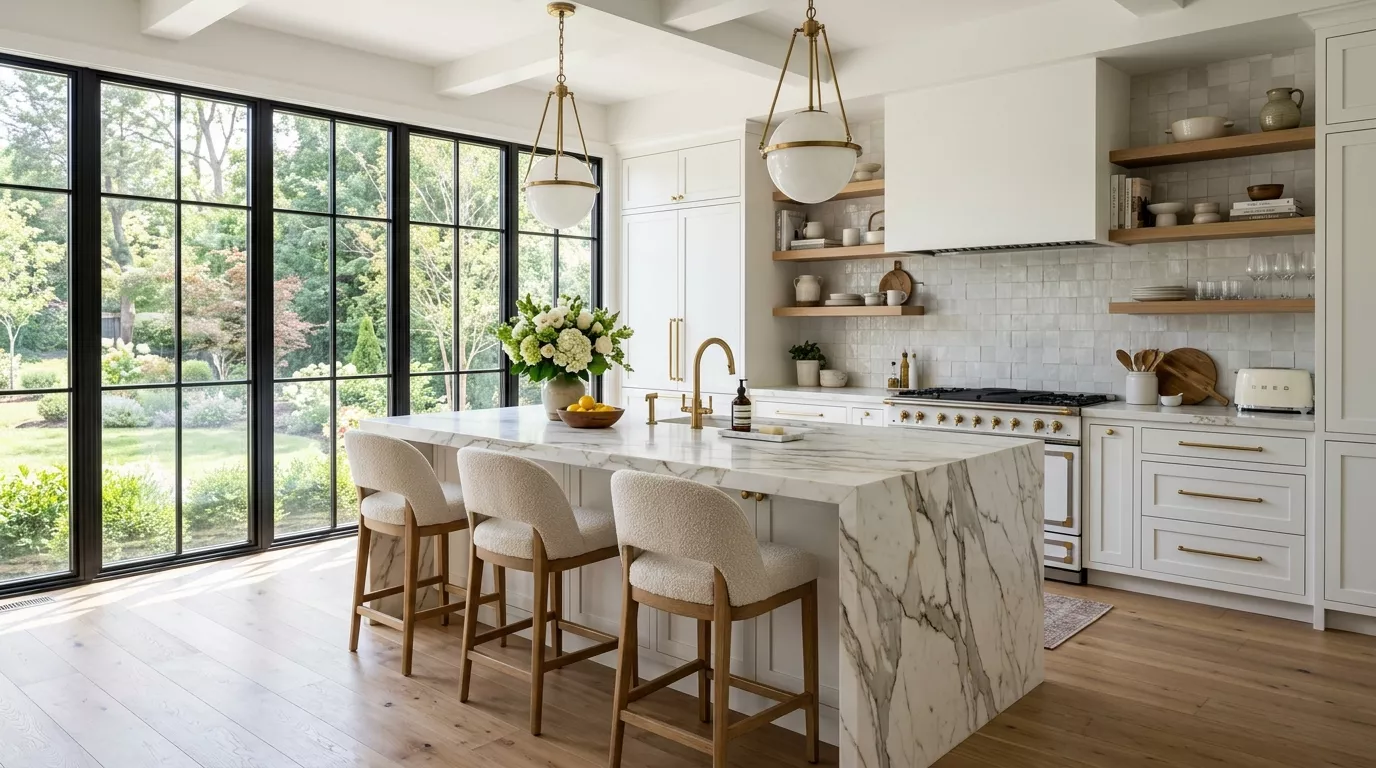
- Statement design moments — a chandelier, a waterfall island, or bold tile backsplash

The difference between a nice kitchen and a luxury kitchen often comes down to the details — the weight of a cabinet door, the way light hits a countertop, or the way storage is hidden so cleanly that the kitchen looks effortlessly minimal.
Top Luxury Kitchen Ideas
1. Custom Cabinetry and Bespoke Storage
Forget prefabricated units. In a luxury kitchen, cabinetry is almost always custom-built, and that makes a massive difference.

Custom cabinets are designed to fill every inch of your wall perfectly. No awkward gaps, no mismatched heights. You choose the wood, the finish, the hardware, and even the interior organization — pull-out spice racks, built-in wine storage, hidden charging drawers, you name it.
Popular cabinet finishes:
- Deep navy and forest green (bold, dramatic, and very popular right now)
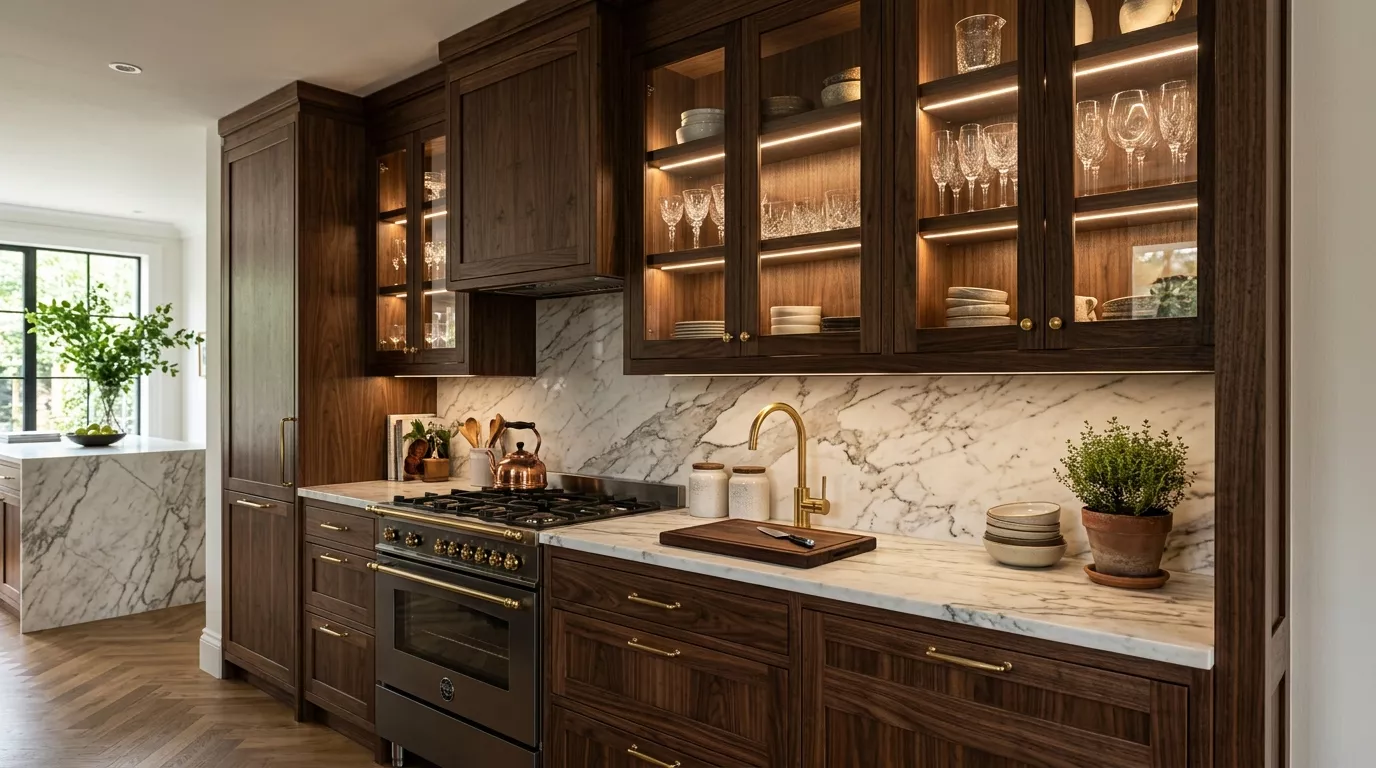
- Warm walnut and oak wood tones (natural, earthy, timeless)
- High-gloss lacquer whites and creams (sleek, contemporary)
- Two-tone combinations — upper cabinets in one shade, lowers in another
One underrated trick: add integrated LED lighting inside cabinets and underneath them. It looks incredibly polished and adds warmth at night.

2. Premium Countertop Materials That Demand Attention
The countertop is the centrepiece of any luxury kitchen. People’s eyes naturally go there first. Choose wisely and it sets the tone for everything else.
Most sought-after countertop materials:
| Material | Look | Durability | Maintenance | Cost Range |
|---|---|---|---|---|
| Calacatta Marble | Dramatic white with bold veining | Moderate | High (sealing required) | $$$$ |
| Quartzite | Natural stone, very hard | High | Low-Medium | |
| Engineered Quartz | Uniform, sleek | Very High | Very Low | |
| Granite | Unique natural patterns | High | Medium | |
| Dekton / Ultra Compact | Ultra-modern, matte finishes | Extremely High | Minimal | |
| Butcher Block (wood) | Warm, artisan feel | Medium | Medium | −$ |

If you want a true showstopper, go for a waterfall edge — where the countertop material continues vertically down the sides of the island. It’s a design statement that never fails to impress.
3. Luxury Kitchen Lighting: The Detail Most People Overlook
Lighting can make or break a kitchen design, and yet it’s the most overlooked element in most renovations. In a luxury kitchen, you need a layered lighting approach — not just one overhead fixture.
The three layers of kitchen lighting:
- Ambient lighting — general illumination; usually recessed ceiling lights or flush fixtures
- Task lighting — focused light for work surfaces; under-cabinet LED strips are the go-to
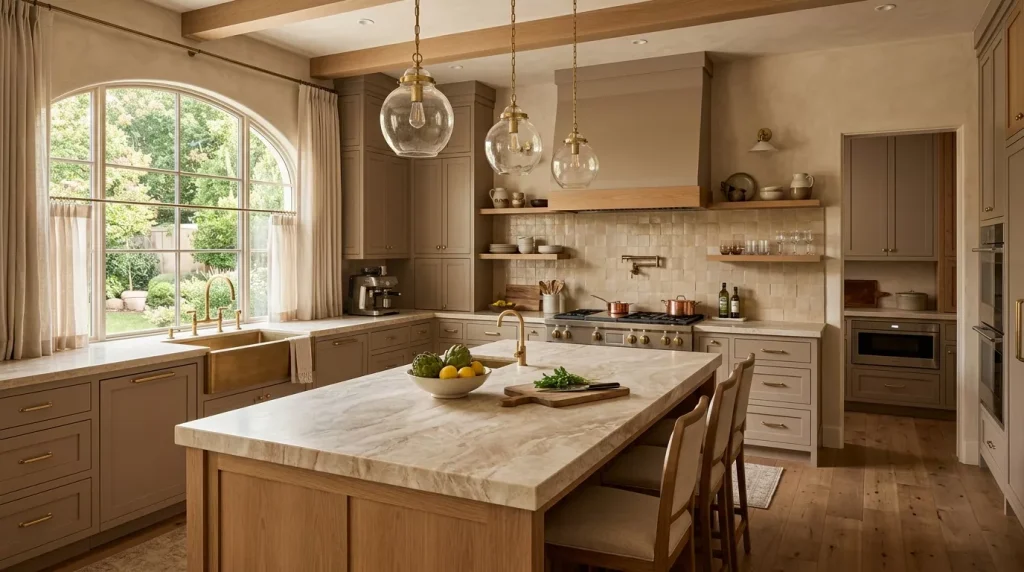
- Accent/Statement lighting — the decorative layer; pendant lights over the island, a chandelier over a dining nook, or lit shelving
In this era, oversized pendants with sculptural forms are incredibly popular over kitchen islands. Think concrete, smoked glass, brushed brass, or matte black shapes that double as artwork.
Warm white lighting (2700K–3000K) is almost always the right choice for kitchens. It flatters food, people, and materials equally.

4. Smart Kitchen Technology Worth the Investment
A luxury kitchen without smart technology feels incomplete. And we’re not just talking about a smart fridge with a screen.
Smart features worth integrating:
- Voice-controlled faucets — hands-free water control while cooking
- Induction cooktops with automated zones — detect pot size and adjust power automatically
- Under-cabinet smart speakers and screens — recipe displays, timers, and music
- Integrated refrigerator columns — built-in, panel-ready units that disappear into cabinetry
- Motorized cabinet systems — drawers and lift-up doors that open at a touch
- Smart ventilation — range hoods that auto-adjust based on cooking heat

The goal is seamless integration. Technology should enhance the kitchen without cluttering it visually.
5. Statement Islands: The Heart of the Luxury Kitchen
The kitchen island has evolved from a simple prep surface to the social, functional, and visual centrepiece of the modern luxury kitchen.
A well-designed island can include:
- A waterfall countertop on one or both sides
- Built-in seating with upholstered bar stools
- A secondary sink or prep sink
- Integrated wine fridge or beverage cooler
- Warming drawers
- Hidden electrical outlets and USB ports

Size matters — a luxury island should be at least 3–4 feet wide to allow comfortable movement on all sides. Many designers now opt for two separate islands rather than one enormous one, particularly in open-plan spaces.
Luxury Kitchen Layouts: A Quick Comparison
Choosing the right layout is foundational. Before materials, before finishes — layout determines how well your kitchen actually functions.
| Layout | Best For | Key Advantage | Limitation |
|---|---|---|---|
| L-Shape | Medium spaces, open plan | Good workflow, versatile | Limited counter space |
| U-Shape | Larger kitchens | Maximum storage & counter space | Can feel enclosed |
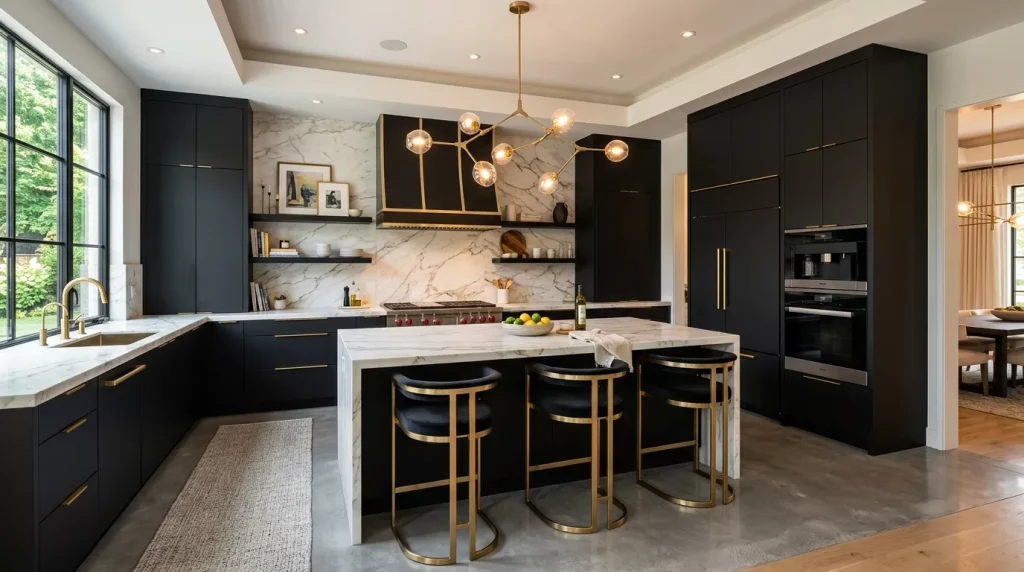
| Island Layout | Open-plan homes | Social hub, extra prep area | Needs significant space |
| Galley | Narrow or compact spaces | Efficient workflow | Not ideal for socialising |
| One-Wall | Studio or loft spaces | Space-saving | Limited storage |
For most luxury home renovations, an island-centred open-plan layout is the gold standard. It combines functionality with a social, open feel that’s perfect for entertaining.
Pros and Cons of Luxury Kitchen Renovations

Before you commit to a high-end kitchen project, it’s worth weighing the full picture.
✅ Pros
- Significant home value increase — a luxury kitchen can return 60–80% of its cost in property value
- Better daily living — quality materials and smart layouts genuinely improve your quality of life
- Durability — premium materials last decades; cheap kitchens often need replacing in 10 years
- Resale appeal — kitchens are among the top features buyers look for
- Personal satisfaction — there’s real joy in a beautifully designed kitchen you use every day

❌ Cons
- High upfront cost — full luxury kitchen renovations typically range from $50,000 to $200,000+
- Longer timelines — custom work takes time; expect 3–6 months from design to installation
- Decision fatigue — the sheer number of choices (finishes, hardware, tiles) can be overwhelming
- Maintenance requirements — some premium materials like marble require regular sealing and care
- Over-capitalising risk — in certain markets, spending too much may not be recouped at resale
Step-by-Step Guide to Planning Your Luxury Kitchen

Planning is everything. Here’s a simple framework to get it right.
Step 1: Set a realistic budget Include a 15–20% contingency buffer for unexpected costs. Custom work almost always throws up surprises.
Step 2: Define your style Browse design references and create a mood board. Identify 3–5 non-negotiable elements before meeting with a designer.
Step 3: Hire the right professionals Work with a kitchen designer (not just a contractor). A good designer will save you far more than their fee by preventing costly mistakes.
Step 4: Sort the layout before anything else The layout governs everything. Finalise your floor plan, island size, and appliance positions before selecting materials.

Step 5: Choose materials from large to small Start with the biggest visual elements — cabinetry and countertops — then work down to hardware, backsplash, and lighting.
Step 6: Integrate technology early Electrical, plumbing, and smart home wiring must be roughed in during construction. Retrofitting later is expensive.
Step 7: Review everything before sign-off Do a detailed walk-through of the 3D render (most designers offer this). Catching errors digitally is far cheaper than fixing them on-site.
Tips for a Smarter Luxury Kitchen Design
These aren’t glamorous tips — but they’re the ones that experienced designers rely on.
- Go taller with upper cabinets — extending cabinetry to the ceiling eliminates dust-collecting space and looks dramatically more luxurious
- Invest in quality hardware — handles and knobs are touched hundreds of times daily; cheap hardware feels cheap every single time
- Choose a single, cohesive metal finish — mixing too many metals (chrome, brass, black) makes a space feel chaotic
- Don’t ignore the pantry — a well-organised butler’s pantry or walk-in pantry adds both function and genuine luxury feel
- Consider acoustic panels — open kitchens can get loud; adding sound-absorbing materials in adjacent areas improves the experience
- Splurge on the sink — an oversized farmhouse or apron-front sink in fireclay or stainless is a small investment with big visual impact
- Plan outlets strategically — pop-up outlets in the island, hidden behind cabinet doors — keep bench space clean and clutter-free
Common Mistakes to Avoid in Luxury Kitchen Design
Even with the best intentions, these mistakes show up repeatedly in renovation projects.
Mistake #1: Prioritising looks over workflow A beautiful kitchen that doesn’t function well is a daily frustration. Always plan around the “kitchen triangle” — sink, stove, refrigerator — before thinking about aesthetics.
Mistake #2: Underestimating storage needs People consistently underestimate how much storage they need. More is always better. Built-in pantry systems, deep drawers, and tall cabinetry pay dividends every day.
Mistake #3: Choosing trendy over timeless Trends come and go fast. A kitchen renovated in a deeply trendy style can feel dated within five years. Lean toward timeless materials and shapes, then add trend-forward elements in easily changeable things like bar stools or décor.
Mistake #4: Skimping on ventilation A powerful, whisper-quiet range hood is non-negotiable in a high-end kitchen. Poor ventilation means cooking odours throughout the home — no amount of marble fixes that.
Mistake #5: Forgetting natural light No lighting design outperforms a well-placed window. If your renovation allows, prioritise skylights or enlarged windows. Natural light transforms a kitchen more than almost anything else.
Mistake #6: Rushing the decision-making process Luxury kitchens take time to design properly. Rushed decisions on materials or layout almost always lead to regret. Give yourself adequate time in the design phase.
Conclusion: Build a Kitchen You’ll Never Want to Leave
Great luxury kitchen ideas aren’t just about impressing guests — though they absolutely will. They’re about creating a space that works beautifully for your life every single day. A kitchen where morning coffee feels like a ritual, where hosting dinner feels effortless, and where every time you walk in, you feel genuinely at home.
The investment in a thoughtfully designed luxury kitchen pays back in ways that are hard to quantify — in comfort, in joy, and in the long-term value it adds to your home.
Ready to start your luxury kitchen journey? Begin with a clear budget, a strong mood board, and the right design professional by your side. The kitchen of your dreams is closer than you think — it just takes the right plan to get there.
Frequently Asked Questions (FAQs)
Q1: What is the average cost of a luxury kitchen renovation?
A: Costs vary widely depending on size, materials, and location. A mid-range luxury kitchen renovation typically starts around $50,000, while high-end custom projects can exceed $150,000–$200,000. Key cost drivers include custom cabinetry, stone countertops, and premium appliance packages. Always budget a 15–20% contingency on top of your quoted price.
Q2: Which countertop material is best for a luxury kitchen?
A: It depends on your lifestyle and aesthetic preferences. Calacatta marble is visually stunning but requires regular maintenance. Quartzite offers similar beauty with better durability. Engineered quartz is the most practical option — highly durable, low maintenance, and available in an enormous range of styles. For the ultimate in modernity, ultra-compact surfaces like Dekton offer exceptional heat and scratch resistance.
Q3: How do I make a small kitchen look luxurious?
A: Several strategies work well. Extend cabinetry to the full ceiling height to draw the eye upward. Use a single, cohesive colour palette to create visual continuity. Invest in quality hardware and a standout light fixture. Choose reflective surfaces — gloss cabinetry, polished stone — to bounce light and open up the space. Good lighting is perhaps the single most impactful upgrade in a compact kitchen.
Q4: Are luxury kitchen appliances worth the extra cost?
A: For frequent home cooks, absolutely. Brands like Sub-Zero, Wolf, Miele, and La Cornue offer performance, reliability, and longevity that consumer-grade appliances rarely match. They also integrate cleanly into custom cabinetry and hold their visual appeal far longer. For someone who rarely cooks, mid-range appliances in a beautifully designed space will deliver similar visual results at a lower price point.
Q5: What kitchen layout is best for entertaining?
A: An open-plan island layout is the clear winner for entertaining. It creates natural flow between the kitchen and living areas, allows hosts to cook while socialising, and provides a central gathering point. A large island with bar seating on one side is ideal — guests can sit, chat, and feel involved without getting in the way of food preparation.
Q6: How long does a luxury kitchen renovation typically take?
A: From the initial design consultation to final installation, expect 3–6 months for a full custom luxury kitchen. This includes the design phase (4–8 weeks), ordering and fabrication of custom elements (8–12 weeks), and the actual construction and installation (4–8 weeks). Delays in material delivery — particularly imported stone or custom appliances — are common, so build flexibility into your timeline.
Q7: What are the best colour schemes for a luxury kitchen?
A: Timeless combinations that consistently look high-end include: warm whites with natural wood accents, deep navy or forest green cabinetry with brass hardware, all-white with dramatic veined marble, and soft grey tones with matte black fixtures. Today, warm earth tones — terracotta, warm taupe, and greige — are gaining popularity as people move away from the cold grey aesthetic of the 2010s.