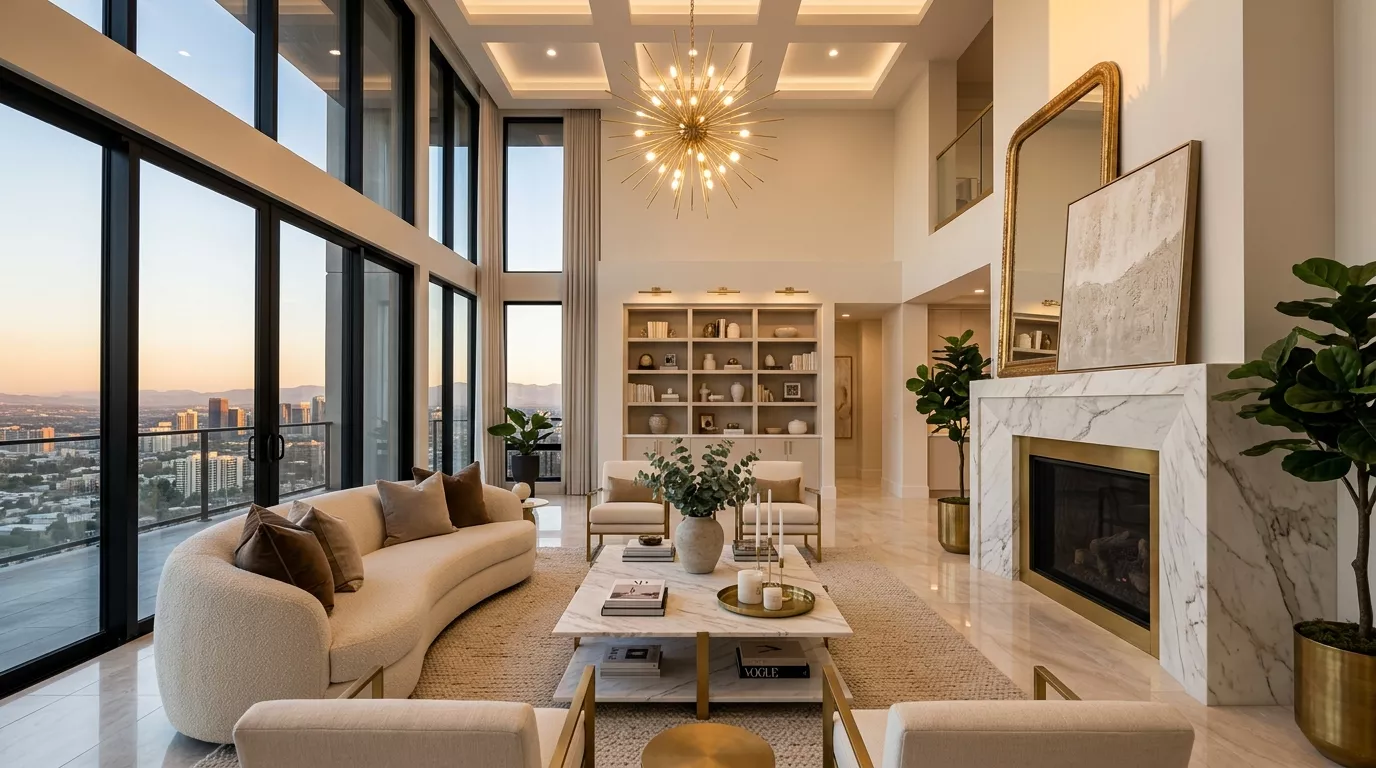
Mid-Century Modern Design: A Complete Home Guide

Mid-Century Modern Design: A Complete Home Guide

There’s a reason mid-century modern never really goes out of style. It peaked in the 1950s and ’60s, and yet walk into any design-forward home today and you’ll almost certainly find at least a trace of it — a walnut credenza, a tulip table, a low-slung sofa with tapered legs. The aesthetic has outlasted every trend that’s come and gone around it.
Mid-century modern is more than just a look. It was a design philosophy built on the idea that beautiful things should also be functional, that organic shapes and natural materials could coexist with bold geometry, and that a well-designed home was one that worked as well as it looked. That philosophy still resonates deeply — which is exactly why it’s as relevant today as it was seventy years ago.
If you’re thinking about bringing mid-century modern into your home, or you’re already halfway there and trying to figure out what’s missing, this guide covers everything from foundational principles to practical room-by-room advice.
What Is Mid-Century Modern Design?
Mid-century modern — often shortened to MCM — refers to a design movement that emerged in the United States and Scandinavia roughly between 1945 and 1969. It grew out of a post-war optimism, a surge of new materials and manufacturing techniques, and a generation of architects and designers who wanted to rethink how everyday people lived.
Names like Charles and Ray Eames, Florence Knoll, Eero Saarinen, Hans Wegner, and Arne Jacobsen defined the era. Their work set the visual and philosophical blueprint for everything that followed: clean lines, honest materials, organic forms, and a deep belief that design was most powerful when it served real life.
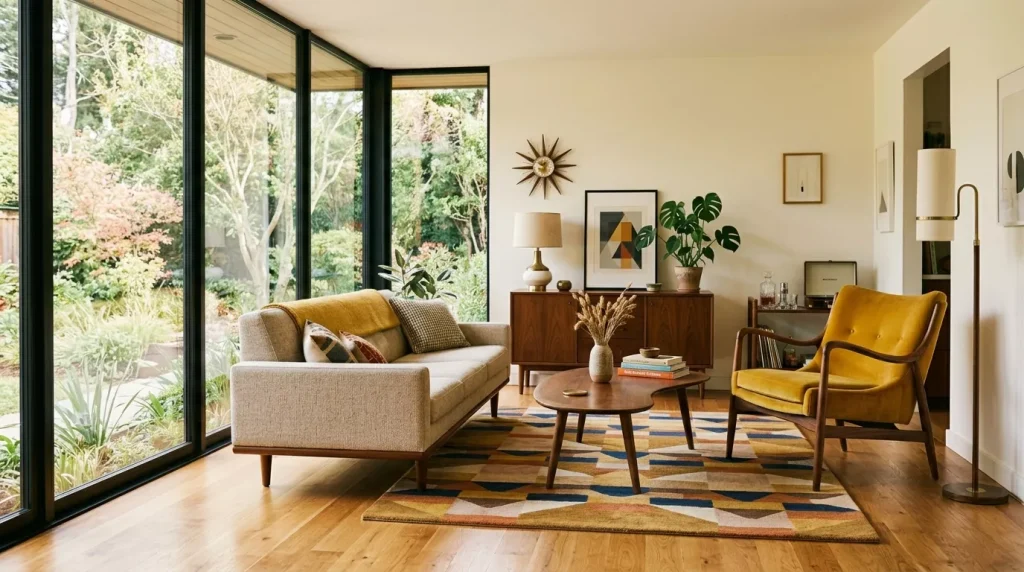
Core characteristics of mid-century modern design:

- Clean, uncluttered lines with minimal ornamentation
- Organic and geometric shapes used together
- Warm natural materials — teak, walnut, rosewood, leather, wool
- Tapered or hairpin legs on furniture (keeping things visually light)
- Bold, earthy accent colors against neutral backgrounds
- Large windows and a strong connection between indoor and outdoor space
- Form following function — every design choice has a purpose
- Integration of art and industrial craft
What makes MCM so enduring is that these principles are genuinely good design. They weren’t just fashionable. They solved problems — making spaces feel larger, lighter, and more livable.

Why Mid-Century Modern Still Works Today
You could argue that MCM is the most reliably “safe” design choice available — except that feels like an insult to something so carefully considered. It isn’t safe. It’s just timelessly calibrated.
Here’s what keeps it relevant:
It photographs exceptionally well. The clean lines, warm woods, and bold accent colors create strong visual contrast that works beautifully in natural light. For anyone thinking about aesthetics in a social-media-conscious world, MCM rooms are consistently the ones you stop scrolling for.
It works with both old and new. Mid-century modern pieces blend with contemporary furniture more naturally than almost any other period style. A genuine 1960s Eames lounge chair looks perfectly at home beside a modern sofa. Very few styles offer that kind of flexibility.

It suits most architectural contexts. Whether you live in a period terrace, a 1970s bungalow, a new-build apartment, or an actual mid-century ranch house, the aesthetic translates without feeling forced.
Quality pieces last for decades. The furniture produced in the MCM era was built to standards that most modern manufacturing doesn’t reach. And the design principles behind it mean that a well-made MCM-inspired piece doesn’t date itself the way trend-led furniture does.
Pros and Cons of Mid-Century Modern Design
A balanced view before you commit to the style:

| Pros | Cons |
|---|---|
| Timeless — genuinely doesn’t date | Authentic vintage pieces can be expensive |
| Highly versatile — works with other styles | Not ideal for maximalist or heavily layered spaces |
| Emphasis on quality materials and construction | Tapered-leg furniture can be fragile with heavy use |
| Clean, uncluttered aesthetic is calming | Can feel cold without warm textures to balance it |
| Strong resale value on authentic pieces | Bold accent colors require confident choices |
| Suits modern homes and period properties alike | Easy to over-modernize and lose the MCM warmth |
| Wide range of reproduction pieces available | Quality reproductions still cost more than fast furniture |
The style rewards investment — in pieces, in decisions, and in understanding the philosophy behind the look. Approached thoughtfully, the pros far outweigh the cons.
The Mid-Century Modern Color Palette
Color in MCM design operates on a simple and effective principle: neutral base, bold accents.

The background of a mid-century modern room is typically restrained — warm whites, soft creams, light grays, greige, and natural wood tones. Against this calm backdrop, deliberately chosen accent colors do the heavy lifting.
Classic MCM accent colors:
- Mustard yellow — possibly the single most recognizable MCM shade
- Burnt orange and terracotta — warm, earthy, autumnal
- Avocado and olive green — rich, organic, and very era-authentic
- Teal and turquoise — cool counterpoints to warm wood tones
- Rust and warm brick red — grounding, strong, and timeless
- Warm charcoal and near-black — used in accents, frames, and metalwork
The key is restraint. You don’t use all of these at once. One or two accent colors, properly balanced against the neutral base and the warm tones of wood, is the MCM formula. More than that, and the room starts to feel chaotic rather than curated.
What to avoid: Cool, blue-toned grays that push into the contemporary minimalist direction. They work against the warmth that mid-century modern depends on. Keep the undertones warm throughout.

Mid-Century Modern Furniture: The Essentials
If there’s one area where MCM design is unmistakable, it’s furniture. The silhouettes from this era are so distinctive that even non-design people recognize them instantly.
Signature Furniture Characteristics
- Tapered legs — angular, splayed, or straight-tapered, always raising the furniture visually off the floor
- Low profile — sofas, beds, and sideboards sit closer to the ground than contemporary equivalents
- Organic curves — rounded backs, curved shells, flowing arm shapes
- Warm hardwoods — teak, walnut, and rosewood dominate, with visible grain as a feature
- Mixed materials — wood paired with leather, metal with upholstered fabric, plastic shells with wood bases
- Clean backs — furniture was designed to look good from every angle, not just the front
Iconic MCM Furniture Pieces Worth Knowing

| Piece | Designer | Why It Matters |
|---|---|---|
| Eames Lounge Chair & Ottoman | Charles & Ray Eames | The definitive MCM luxury chair — still in production |
| Tulip Chair & Table | Eero Saarinen | Eliminated the “ugly clutter” of chair legs |
| Egg Chair | Arne Jacobsen | Defined organic sculptural seating |
| Wishbone Chair | Hans Wegner | Danish craftsmanship at its most refined |
| Barcelona Chair | Mies van der Rohe | Architectural furniture at its purest |
| Nelson Platform Bench | George Nelson | Functional simplicity as statement piece |
| Noguchi Coffee Table | Isamu Noguchi | Sculptural glass and wood in perfect balance |
You don’t need originals. There are excellent reproductions of every piece above. But understanding what these pieces represent helps you make better choices even when you’re buying something new.

How to Design a Mid-Century Modern Home: Step-by-Step Guide
Step 1: Establish the Foundation with Flooring
MCM design thrives on warm, natural flooring. Hardwood floors — particularly in walnut, oak, or teak tones — are ideal. If you have existing wooden floors, stripping them back and finishing with a warm-toned oil or stain is a highly effective first move.
If you can’t change the flooring, a large area rug in a geometric print or solid warm tone can visually anchor the room and shift the color temperature. Wool rugs in mustard, rust, or soft orange are particularly authentic.
Step 2: Choose Your Wall Color
Mid-century modern walls are typically calm and relatively neutral — they’re the backdrop, not the feature.
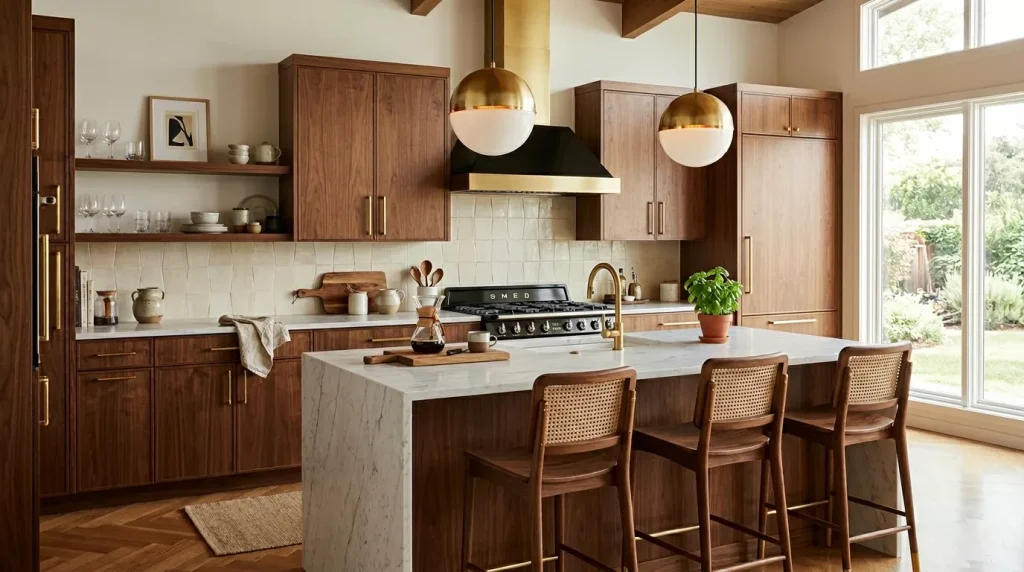
Warm white and off-white are the most common MCM wall colors. They bounce light, highlight the warmth of natural wood, and give bold accent pieces space to breathe.
Warm greige works beautifully in rooms with less natural light.
A single feature wall in a rich accent color — deep mustard, olive green, or warm terracotta — is a very MCM approach to adding color without overwhelming a space. Keep the remaining three walls neutral if you go this route.
Avoid overly cool whites, stark blues, or anything with a gray-green undertone — they fight against the warmth the style depends on.
Step 3: Select Your Key Furniture Pieces
This is where most of the budget should go. In a mid-century modern room, the furniture is the design. You don’t need many pieces — you need the right pieces.

Living room priorities:
- A low-profile sofa in a solid warm-toned fabric (burnt orange velvet, mustard wool, warm oatmeal linen)
- A sculptural coffee table — Noguchi-inspired glass and wood, or solid walnut
- At least one iconic chair silhouette — shell chair, lounge chair, or a Wegner-inspired design
- A credenza or sideboard in teak or walnut with tapered legs
The rule: Every piece of furniture should have visible legs. Furniture that sits directly on the floor — no visible legs, no raised profile — breaks the visual lightness that MCM requires. When in doubt, pick the piece with more leg.
Step 4: Layer in Textiles
MCM isn’t a cold or austere aesthetic, despite its clean lines. The warmth comes heavily from textiles — and choosing them well makes an enormous difference.
Best fabrics for MCM spaces:
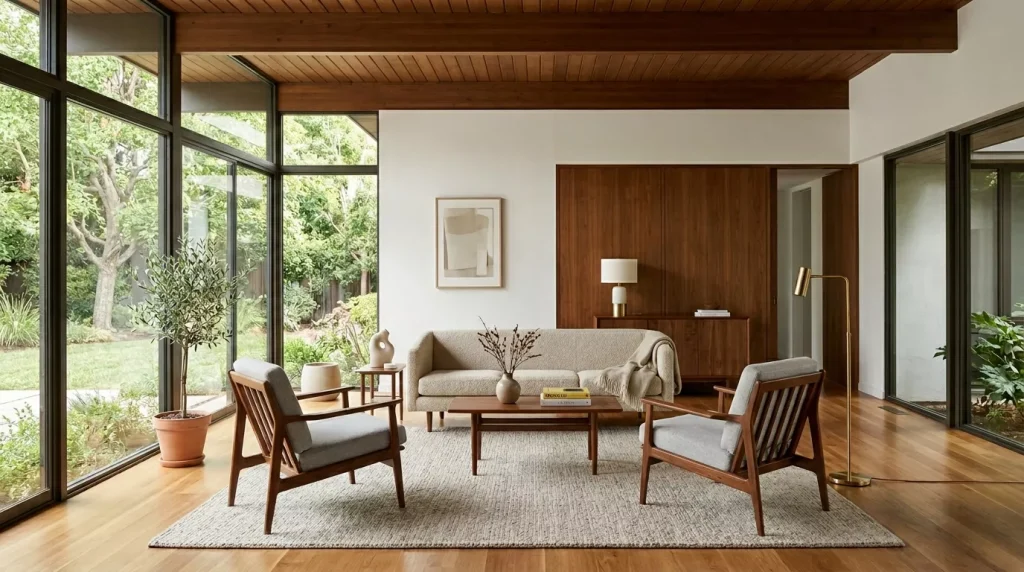
- Boucle and bouclé-adjacent weaves for sofas and chairs
- Tweed and wool blends in warm earth tones
- Leather — especially in warm brown, cognac, or black — for accent chairs
- Wool flat-weave or geometric-print rugs
- Linen in warm neutrals for curtains (always floor-length, never fussy)
Keep patterns simple. Geometric prints, abstract motifs, and simple stripes all fit the era. Avoid anything overly ornate, heavily floral, or that reads as traditional or country.
Step 5: Add Signature MCM Lighting
Lighting is often where mid-century modern interiors either come together or fall apart.
What to look for:

- Sputnik chandeliers — the starburst multi-arm pendant that defines MCM ceiling lighting
- Arc floor lamps — a long arched stem with a dome shade, usually in brushed brass or black
- Cone pendant lights — simple, clean, and endlessly versatile
- Mushroom table lamps — rounded shade, clean base, warm glow
- Globe pendant lights — simple spherical pendants in frosted glass or metal
Metal finishes: Brushed brass, warm gold, and matte black are the most MCM-authentic options. Avoid cold chrome, nickel, or contemporary silver finishes — they fight the warmth of the style.
All lighting should produce a warm-toned glow (2700K–3000K bulbs). Nothing kills MCM atmosphere faster than cool-blue overhead lighting.
Step 6: Hang Art and Accessorize

In a mid-century modern room, accessories should be deliberate, relatively spare, and genuinely interesting.
Art choices:
- Abstract expressionist prints (think Kandinsky, Rothko, Miro influence)
- Geometric graphic prints in MCM accent colors
- Vintage-style botanical or travel poster prints
- Simple architectural photography in warm frames
Accessory objects:
- Ceramic vessels in organic shapes
- Sunburst or starburst wall clocks (an iconic MCM detail)
- Wooden bowls and sculptural objects in walnut or teak
- A globe — genuinely authentic to the era
- Stacked books on a credenza or low shelf
- A single dramatic plant (rubber tree, fiddle-leaf fig, bird of paradise)

The MCM rule for accessories: curate, don’t collect. A small number of well-chosen objects is always more effective than a shelf crowded with things. Each piece should have some visual weight — a strong shape, an interesting material, a relationship to the color palette.
Mid-Century Modern Room by Room
Living Room
This is where MCM has the most impact. A low sofa in a warm-toned fabric, a walnut or teak credenza along one wall, a sculptural coffee table, and a Sputnik pendant overhead. Add a large geometric rug, a single accent chair, a starburst clock, and you have a genuinely complete MCM living room. Keep the surfaces relatively clear.
Bedroom
MCM bedrooms are calm and unfussy. A low-profile bed frame in walnut with simple, clean lines is the anchor. Matching or closely complementary nightstands with tapered legs flank it. Warm white walls, warm-toned linen bedding, a single pendant on each side instead of table lamps, and a cone or arc floor lamp in one corner. A teak or walnut dresser with minimal hardware. Nothing excessive.
Kitchen and Dining Room
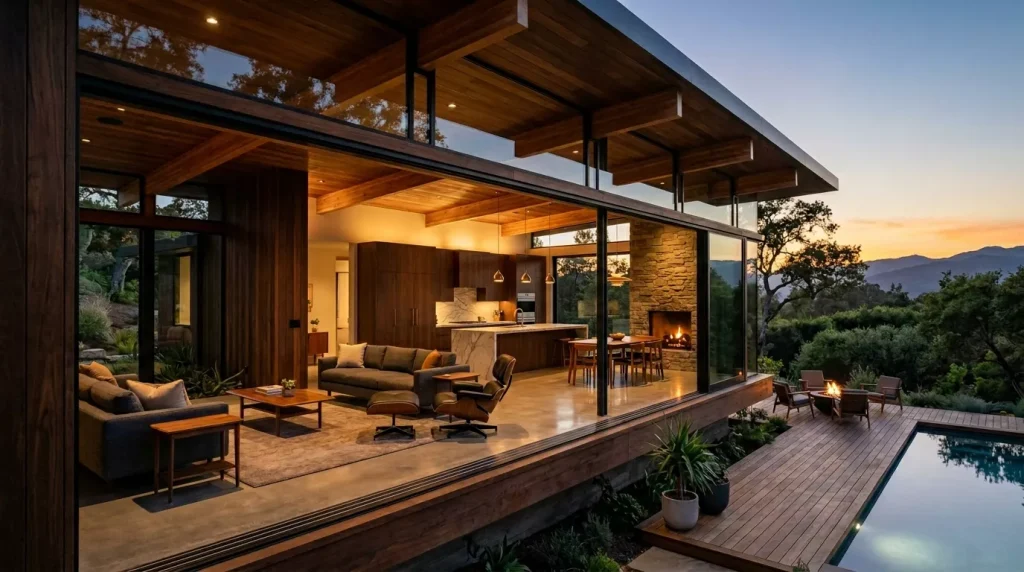
In kitchens, MCM comes through in the material choices: warm wood cabinet fronts (or shaker-style doors refinished in warm tones), brass hardware, terrazzo or stone countertops, and open shelving with curated ceramics. For dining, a round or oval table — Saarinen’s Tulip table is the reference point — with organic-shaped chairs delivers the aesthetic immediately.
Home Office
MCM home offices are among the most satisfying to design. A solid walnut desk with tapered legs. A vintage-style swivel chair in leather. Open walnut shelving for books. A cone desk lamp in brass. Clean, purposeful, and visually excellent.
Mid-Century Modern vs. Related Styles

| Style | Key Vibe | How It Differs from MCM |
|---|---|---|
| Mid-Century Modern | Warm, organic, functional, post-war optimism | Clean lines, warm wood, bold earthy accents |
| Scandinavian / Hygge | Minimalist, pale, cozy, serene | Cooler palette, less bold color, more softness |
| Industrial | Raw, urban, masculine, unfinished | Exposed materials, darker tones, less organic warmth |
| Art Deco | Glamorous, geometric, luxurious | Highly decorative, more ornate, less functional focus |
| Bauhaus | Highly functional, geometric, minimal | Less warm, more austere, academic and structural |
| Retro / 70s | Earthy, plush, maximalist | More pattern-heavy, shag textures, less structural clarity |
| Contemporary Modern | Sleek, neutral, streamlined | Cooler tones, more white space, fewer warm wood tones |
MCM sits in a sweet spot. It’s warmer than Scandinavian, more livable than Bauhaus, more restrained than retro, and more characterful than most contemporary modern. That positioning is a large part of why it continues to dominate design conversation decades later.
Common Mistakes to Avoid in Mid-Century Modern Design
1. Going too dark with wood. Teak and walnut are the authentic MCM woods — medium to warm-dark tones with visible grain. Very dark stained or ebonized wood tips into a more contemporary or industrial direction and loses the characteristic warmth of the style.

2. Choosing furniture without legs. Leg-free, floor-hugging furniture breaks the visual lightness that defines MCM interiors. Even a bed frame should have some visible leg profile. If a piece of furniture looks like it’s glued to the floor, reconsider it.
3. Mixing too many accent colors at once. MCM uses bold colors sparingly and deliberately. One or two accent colors against a warm neutral base is the formula. Using mustard, burnt orange, avocado green, and teal all in the same room is too much — you’ll lose the calm sophistication the style is built on.
4. Using overly ornate or fussy accessories. Decorative objects in MCM rooms are clean, sculptural, and spare. Heavy Victorian-style ornaments, busy floral arrangements, and excessive decorative objects clash with the philosophy of purposeful simplicity.
5. Ignoring scale. Low-profile furniture in a high-ceilinged room needs large-scale art and tall plants to prevent the room from looking oddly proportioned. Scale relationships matter enormously in MCM spaces.
6. Over-modernizing. There’s a version of “MCM-inspired” that strips out all the warmth — cool whites, minimal wood, no texture — and leaves something that reads as contemporary minimalism. That’s not mid-century modern. Keep the warm wood, the bold accents, and the organic shapes. Those elements are non-negotiable.

Tips for Getting Mid-Century Modern Right
- Start with one genuine quality piece — a real Eames reproduction or a solid walnut credenza. Build everything else around it. One excellent piece elevates the whole room.
- Shop vintage and auction houses — original MCM pieces are still findable at reasonable prices if you’re patient. Teak furniture from the 1960s in particular is often very affordable.
- Mix periods deliberately — a genuine 1960s piece beside a new sofa and a contemporary rug is more interesting than a room where everything is the same era.
- Let the wood be the pattern — in rooms where the woodgrain is beautiful and prominent, you don’t need much additional pattern. Let the material do the work.
- Use plants strategically — a large, sculptural houseplant (rubber tree, fiddle-leaf, bird of paradise) in a corner adds organic life and scale without disrupting the aesthetic.
- Invest in lighting before accessories — the right pendant or arc lamp transforms the atmosphere of a room faster than any accessory change. It’s often undervalued in the budget.
- Be patient with the sourcing — MCM rooms built quickly tend to look forced. The best versions of this style develop over time, with pieces chosen carefully and added gradually.

Conclusion: Why Mid-Century Modern Deserves a Place in Your Home
Mid-century modern design has survived every passing trend for seven decades, and it isn’t done yet. The reason is simple: it was built on principles that are genuinely, durably good — respect for natural materials, a commitment to function, and a belief that beautiful design should serve real human lives.
Whether you’re starting from scratch or layering MCM pieces into an existing home, the approach is the same. Choose quality over quantity. Let warm wood tones do the heavy lifting. Pick one or two bold accent colors and commit to them. Keep surfaces clear and objects purposeful. Let every piece earn its place.
Mid-century modern isn’t a style you apply to a room like a filter. It’s a way of thinking about space, material, and function. When you get that right, the look follows naturally — and it stays that way for years.
Ready to bring mid-century modern into your home? Start with one signature piece — a walnut credenza, a statement chair, a Sputnik pendant light — and build your vision from there. The style will reward every thoughtful decision you make.
FAQs About Mid-Century Modern Design
Q1: What exactly is mid-century modern design?
Mid-century modern is a design movement that emerged primarily between 1945 and 1969, characterized by clean lines, organic and geometric shapes, warm natural materials like walnut and teak, tapered furniture legs, and a fundamental philosophy of form following function. It was pioneered by designers like Charles and Ray Eames, Eero Saarinen, and Hans Wegner, and it drew from both American post-war optimism and Scandinavian craftsmanship traditions. Today it refers both to authentic vintage pieces from that era and to contemporary furniture and decor inspired by those same principles.
Q2: How is mid-century modern different from just “modern” design?
Contemporary or modern design tends toward cool neutrals, sleek surfaces, minimal ornamentation, and a cooler, more restrained palette. Mid-century modern is distinctly warmer — in its wood tones, its accent colors, its organic shapes, and its overall atmosphere. MCM has personality in a way that pure contemporary minimalism often doesn’t. It also has a much stronger connection to natural materials. Where modern design can feel clinical, MCM typically feels inviting.
Q3: Do I need to buy original vintage pieces to achieve mid-century modern style?
Not at all. While original pieces from the era have significant value — both aesthetic and financial — there are excellent reproductions of virtually every iconic MCM design available today. What matters more than authenticity is quality. A well-made reproduction in genuine walnut will serve the aesthetic far better than a poorly made “vintage” piece in cheap materials. Focus on solid wood construction, quality upholstery, and pieces that genuinely reflect MCM proportions and silhouettes.
Q4: What colors work best in a mid-century modern home?
The MCM color formula is a warm neutral base — warm white, cream, soft greige — with one or two bold accent colors. The most authentic accent shades are mustard yellow, burnt orange, terracotta, olive and avocado green, warm teal, and rust. These colors appear in upholstery, rugs, accent pillows, and occasional painted surfaces. The key is to use them sparingly and confidently — one or two strong accent colors in an otherwise calm room is far more effective than scattering many colors throughout.
Q5: Can mid-century modern work in a small home or apartment?
Mid-century modern is actually particularly well-suited to smaller spaces. The low-profile furniture keeps rooms feeling open and airy. The emphasis on clean lines means there’s no visual clutter from ornate detailing. The warm wood tones add warmth without weight. And the MCM principle of purposeful, well-chosen pieces over accumulation of objects is exactly the right approach for compact living. A small apartment with a walnut credenza, a low sofa, good lighting, and a few carefully chosen accessories can feel more complete than a larger space filled with the wrong things.
Q6: What’s the difference between mid-century modern and Scandinavian design?
They share common roots — both value clean lines, natural materials, and functional design, and Scandinavian designers like Hans Wegner and Arne Jacobsen were central to the MCM movement. The key differences are in palette and warmth. Scandinavian design (and its modern expression, hygge) tends toward cooler, paler colors — lots of white, soft gray, and light wood tones. MCM leans warmer — darker walnut and teak, bolder earthy accent colors, and a slightly more dramatic visual presence. They layer together beautifully, but they have a distinct difference in temperature and mood.
Q7: How do I start incorporating mid-century modern style without a full redesign?
Start with the piece that will have the most immediate visual impact in the room you use most. In a living room, that’s usually the sofa or a statement armchair. In a bedroom, the bed frame or a walnut dresser. Once you have one anchor piece, everything else follows more naturally. Change your lighting next — a Sputnik pendant or arc floor lamp is a very fast and effective atmosphere shift. Then add a geometric rug, swap in some warm-toned throw pillows, and place a sculptural plant in a corner. You’ll be surprised how much MCM character can be introduced without starting from scratch.