Eclectic Bedroom Decor Ideas That Actually Work

Eclectic Bedroom Decor Ideas That Actually Work

There’s something deeply personal about an eclectic bedroom. Unlike styles that follow a strict rulebook, eclectic bedroom decor gives you permission to be completely yourself — to mix a vintage dresser with a modern pendant light, layer a Moroccan rug over hardwood floors, and hang a gallery wall that tells your actual story. It’s one of the most liberating approaches to interior design, and when it’s done well, it looks absolutely stunning.
But “eclectic” doesn’t mean random. That’s the part most people miss.

Done wrong, it just looks like a cluttered storage space that can’t make up its mind. Done right, an eclectic bedroom feels curated, layered, and intentionally personal — like a room that grew organically rather than being ordered from a single catalog page.
This guide covers everything you need to know to get it right: the ideas, the rules worth keeping, the mistakes to skip, and a step-by-step approach to building a space you’ll genuinely love waking up in.
What Exactly Is Eclectic Bedroom Decor?
Before we get into ideas, it helps to understand what eclectic actually means in a design context. The word comes from the Greek “eklektikos,” meaning “to select.” In interior design, eclectic style means intentionally selecting elements from different design movements, time periods, and cultural aesthetics and blending them into a single cohesive space.

Think: a carved wooden headboard from a flea market, crisp white linen bedding, a 1960s arc floor lamp, and a collection of framed vintage travel posters. Each piece comes from somewhere different. Together, they create something that feels entirely unique.
The key word is cohesive. Every successful eclectic room has an underlying thread — a repeated color, a consistent mood, or a dominant texture — that ties all the mixed elements together. Without that thread, it’s just clutter.
Eclectic Bedroom Decor Ideas to Inspire Your Next Redesign
Now for the fun part. Let’s look at actual eclectic bedroom decor approaches that work across different tastes, budgets, and room sizes.

Mix Eras and Furniture Styles — Intentionally
One of the defining moves in eclectic design is deliberately pairing furniture from different periods. A mid-century modern nightstand next to a baroque-style vanity chair. An industrial metal bed frame paired with an ornate antique mirror above it.
The trick is to ensure the pieces share at least one common trait — scale, color, material, or finish. Two very different pieces in similar wood tones will always feel more connected than two clashing finishes.
Great era combinations to try:
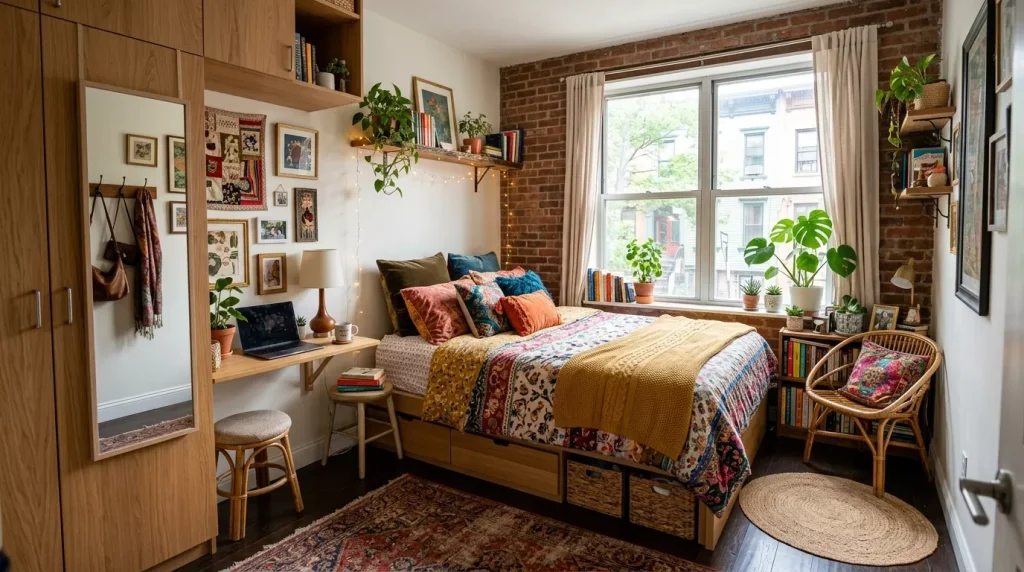
- Mid-century modern + Bohemian (the most popular eclectic pairing right now)
- Art Deco + Contemporary minimalist
- Rustic farmhouse + Industrial
- Victorian + Modern Scandinavian
Don’t feel like you need to match an entire room to one era. Even two well-chosen pieces from different design movements can shift the energy of a space dramatically.
Layer Textures and Patterns Like a Pro
Texture is the heart of eclectic bedroom design. Where other styles stay restrained — a single material, a flat palette — eclectic rooms embrace layering.

Think about combining:
- Velvet cushions on a linen duvet
- A chunky knit throw over a sleek leather bench
- Rattan and raw wood alongside polished brass accents
- A shaggy rug placed over flat-weave kilim panels
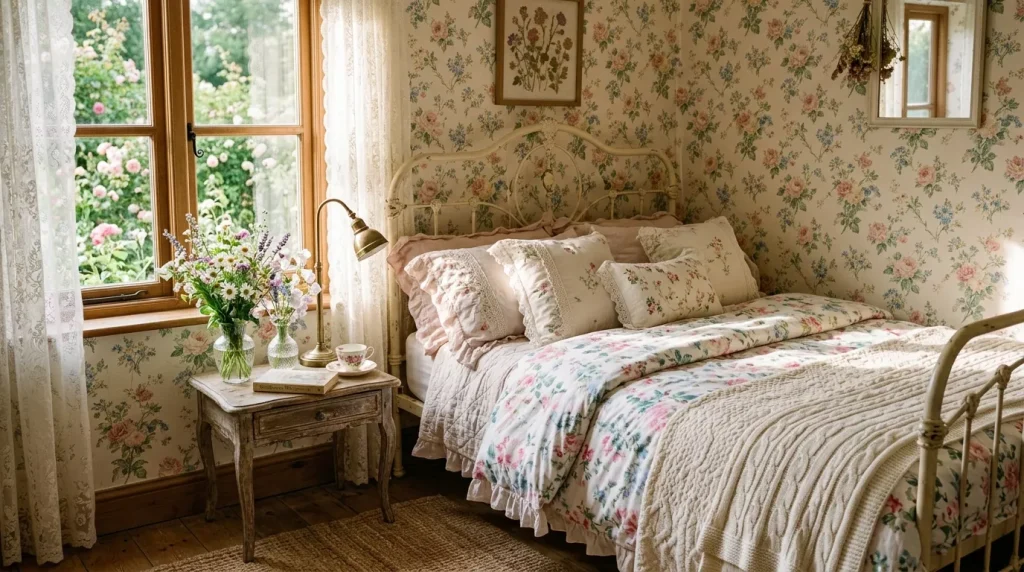
Patterns, too, can be mixed — but they need to share a tonal relationship. A floral pillowcase, a geometric duvet cover, and a striped rug can absolutely coexist if they’re all in the same warm palette of mustard, rust, and cream.

The volume rule: if you’re mixing three or more patterns, vary the scale. Use one large-scale pattern, one medium, and one small. That contrast in scale is what keeps the room looking curated rather than chaotic.
Color Palettes That Work for Eclectic Bedrooms
Color is where eclectic rooms sometimes falter. Without a clear palette, a room with mixed styles can tip from “collected and layered” into “visually exhausting.”
Here are the most successful color approaches for an eclectic bedroom:
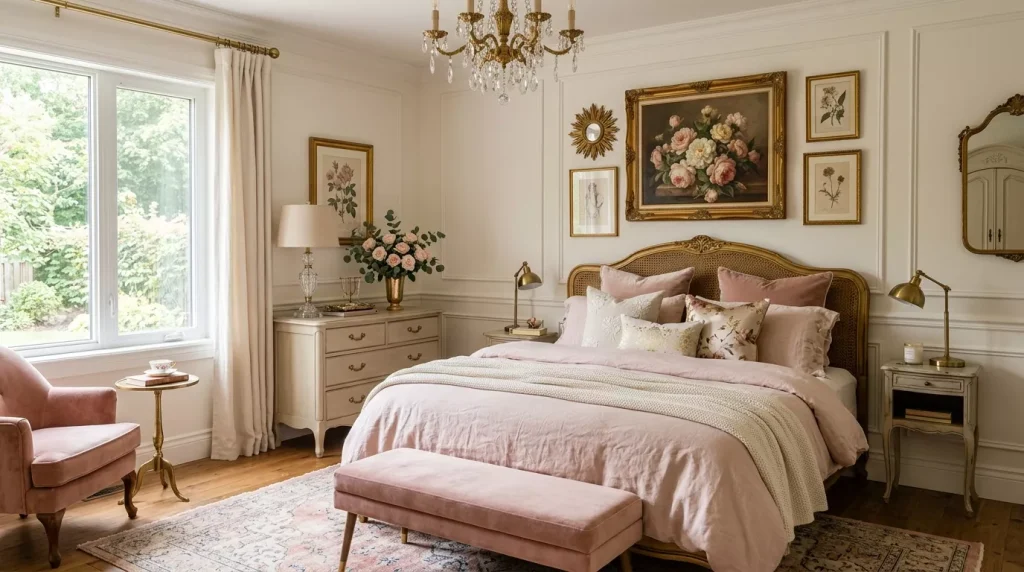
Warm and earthy: Terracotta, rust, mustard, ivory, and warm olive. These tones tie together pieces from wildly different eras because they all feel like they belong to the same natural world.
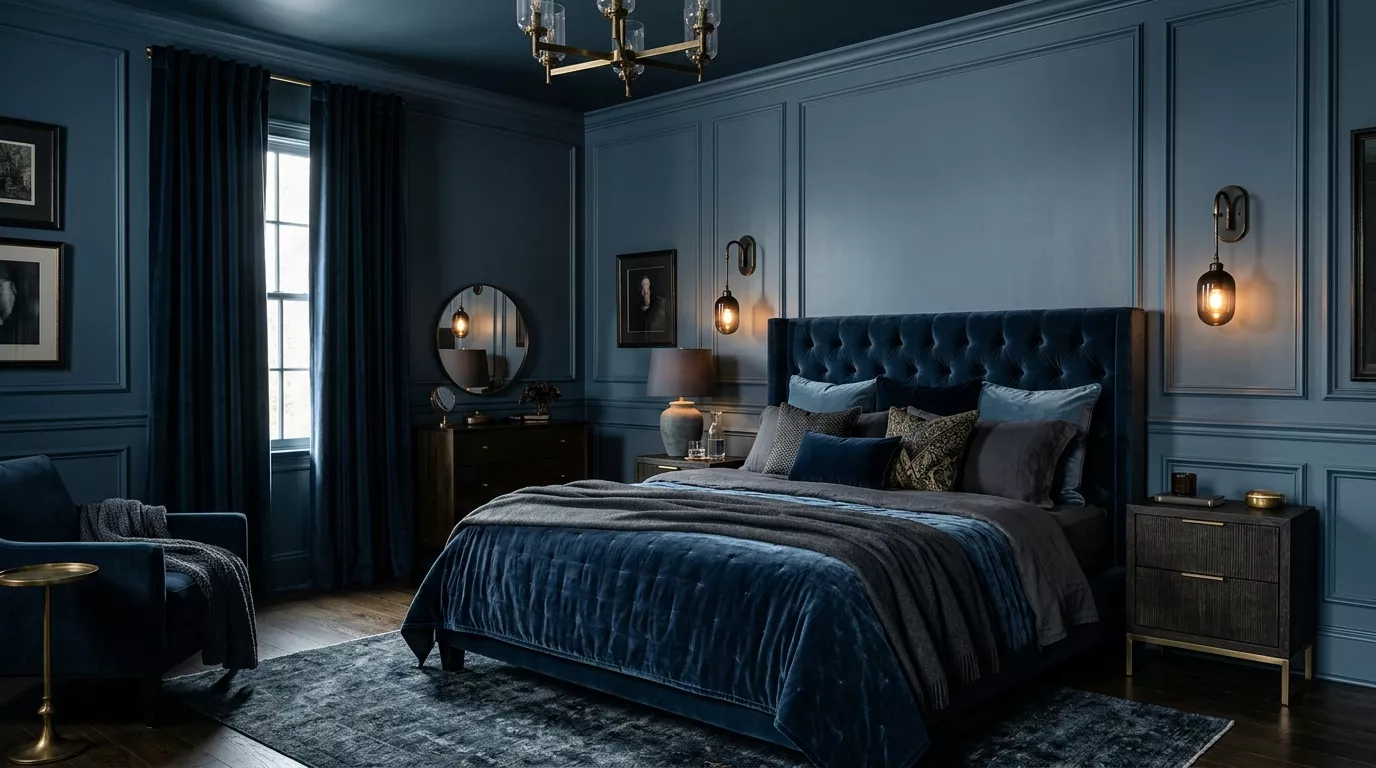
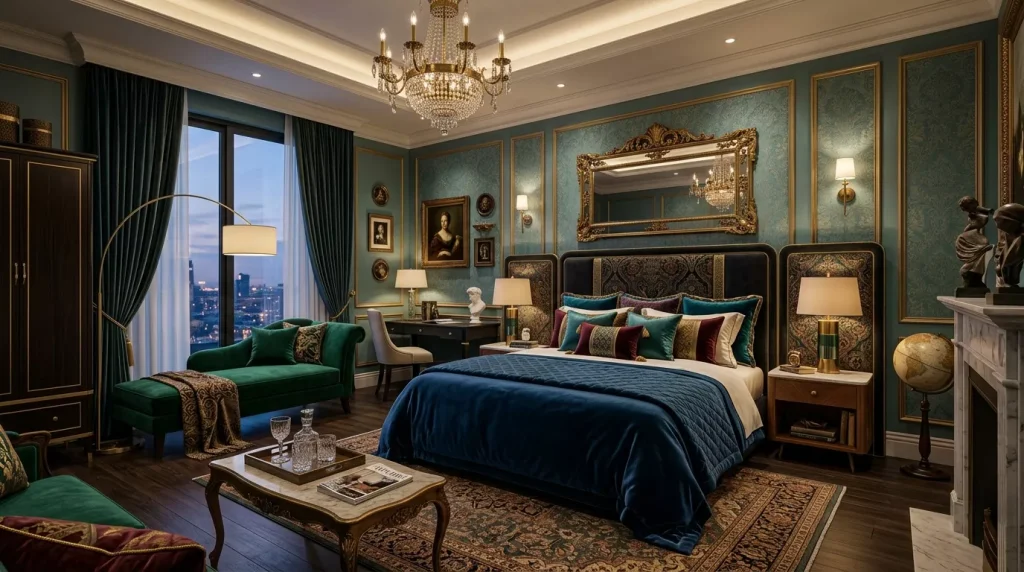
Moody and jewel-toned: Deep emerald, sapphire blue, plum, and gold. Rich colors unify a space quickly and make even mismatched furniture look intentional.
Neutral with strategic pops: A base of warm whites and beige, with two or three bold accent colors introduced through textiles and art. This is the easiest approach for beginners.
Black and warm neutrals: Black acts as a unifying anchor. When every piece in the room shares at least a touch of black — a lamp base, a frame, a chair leg — the eye moves more smoothly across mixed styles.

Gallery Walls and Artwork: The Soul of an Eclectic Bedroom
Nothing says eclectic more powerfully than a thoughtfully assembled gallery wall. It’s where your personal history, aesthetic obsessions, and collected pieces come together visually.
Effective eclectic gallery walls combine:
- Framed photography alongside oil paintings
- Vintage prints next to contemporary abstract pieces
- Mixed frame sizes and finishes, unified by a shared color story
- Decorative objects (mirrors, wall baskets, sculptural pieces) mixed between frames

The most common mistake? Treating the gallery wall like a project to complete in one afternoon. The best ones are built slowly — a piece here, a frame there — which gives them that genuine sense of being collected over time rather than curated at once.
Start with an anchor piece (something larger or more meaningful than the rest), then build outward. Lay everything on the floor before you commit a single nail to the wall.
How Eclectic Compares to Other Popular Bedroom Styles
It helps to understand what makes eclectic distinct from the styles it’s often confused with.
| Style | Core Principle | Color Approach | Furniture | Feel |
|---|---|---|---|---|
| Eclectic | Curated mixing of styles, eras, cultures | Anything with a unifying thread | Mixed periods, intentional contrasts | Personal, layered, unique |
| Bohemian | Free-spirited, globally inspired, organic | Warm, rich, earthy | Relaxed, low, natural materials | Casual, hippie, artsy |
| Maximalist | More is more, intense layering | Bold, saturated, multiple hues | Pattern-heavy, ornate | Dramatic, loud, expressive |
| Minimalist | Less is more, function over ornament | Monochrome or restrained | Clean lines, no excess | Calm, spare, structured |
| Mid-Century Modern | Post-war design language | Warm neutrals + muted pastels | Tapered legs, organic curves | Retro, warm, refined |
| Scandinavian | Functional simplicity | White, gray, natural wood | Light woods, clean | Cool, airy, understated |
The key difference between eclectic and maximalist is intention vs. abundance. Maximalism celebrates visual excess. Eclecticism celebrates personal curation — it’s about the meaning of each piece, not just the volume of pieces.
The difference between eclectic and bohemian is scope. Bohemian is its own aesthetic world with specific cultural references. Eclectic borrows from anywhere — including boho elements — without being confined to that world.

Pros and Cons of Eclectic Bedroom Decor
Like any design approach, eclectic style has real strengths and genuine challenges. Knowing both will help you decide if it’s the right fit for your space and personality.
✅ Pros
- Completely personal — No other room will look exactly like yours, because it’s built from your specific tastes and collected pieces.
- Budget-friendly — Eclectic design actively celebrates thrifted finds, vintage pieces, and inherited furniture. You don’t need to buy everything new.
- Endlessly adaptable — As your taste evolves, so can your room. You can add, swap, or reframe pieces without disrupting the whole design.
- Forgives imperfection — Slightly mismatched nightstands? Different wood tones in the same room? In eclectic design, that’s often a feature, not a flaw.
- Rich and layered — Eclectic bedrooms feel lived-in and warm in a way that perfectly matched, catalog-curated rooms rarely do.
❌ Cons

- Easy to get wrong — Without the unifying elements (color thread, consistent mood, scale balance), it slides into clutter very quickly.
- Harder to achieve than it looks — Despite appearances, eclectic design requires more design knowledge than choosing a single cohesive style and buying furniture in it.
- Can feel visually restless — People who crave calm, spa-like bedrooms may find eclectic decor overstimulating rather than soothing.
- Difficult to advise on — Because it’s so personal, it’s hard to follow a single guide or formula. What works in one room may not work in yours.
- Risk of impulse-buying mistakes — Because “anything goes,” it’s easy to justify every purchase as eclectic, even when a piece genuinely doesn’t belong.
Step-by-Step Guide to Designing Your Eclectic Bedroom

If you’re starting from scratch or rethinking a current room, this process will help you build a coherent eclectic space rather than an accidental mess.
Step 1: Define Your Anchor Aesthetic Eclectic doesn’t mean you start with nothing. Choose one primary style that resonates most with you — bohemian, mid-century modern, vintage, industrial — and use it as your foundation. Everything else will orbit this anchor.
Step 2: Choose Your Unifying Color Palette Select two to four colors that will appear consistently across the room. These don’t have to dominate everything, but they should show up often enough that the eye finds continuity. Write them down. Reference them every time you consider a new purchase.
Step 3: Start with the Bed The bed is always the largest visual element in a bedroom. Choose your bedframe and bedding first, then build the rest of the room around them. It’s far easier to work outward from the bed than to try to make a bed fit a room that’s already furnished.

Step 4: Curate, Don’t Accumulate Every piece you bring into the room should earn its place. Ask two questions: Does it connect to the color palette? Does it connect to at least one other element in the room through texture, era, or material? If the answer to both is no, it probably doesn’t belong.
Step 5: Add Textiles Last Rugs, curtains, cushions, and throws are the easiest and most affordable way to pull the palette together. Add them after the larger furniture pieces are in place, and use them deliberately to bridge any gaps between contrasting elements.
Step 6: Step Back and Audit Live with the room for a few weeks before declaring it done. Notice which pieces your eye keeps getting stuck on — those are the ones that don’t belong. The goal is a room where the eye travels smoothly around the space, finding points of interest without getting confused.
Common Mistakes People Make with Eclectic Bedroom Decor
These are the most frequent missteps, and most of them are easy to avoid once you know they exist.
❌ Confusing eclectic with “no rules” Eclectic has rules — they’re just flexible ones. Ignoring all structure leads to visual noise, not personal style. The rules of color harmony, scale, and proportion still apply.
❌ Buying everything at once An eclectic room that was assembled in a single weekend shopping trip almost always looks that way. The authenticity of eclectic design comes from pieces gathered over time with real intention behind each one.
❌ Ignoring scale A giant ornate armoire next to a tiny delicate side table creates imbalance that no color palette can fix. Mix styles freely, but always consider whether pieces are proportionally compatible.
❌ Too many focal points Eclectic rooms can easily end up with five different things competing to be the statement piece — the bold rug, the gallery wall, the dramatic headboard, the oversized plant, and the vintage mirror. Choose one or two focal points and let the rest of the room support them.
❌ Forgetting negative space Even in an eclectic bedroom, your eye needs places to rest. Not every wall, surface, and corner needs to be filled. White or neutral space makes the pieces you do display look more deliberate and special.
❌ Mixing too many wood tones carelessly Multiple wood tones can absolutely coexist in an eclectic room, but they need to share an undertone (all warm, or all cool). Warm honey oak next to cool ash gray creates tension that feels unresolved rather than intentional.
Pro Tips for Nailing Eclectic Bedroom Style
These are the insights that separate a genuinely beautiful eclectic room from one that’s just trying to be.
- Repeat colors in threes. For any accent color to feel intentional rather than accidental, it should appear in at least three places in the room. One terracotta pillow looks like a mistake. Three terracotta elements look like a design decision.
- Use black as a bridge. When you have pieces from very different eras and styles, adding a touch of black to several of them — through lamp bases, frames, hardware — visually ties the room together in a subtle, powerful way.
- Shop vintage and thrift stores with your palette in mind. Take photos of your room and color swatches to secondhand shops. This keeps impulse purchases from derailing the cohesion you’ve worked to build.
- Let one piece be genuinely weird. Every great eclectic room has at least one piece that surprises — an unexpected sculpture, an unusually shaped mirror, a textile that belongs in another country. That one surprising piece is often what gives the room its personality.
- Treat plants as decor elements, not afterthoughts. Large-scale plants — a fiddle leaf fig, a monstera, a tall snake plant — add organic texture and movement that pulls together diverse furniture pieces naturally.
- Edit ruthlessly. The discipline of removing pieces that don’t serve the room is what separates a styled eclectic bedroom from a cluttered one. When in doubt, take it out.
Conclusion: Your Bedroom, Your Rules — But Make It Count
Eclectic bedroom decor is ultimately an act of self-expression. It’s the style that says you’ve lived a little, collected things that meant something to you, and refused to let a single trend define your space. And when it’s done with even a small amount of intention, it produces bedrooms that are genuinely beautiful — not in a showroom way, but in a “this is someone’s real life and real taste” way that’s far more compelling.
The key takeaways are simple: anchor your palette, curate rather than accumulate, build slowly, and give your room a unifying thread that ties the mix together. Follow that framework and the rest is genuinely up to you.
Ready to start? Pick one piece you already own that you absolutely love — a vintage lamp, a bold rug, a painting — and build your eclectic bedroom around it. That one piece you love most is almost always the best anchor point. Start there and let the room grow outward.
FAQs: Eclectic Bedroom Decor
Q1: What is the difference between eclectic and maximalist bedroom decor?
Eclectic decor is defined by the deliberate mixing of different design styles, eras, and cultural aesthetics with intentional curation. Maximalism, on the other hand, is defined by visual abundance — more patterns, more color, more objects. An eclectic room can actually be quite restrained in terms of quantity; it’s the diversity of elements that defines it, not the volume. Maximalism often uses many pieces within a consistent aesthetic, while eclecticism uses fewer pieces from many different aesthetics.
Q2: How do I keep an eclectic bedroom from looking messy or cluttered?
The most effective tools are a unified color palette and negative space. When every piece in the room shares at least one color from a consistent palette, the eye accepts the mix as intentional. Negative space — areas of wall, floor, or surface that are deliberately left empty — gives the curated pieces room to breathe and be noticed. Also, limit your focal points. If everything is competing for attention, nothing stands out, and the room just reads as busy.
Q3: Can I do eclectic bedroom decor on a budget?
Absolutely — eclectic design is arguably the most budget-friendly approach to interior design that exists. Because it celebrates mixing thrifted pieces, vintage finds, inherited furniture, and handmade objects, you’re actively encouraged to shop secondhand, repurpose what you have, and invest selectively rather than buying everything new. The most authentic eclectic bedrooms are usually the ones assembled over time from affordable, personally meaningful pieces rather than purchased wholesale.
Q4: What are the best colors for an eclectic bedroom?
There’s no single answer, since eclectic rooms can work in almost any palette. That said, the most commonly successful eclectic bedroom palettes are warm earth tones (terracotta, mustard, olive, cream), moody jewel tones (emerald, sapphire, plum, gold), and warm neutrals with bold pops (beige and ivory bases with two or three vivid accents). Whatever palette you choose, the key is consistency — every piece in the room should connect back to that palette in at least one way.
Q5: How do I mix patterns without the room looking overwhelming?
The most reliable technique is to vary the scale of your patterns while keeping them within the same color family. Choose one large-scale pattern (a bold floral duvet or a large geometric rug), one medium-scale pattern (a mid-sized stripe or abstract print on cushions), and one small-scale pattern (a tiny print or subtle texture). When these three scales coexist in matching or complementary colors, the eye reads them as layered and intentional rather than conflicting.
Q6: Is eclectic decor hard to change or update over time?
It’s actually one of the most flexible design approaches available. Because there’s no strict style rulebook to maintain, you can add, remove, or swap pieces relatively easily without disrupting the whole room. New purchases just need to connect with the established color palette and not overwhelm the existing balance of scale and texture. You can evolve an eclectic bedroom gradually over years without ever feeling like you need to start over from scratch.
Q7: Can eclectic bedroom decor work in a small bedroom?
Yes, though it requires more discipline with editing. In a small bedroom, the risk of visual overwhelm is higher, so you’ll want to be even more selective about what earns a place in the room. Stick to a tighter color palette, limit your pattern mixing to two or three elements rather than five or six, and prioritize vertical space — gallery walls and tall bookshelves bring personality and style without consuming valuable floor space. Mirrors are also particularly useful in small eclectic rooms, as they add depth and reflect the layered aesthetic beautifully.