Olive Green Living Room Ideas That Actually Wow

Olive Green Living Room Ideas That Actually Wow
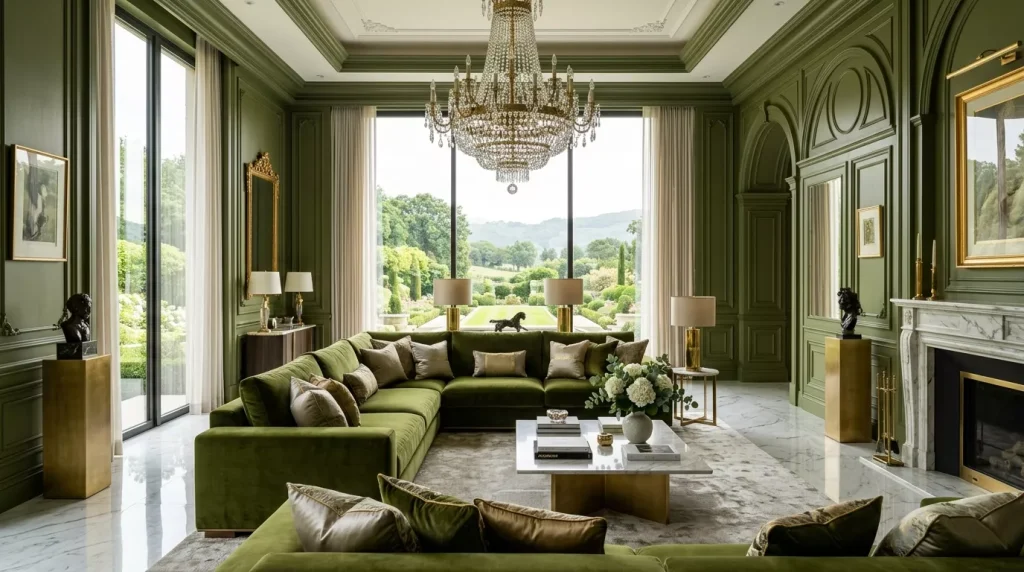
Some colors make a room look nice. Olive green makes a room feel like somewhere. That’s the distinction that’s turned olive green living room ideas into one of the most searched interior topics of recent years — and it’s a distinction worth understanding before you pick up a paint brush or order a new sofa.
Olive green occupies a unique space in the color world. It’s warm enough to feel inviting, complex enough to feel interesting, and muted enough to stay out of its own way. It doesn’t shout. It doesn’t fade either. And when it’s paired with the right textures, finishes, and accent tones, it creates a living room that people walk into and immediately feel comfortable in.
This guide is built around practical decisions — not just inspiration. You’ll find ideas broken down by budget, by wall treatment, by fabric and texture, and by the specific mistakes that trip people up even when their instincts are good. Let’s start where most living room decisions actually start: the sofa.
The Psychology Behind Olive Green in a Living Room
Before getting into specifics, it’s worth spending a moment on why olive green works so well in social, shared spaces — because understanding this will help you make better decisions throughout the design process.
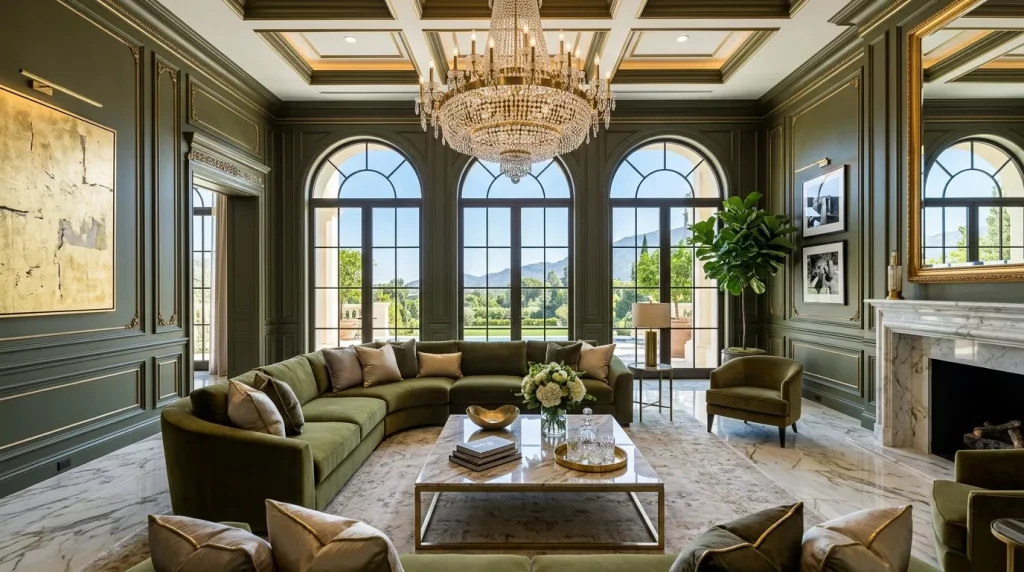
Green, broadly speaking, is the color most associated with nature and restoration. It lowers cortisol levels, reduces anxiety, and signals safety — which is why it shows up consistently in spaces designed for relaxation and recovery. Hospital waiting rooms, meditation spaces, and high-end hotel lobbies all use green deliberately.
But olive green adds another layer. Its muted, earthy quality anchors it in the physical world — soil, bark, dried herbs, autumn leaves. It references age and permanence rather than freshness or novelty. This gives olive-green rooms a sense of weight and rootedness that brighter, more saturated greens can’t achieve.
The practical upshot: a living room in olive green tends to feel calm without feeling cold, warm without feeling claustrophobic, and interesting without feeling restless. Those are hard qualities to find in a single color.
Olive Green Living Room Ideas for Every Budget
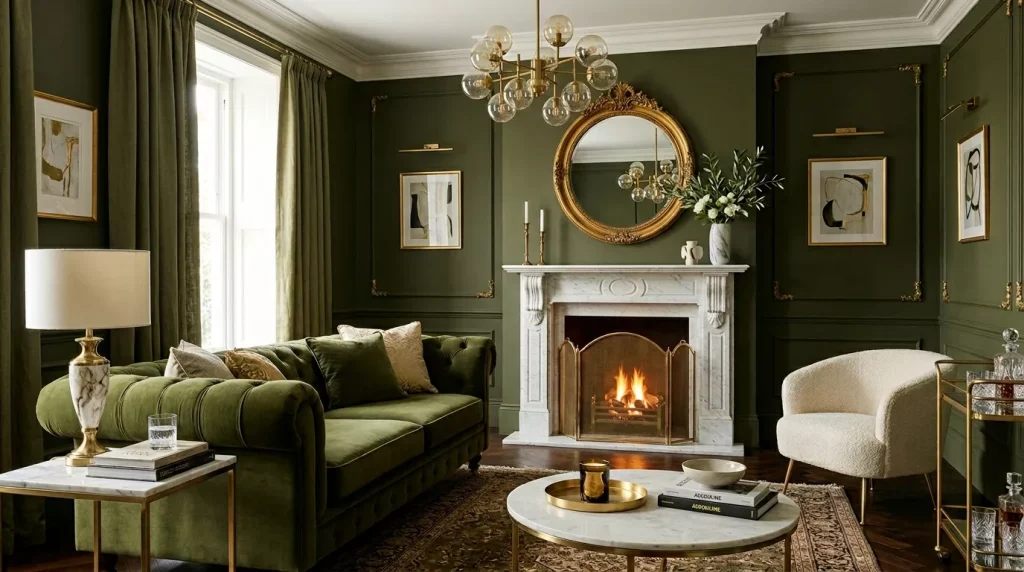
One of the most useful ways to think about olive green is through the lens of budget — because the color works at every investment level, and knowing where your money goes furthest helps you prioritize.
Budget-Friendly Olive Green Updates (Under $200)
You don’t need to spend thousands to feel the effect of olive green in your living room. Some of the most impactful changes cost very little.
What to try:
- Two or three olive green velvet cushion covers for your existing sofa ($15–$30 each)
- A large olive green throw draped over an armchair or couch arm ($30–$60)
- A set of olive green taper candles or a trio of matte ceramic vessels in earthy green tones ($20–$40)
- A botanical print with olive, forest green, and warm ochre tones in a simple frame ($20–$50)
- One large pots of trailing green plants — pothos or devil’s ivy thrive indoors and cost almost nothing ($10–$20)
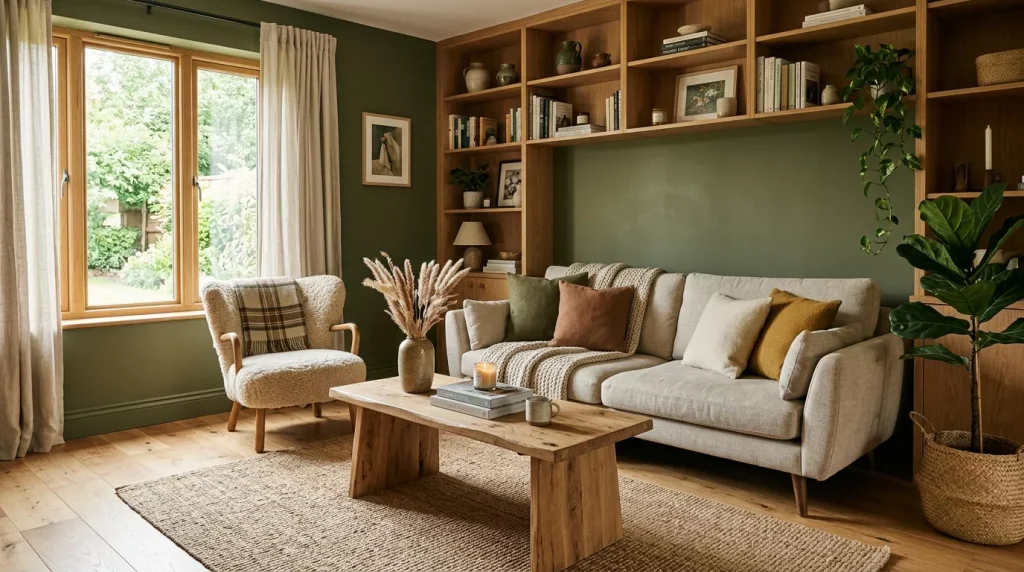
These small investments introduce the color into your space without disrupting anything structurally. They’re also reversible, which matters if you’re testing the palette before committing.
Mid-Range Refresh ($200–$1,000)
At this level, you can make changes that genuinely shift the personality of the room.
Where the money goes furthest:
- A quality tin (or two) of olive green paint and supplies to transform one feature wall — often the most impactful single change available ($80–$150 all-in)
- A new set of linen or velvet curtains in olive green, hanging floor to ceiling ($150–$400 depending on window size)
- A medium-sized woven or natural fiber rug in warm earth tones that ground the room ($100–$300)
- New hardware for existing furniture — drawer handles and cabinet pulls in matte brass or dark iron ($40–$100)
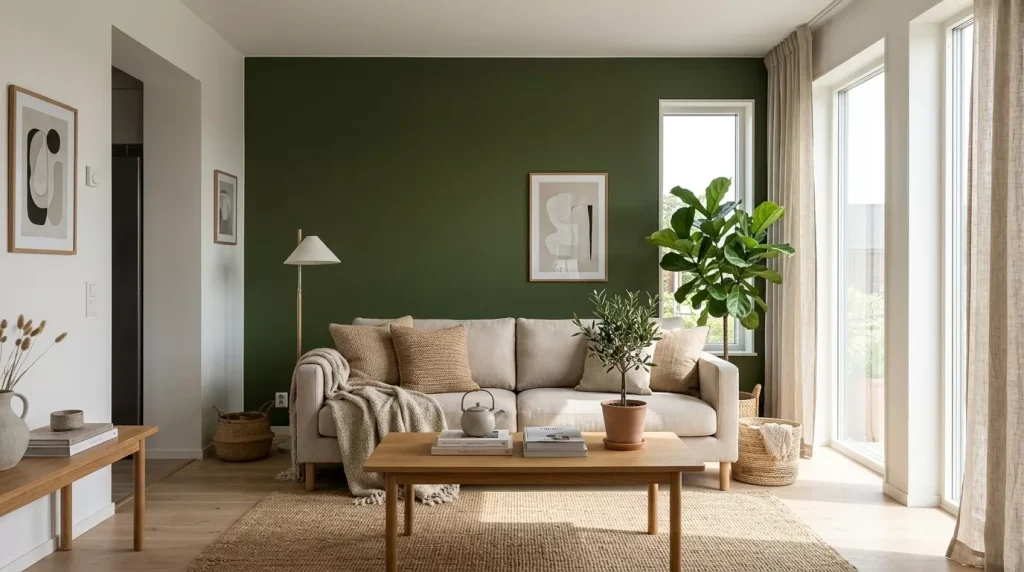
This tier moves you from “olive green accents” to “olive green room” — there’s a meaningful difference in how the space registers to anyone who walks in.
Full Room Investment ($1,000 and Up)
If you’re ready to commit fully, this is where an olive green living room becomes something genuinely memorable.
- New sofa in olive green velvet or textured linen — the single most impactful investment in an earthy living room
- Professional painting of all four walls including ceiling treatment in a complementary warm white
- Bespoke or quality curtains with lining, floor-to-ceiling
- Statement lighting — a sculptural floor lamp or pendant in aged brass or warm metal
- Quality natural materials — a large jute or wool rug, real wood side tables, ceramic lamp bases
At this level, every element is chosen to work together, and the result is a room that looks and feels deliberate in the best possible way.
Olive Green Wall Ideas That Go Beyond Basic Paint
Most people think of painting when they consider olive green walls — but there are several other approaches worth knowing about, some of which deliver results that paint simply can’t.
Limewash and Textured Plaster Finishes
Limewash paint has had a major revival in interior design, and for good reason. It creates a soft, naturally variegated surface where the color is not perfectly uniform — it shifts slightly across the wall, catching light differently throughout the day.
In olive green, this technique is extraordinary. The tonal variation stops the color from looking flat or heavy, and it gives the wall an artisanal, almost ancient quality that paint alone rarely achieves. It suits rustic, bohemian, and Mediterranean-inspired living rooms especially well.
Venetian plaster is a more intensive version of the same idea — a layered, burnished finish that creates an almost translucent depth. More expensive and requiring professional application, but the results are unlike anything else.
Olive Green Wallpaper
Wallpaper gives you options paint simply doesn’t — pattern, texture, and print. Botanical wallpapers with olive green backgrounds and warm-toned foliage are a popular choice because they reinforce the nature-inspired quality of the color while adding decorative richness.
Large-scale leaf prints, abstract organic shapes, and vintage botanical illustration styles all suit olive beautifully. Use wallpaper on a single feature wall — behind the sofa or the main seating area — and keep remaining walls in a complementary warm neutral to let the pattern breathe.
Painted Panels, Dado Rails, and Color Blocking
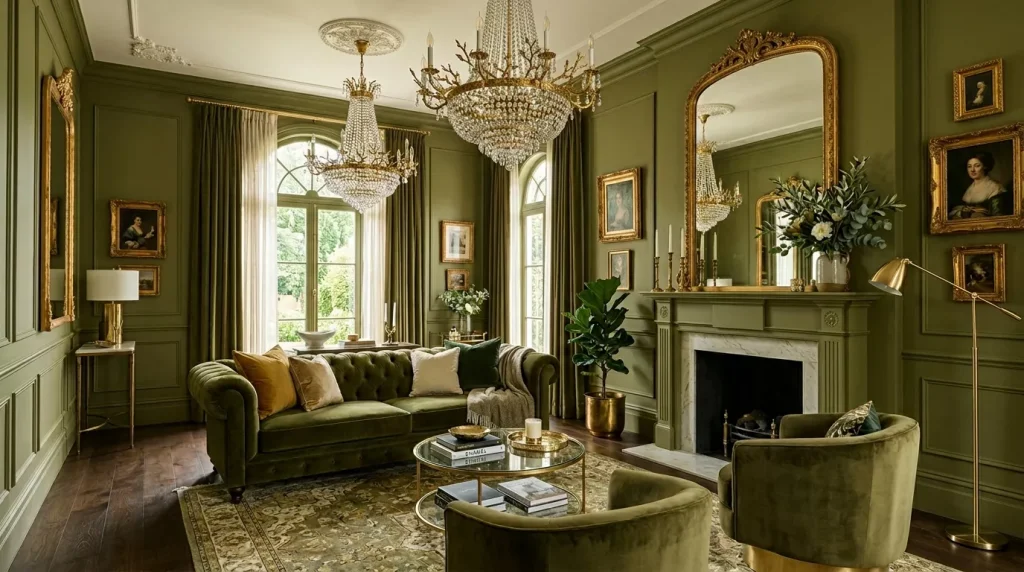
For something more architectural, painted paneling in olive green with lighter neutral paint above creates a sense of tailored, considered design. This works especially well in living rooms with period features — cornicing, dado rails, picture rails — where the olive grounds the lower half of the room while the upper walls stay light and open.
Color blocking — painting the lower two-thirds of the wall in olive and the upper section in a contrasting warm cream — is a contemporary take on the same concept. No dado rail required.
The Best Accent Colors to Pair With Olive Green
Olive green is accommodating, but it still has preferences. Here are the accent color families that consistently bring out the best in it.
| Accent Color | Tone Relationship | Visual Effect | Best Application |
|---|---|---|---|
| Warm cream or linen | Analogous warmth | Soft, airy, classic | Walls, large upholstery |
| Burnt orange or rust | Warm contrast | Energetic, earthy | Cushions, ceramics, art |
| Terracotta | Complementary earth | Rich, Mediterranean | Rugs, pots, throws |
| Deep burgundy or wine | Bold contrast | Sophisticated, moody | Accent chair, artwork |
| Antique brass or gold | Metallic warmth | Luxurious, curated | Hardware, lamps, frames |
| Warm caramel or tan leather | Natural contrast | Relaxed, organic | Armchair, footstool |
| Dusty blush pink | Soft unexpected | Romantic, vintage | Cushions, vases |
| Charcoal or soft black | Cool contrast | Graphic, grounded | Frames, furniture legs |
Two or three accents from this table work far better than attempting to use all of them. Pick your combination and stick to it — the restraint is what makes it look designed rather than assembled.
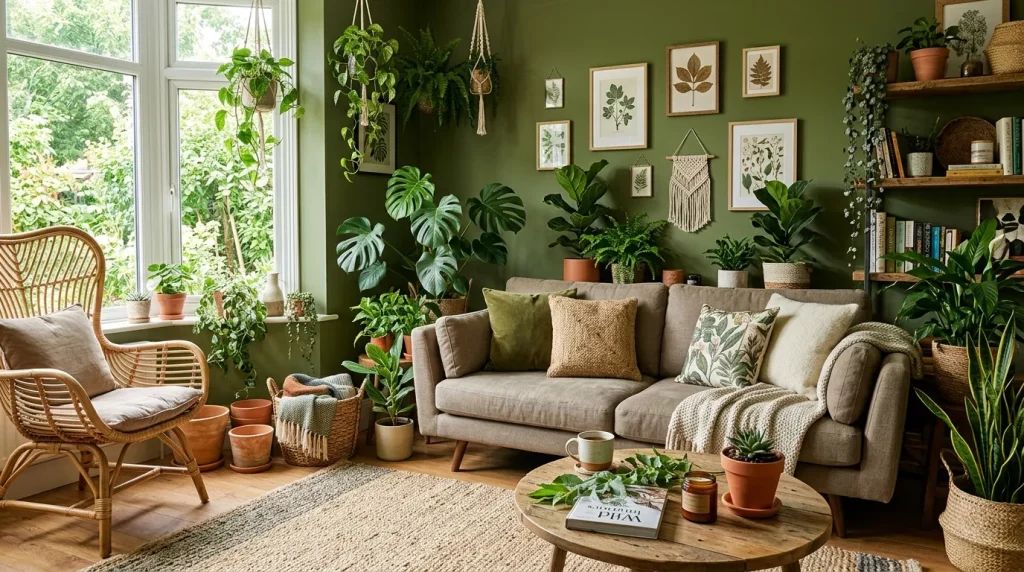
How to Layer Textures in an Olive Green Living Room
Here’s something most interior design guides skip over: color alone doesn’t make a room interesting. Texture does. And olive green — precisely because it’s a muted, complex tone rather than a vivid one — depends on layered texture to reach its full potential.
Think about the surfaces in your living room and what they bring to the tactile story of the space.
Texture layering that works beautifully with olive green:
- Velvet — richly absorbs light, deepens the look of olive green upholstery or cushions
- Chunky knit or boucle — adds softness and casual warmth; great for throws and accent cushions
- Natural jute or sisal — rough, organic texture that grounds the room and references the outdoors
- Smooth glazed ceramic — adds a clean counterpoint to rougher textures; works well in lamp bases and vases
- Aged or oiled wood — warmth and tactile richness that synthetic materials never quite replicate
- Linen — slightly crumpled, relaxed quality that suits an earthy palette more than crisp, formal fabrics
- Rattan or cane — lightweight, natural, and very much at home in an earthy green space
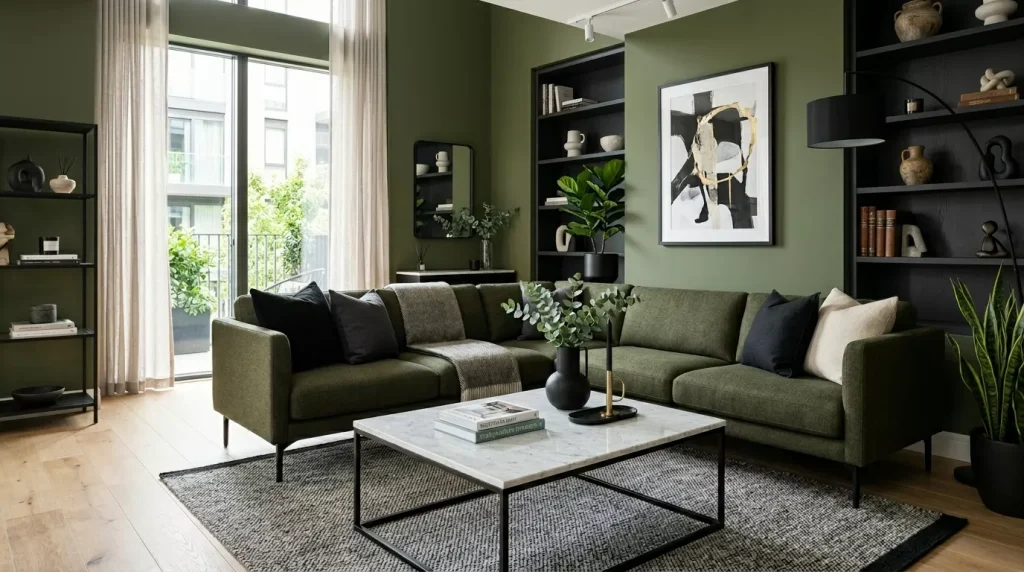
The goal is contrast within a cohesive palette. Rough against smooth, matte against subtle sheen, soft against hard. Each pairing adds interest without introducing a new color into the mix.
Step-by-Step Guide to Refreshing Your Living Room With Olive Green
Whether you’re starting fresh or updating what you already have, here’s a practical sequence that prevents the most common planning errors.
Step 1: Audit Your Existing Room List what stays and what changes. Your flooring, existing large furniture, and fixed elements (fireplace surround, built-in shelving) are likely staying. Know what you’re working with before adding anything new.
Step 2: Identify the Light Quality Is your living room north-facing, south-facing, or mixed? How does sunlight move through the space across a typical day? This determines which shade of olive — warm golden, cooler grey-olive, or deep muted green — will perform best in your specific conditions.
Step 3: Choose Your Primary Olive Application Where will olive green make the biggest impact in your room? Walls, sofa, curtains? Choose one primary application and build from there. Trying to implement everything at once makes budgeting and decision-making far more difficult.
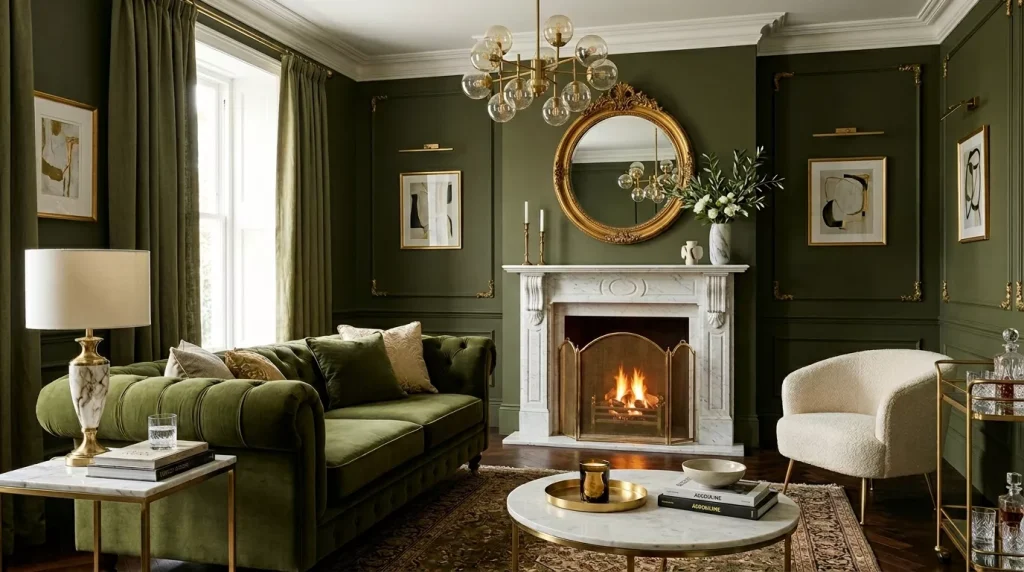
Step 4: Lock In Your Supporting Palette Based on the accent color table above, choose two supporting tones. These should appear across your cushions, rug, art, and accessories in varying proportions. More of the lighter tone, less of the bolder one.
Step 5: Map Out Your Texture Mix Go through the texture list from the previous section and identify at least four different materials you’ll include. Assign each to a specific piece — a jute rug, velvet cushions, a linen throw, a ceramic lamp base.
Step 6: Set Your Lighting Plan Decide on your lighting before you finalize anything else. Ceiling light for overhead fill, a floor lamp in one corner, table lamps on side tables or a console. Warm bulbs only — 2700K to 3000K. Layer the sources so you can adjust the room’s mood.
Step 7: Shop Deliberately, Add Gradually Buy the anchoring pieces first — the sofa, the curtains, the rug. Then add accessories in smaller increments over a few weeks. Rooms that are fully dressed on day one rarely feel as good as rooms that evolve. Give yourself room to discover what the space actually needs.
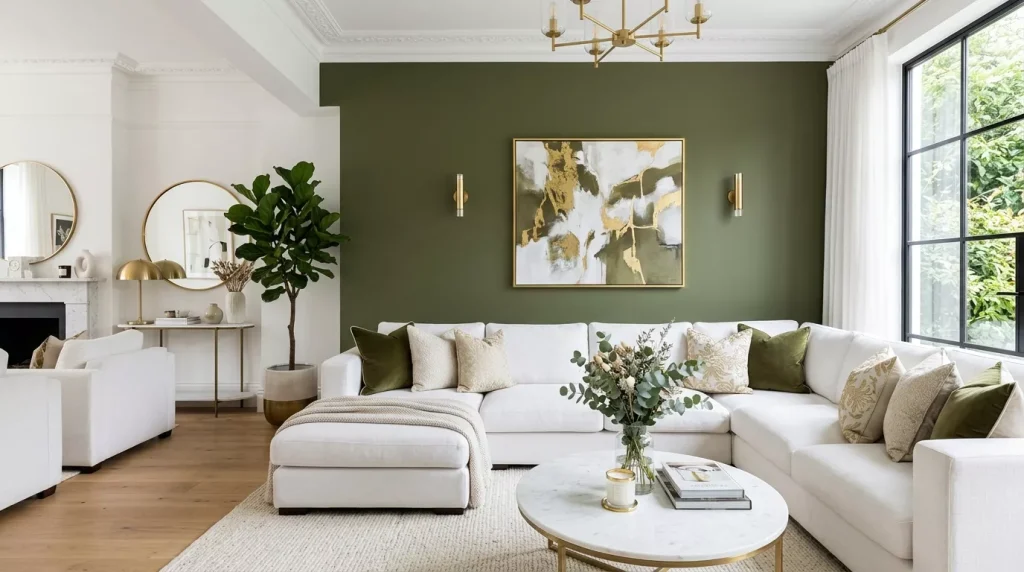
Pros and Cons of an Olive Green Living Room
Pros:
- Creates instant warmth and a sense of enclosure that invites people to relax
- Ages beautifully — olive green doesn’t feel dated the way bolder trend colors do
- Looks genuinely different throughout the day as light changes
- Pairs well with almost every natural material — wood, rattan, jute, linen, stone
- Works in both small and large living rooms with thoughtful application
- Relatively easy to refresh around — swap accent colors without touching the olive
- Photographs beautifully, which matters for anyone sharing their home online
Cons:
- Requires careful shade selection — wrong undertone in the wrong light is an expensive mistake
- Very dark olive shades can feel heavy in rooms without strong natural light
- Can clash with existing cool-toned furniture or flooring if not accounted for
- Warm-toned accessories are essential — the wrong pairing strips the color of its appeal
- Repainting later means covering a darker tone, which typically requires extra coats and primer
- Not universally popular — some buyers prefer neutrals, which is worth considering before selling
Tips for Getting Olive Green Living Room Right
- Always test your chosen shade on the actual wall. Paint A4-sized sample patches and observe over 48 hours before committing. The difference between olive shades is subtle in a swatch book and dramatic on a wall.
- Warm white beats bright white. If your olive green walls are the star, bright white trims and ceilings compete with them. A warm white — linen, ivory, or an off-white with a yellow or pink base — keeps everything harmonious.
- Use large-scale pieces to introduce the color, not just small ones. A living room where olive green only appears in small accessories can feel timid rather than designed. One large statement piece — a sofa, a rug, a curtain — anchors the palette properly.
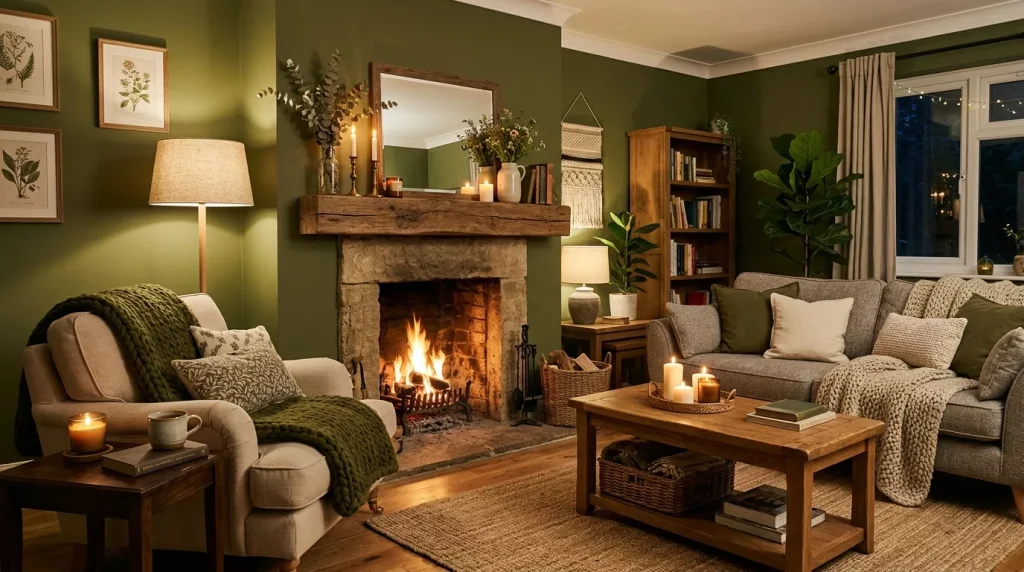
- Scent and organic elements reinforce the palette. A eucalyptus stem in a simple vase, dried herbs in a ceramic pot, beeswax candles on the mantle — these small organic elements make an earthy green room feel complete in a way that purely visual choices don’t.
- Don’t match, coordinate. Your olive cushions shouldn’t be the exact same shade as your olive wall. Slight variation — different tones, different textures in the same color family — looks far more natural and considered than exact matching.
- Treat the room as a whole, not as individual pieces. Step back frequently during the styling process. What looks right up close can feel off when you view the room from the doorway. The view from the threshold is the most important one.
Common Mistakes People Make With Olive Green Living Rooms
1. Buying Paint Online Without Testing It Screen calibration differences mean that the olive green you see on a monitor or phone screen may look significantly different in real life. Always order physical sample pots — never commit to a full tin based on a digital image alone.
2. Pairing Olive With Cool-Toned Grey This is probably the single most common error. Cool grey and warm olive pull in opposite temperature directions, and the result is a room that feels slightly off without the occupant being able to say why. If you want a neutral alongside olive, choose warm greige, camel, or a putty tone instead.
3. Choosing Olive Without Considering the Existing Floor A terracotta tile floor with warm olive walls is glorious. A cold grey or blue-toned laminate floor beneath olive green walls creates a disconnect that’s very difficult to resolve without changing one or the other. Your floor is already fixed in most cases — let it guide your shade selection.
4. Going Too Dark in a Low-Light Room Very deep, near-khaki olives look stunning in rooms that get strong natural light for several hours a day. In a north-facing or basement living room, the same shade reads as almost brown and makes the space feel cave-like. Choose lighter, mid-tone olives for rooms with limited sunlight.
5. Treating It Like Any Other Neutral Olive green is not a neutral. It’s a color — a complex, beautiful one — but it makes design demands that true neutrals don’t. It needs complementary tones, warm lighting, and natural materials to perform at its best. Treating it like a backdrop and pairing it with whatever is convenient leads to rooms that feel confused rather than curated.
6. Rushing the Accessory Stage Accessories are where olive green rooms get their personality, and rushing this stage is where most people under-deliver. Take your time. Sit with the larger pieces for a week or two before adding accessories. What the room needs will become clearer once the anchoring elements are in place.
FAQs About Olive Green Living Room Ideas
Q1: What is the best shade of olive green for a living room?
The “best” shade depends almost entirely on your room’s light conditions and the secondary palette you’re building around it. For warm, well-lit rooms, a golden or amber-olive brings out the color’s warmth beautifully. For rooms with cooler or more limited light, a greyer, more muted olive performs better and doesn’t turn muddy. If you’re unsure, a mid-tone olive with balanced warm-grey undertones is the most universally forgiving starting point.
Q2: Can olive green work in a modern living room?
Absolutely — and arguably very well. Contemporary living rooms benefit from the warmth that olive green adds to otherwise clean, minimal spaces. The key is restraint in application: one dominant olive surface (a sofa or feature wall), matte or satin finishes, simple forms, and considered hardware in a single metal finish. The earthy quality of olive prevents a modern room from feeling cold or clinical, which is one of the most common criticisms of minimalist interiors.
Q3: Is olive green hard to decorate around?
Not once you understand its temperature. Olive green is a warm color, so it decorates naturally with other warm tones — cream, wood, terracotta, brass, rust, camel, blush. Where people struggle is when they try to mix olive with cool-toned accessories or furniture. Keep everything in the warm temperature family and olive green is actually one of the easier colors to build a room around.
Q4: How do I make a small living room work with olive green?
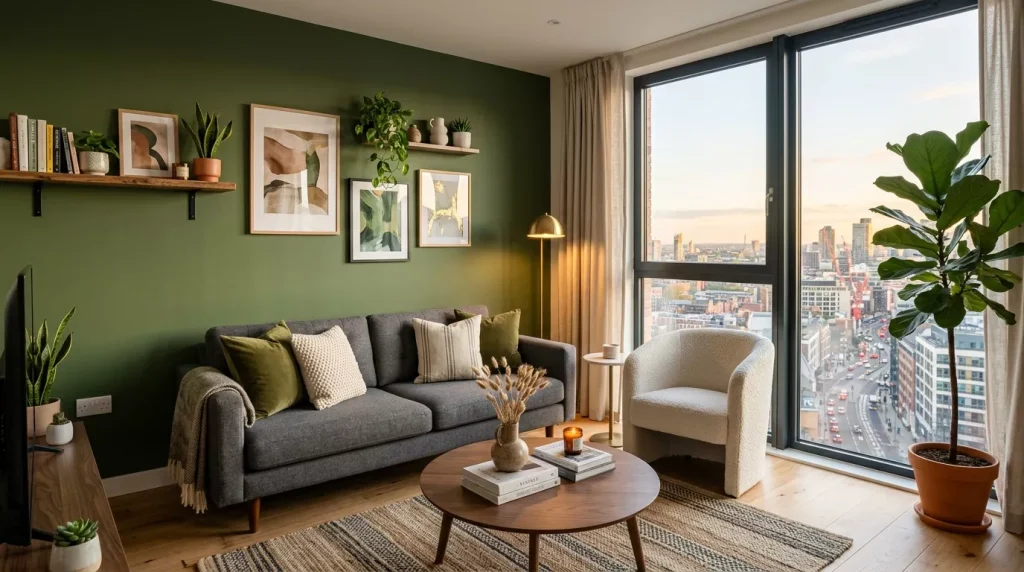
Use olive green strategically rather than comprehensively. A single olive green feature wall behind the main seating area adds depth and character without closing the room in. Keep the remaining three walls in a light warm neutral. Use mirrors to bounce light around, choose furniture with exposed legs to maintain a sense of floor space, and avoid heavy window treatments that block natural light.
Q5: What type of rug works best in an olive green living room?
Natural fiber rugs — jute, sisal, or seagrass — suit the earthy quality of olive green beautifully and work across every style from rustic to contemporary. Wool rugs in warm neutral tones (oatmeal, natural, warm grey) are another excellent choice. For a bolder approach, a vintage-style Persian or Moroccan rug with warm tones — rust, cream, terracotta, soft gold — can anchor an olive room dramatically. Avoid rugs with strong cool tones or very bright saturated colors that fight the palette.
Q6: Does olive green work with dark wood floors?
Very well. Dark wood floors — especially those with warm, amber-brown undertones — pair naturally with olive green because both colors reference the same natural landscape. The combination feels grounded and genuinely organic. Avoid dark wood floors with very cool, grey-toned finishes alongside warm olive walls — the temperature mismatch is difficult to resolve without a large rug to bridge the gap.
Q7: What plants work best in an olive green living room?
Almost any plant works well in an earthy green space because the living greenery reinforces the room’s overall palette rather than competing with it. The most impactful choices are large-leafed specimens that add architectural presence: fiddle-leaf fig, monstera, rubber plant, or a large peace lily. For shelves and side tables, trailing pothos, ivy, or string-of-pearls add cascading organic movement. Dried botanicals — pampas grass, dried eucalyptus, aged seed heads — add warmth and texture without requiring ongoing care.
Conclusion: Make Your Living Room Feel Like Somewhere Real
A living room should feel like more than a room with furniture in it. It should have a quality — warmth, personality, depth — that makes people feel genuinely comfortable the moment they walk in.
That’s what olive green living room ideas do at their best. They take a color with real visual intelligence and use it to build spaces that feel considered, human, and genuinely inviting. Not trend-chasing. Not playing it safe. Somewhere in the middle — and that middle ground is exactly where great rooms live.
The ideas in this guide give you everything you need to get started, from a $30 set of cushion covers to a full four-wall commitment. The only wrong move is choosing nothing and living with a room that never quite feels right.
Pick one change — a cushion, a curtain, a single wall — and bring olive green into your living room this week. Give it two weeks to settle in. We’d be surprised if you stop there.