Coastal Living Room Ideas That Bring the Ocean Home

There is something about the coast that makes everyone breathe a little deeper. The open air, the sound of waves, the sun-bleached colors, the feel of soft sand underfoot — it is the kind of atmosphere most of us would love to carry home with us. The good news? You absolutely can.
Coastal living room ideas are more popular than ever, and for good reason. This design style captures that relaxed, sun-soaked energy without requiring you to live anywhere near the water. Whether you are in a city apartment, a suburban house, or yes, an actual beach cottage — the coastal look is achievable, practical, and genuinely beautiful.
In this guide, we will walk through everything: color palettes, furniture choices, smart decorating tips, common mistakes to avoid, and a step-by-step plan to transform your living room into a serene coastal retreat.
What Is Coastal Living Room Style — And What It Is Not

Before diving into the details, it helps to clear up a common misconception. Coastal style is not the same as nautical style.
Nautical is anchors, rope, red-white-and-blue stripes, ship wheels, and everything that looks like it belongs on a sailor’s uniform. It is charming, but it is a specific — and often heavy-handed — look.
Coastal is broader, lighter, and far more livable. It draws from the natural environment of the coastline: the bleached wood, the soft sand, the shifting sea blues and greens, the organic textures of seagrass and linen. It feels effortless rather than themed.
Within coastal design, there are a few sub-styles worth knowing:
- Classic Coastal: Blue and white palettes, striped fabrics, breezy curtains, natural wood
- Modern Coastal: Clean lines, more white and grey, minimal accessories, understated elegance
- Boho Coastal: Warmer sandy tones, rattan, macramé, layered textures, eclectic accessories
- Coastal Farmhouse: Shiplap walls, vintage wood, soft neutrals with ocean-blue accents
Understanding which variation appeals to you will make every design decision that follows much easier.
The Coastal Color Palette: Getting the Tones Right

Color is the fastest, most affordable way to shift a room’s energy — and in coastal design, it is doing most of the heavy lifting.
The coastal palette is built on light, airy, nature-inspired tones. Here is a breakdown:
| Color Family | Example Shades | Best Used For |
|---|---|---|
| Ocean Blues | Navy, Cornflower, Slate Blue | Accent walls, cushions, rugs |
| Sandy Neutrals | Warm Beige, Wheat, Oat | Walls, large sofas, curtains |
| Seafoam & Sage | Soft Mint, Pale Aqua, Sage Green | Accent chairs, vases, cushions |
| Crisp Whites | Bright White, Creamy White | Walls, trim, slipcovers |
| Driftwood Tones | Warm Grey, Bleached Brown | Wood furniture, frames |
| Coral Accents | Dusty Coral, Terracotta | Throw pillows, ceramics (small doses) |
The golden rule of coastal color: Start with a light, neutral base — usually a warm or bright white — and layer in ocean-inspired accents. Avoid going too dark or too saturated. Coastal rooms live and breathe in soft, natural light.
The 60-30-10 rule works brilliantly here. 60% crisp white or sandy neutral (walls, large sofa), 30% ocean blue or seafoam (rugs, curtains, chairs), and 10% warm accent (coral pillow, driftwood frame, terracotta pot).
Coastal Living Room Style Ideas: Furniture That Sets the Tone
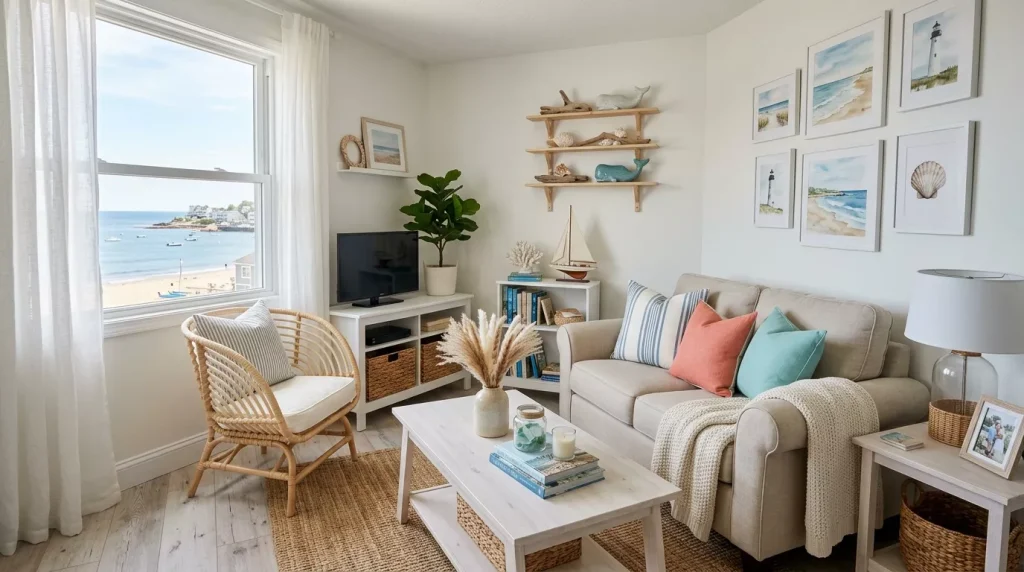
Your furniture is the backbone of the room, and in coastal design, the choices are guided by two things: lightness and naturalness.
The Right Sofa
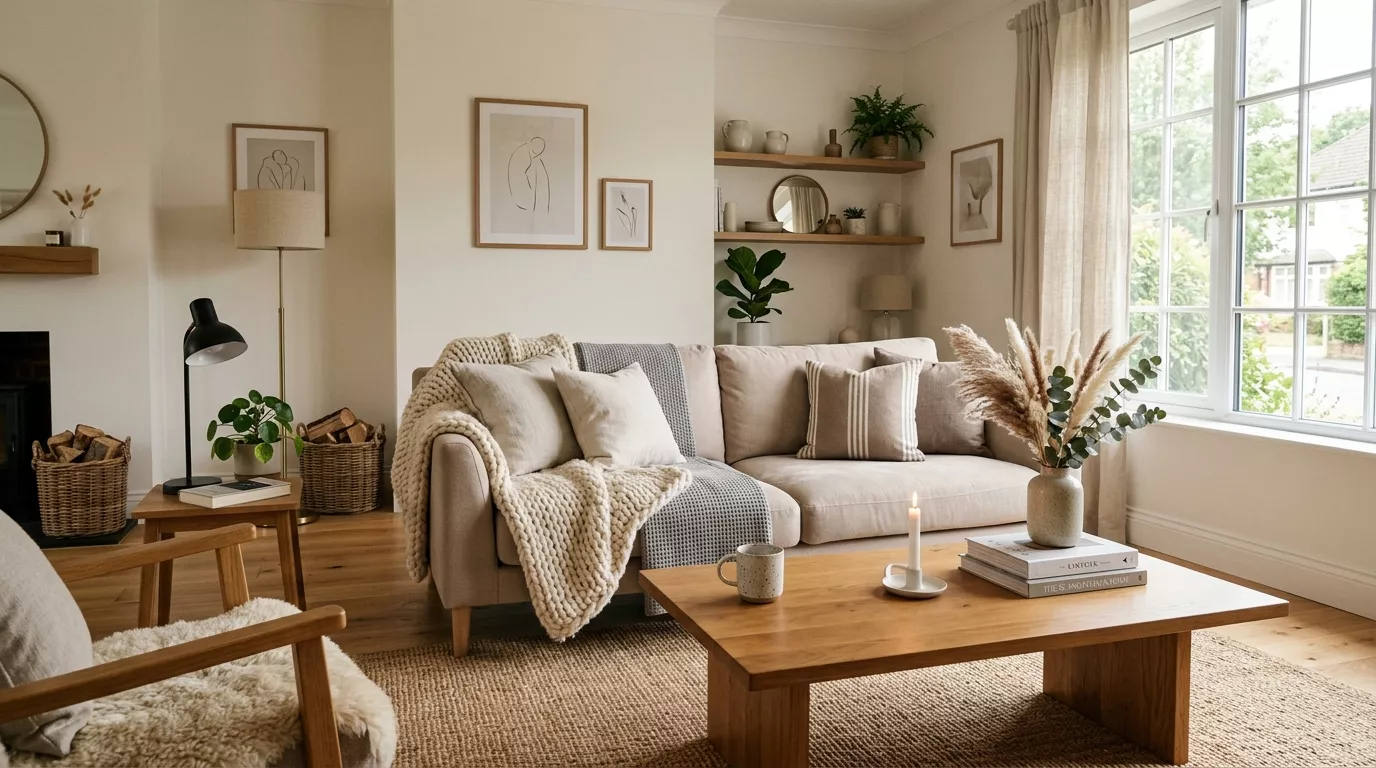
The ideal coastal sofa is light in color and natural in texture. A white or cream linen slipcover sofa is practically the poster child of this style. Slipcovers have the added bonus of being washable — practical for a style that is meant to feel relaxed and lived-in.
Avoid: dark leather sofas, very low and angular modern sectionals, or anything that feels heavy and formal.
Coffee Tables and Side Tables
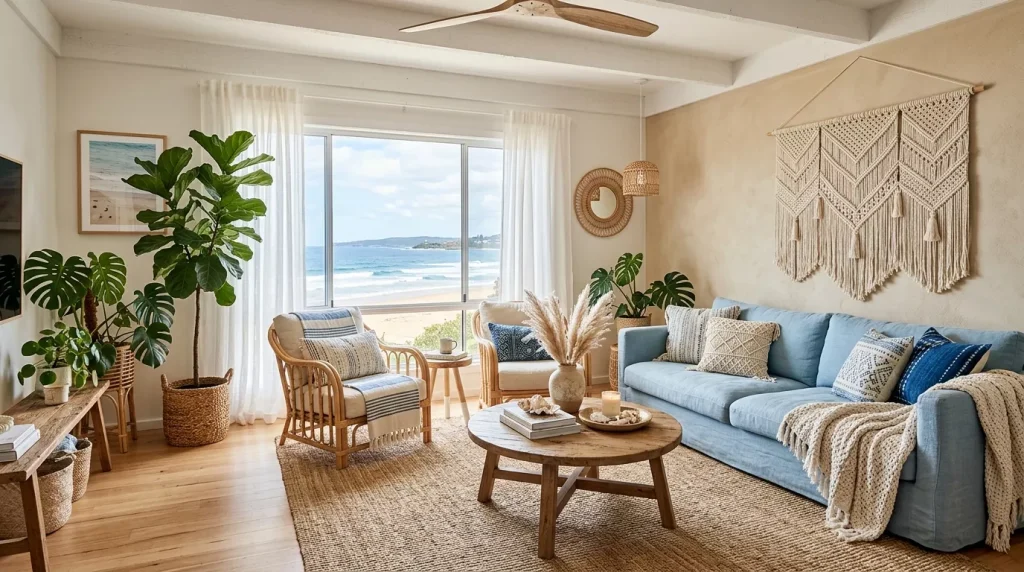
Bleached wood, driftwood-style finishes, whitewashed oak, or light rattan — these are your materials. Look for pieces that have a slightly worn, sun-baked quality. Perfectly polished and lacquered tables feel too formal for the coastal aesthetic.
Round tables work especially well in smaller coastal living rooms because they echo the organic shapes found in nature (shells, stones, tide pools).
Seating Accents
Rattan armchairs, wicker accent chairs, or a natural bamboo accent seat adds incredible texture and authenticity. These are staple pieces in coastal interiors. A pair of rattan chairs flanking a sofa is a classic coastal living room arrangement that never gets old.
Storage Solutions

Wicker baskets, seagrass storage bins, and whitewashed wooden bookshelves keep things organized while looking completely at home in a coastal space. Skip the sleek, high-gloss storage units — they belong in a different design story.
Coastal Décor and Accessories: Less Is More (Mostly)

Here is where many people go wrong: they go overboard (no pun intended) with themed accessories. The key to beautiful coastal décor is restraint combined with authenticity.
Decorative elements that work:
- Organic textures: Driftwood sculptures, woven wall art, macramé hangings, jute table runners
- Natural collections: A bowl of shells, sea glass in a glass jar, smooth river stones — displayed simply, not crammed onto every surface
- Ocean-inspired ceramics: Soft blue pottery, white coral-shaped candle holders, sand-colored vases
- Greenery: Tropical or coastal plants like palms, snake plants, succulents, or a simple trailing pothos
- Books and art: Coffee table books about the ocean, architecture, or travel; abstract watercolor prints in ocean tones; simple line drawings of coastal landscapes
What to skip:
- Plastic seashell collections in bags
- Novelty anchors and fish decorations everywhere
- Overly literal “Beach House” signs or “Life is Better at the Beach” prints
- Fishing nets used as décor (unless done with great restraint and taste)
The goal is for someone to walk into the room and feel the coast — not be told about it by every single object in the room.
Textiles and Fabrics: Softness Meets Durability
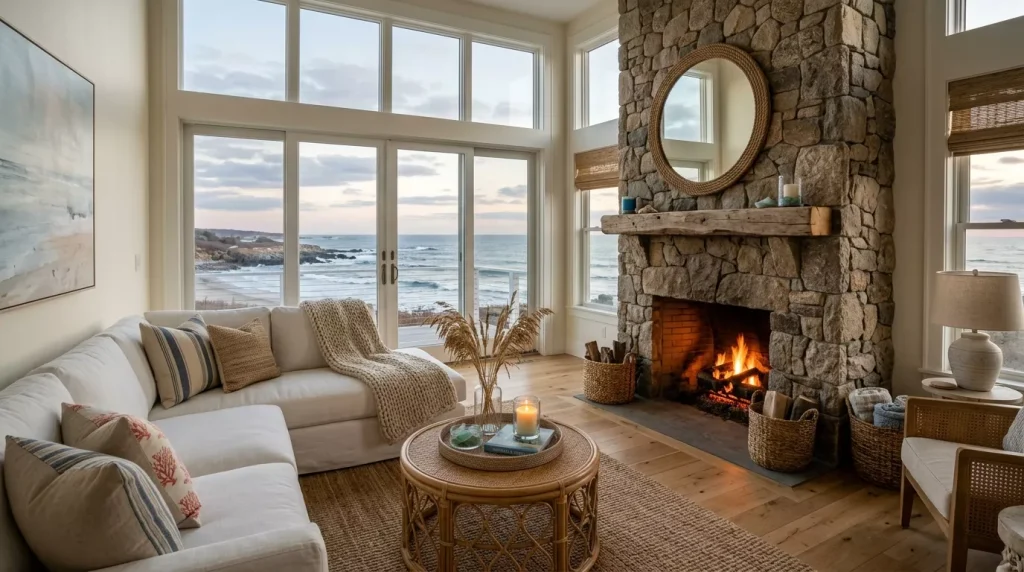
Coastal living rooms use textiles to layer texture and warmth without heaviness. Here is what to reach for:
- Linen: Breathable, natural-looking, and beautifully imperfect. Use it for curtains, sofa covers, and cushions.
- Cotton canvas: Durable and casual. Great for pillow covers and slipcovers.
- Jute and sisal: The go-to rug materials for coastal spaces. They add incredible organic texture and are highly durable.
- Seagrass: Similar to jute but with a tighter weave. Beautiful for area rugs or baskets.
- Striped fabrics: When used in classic coastal tones (navy and white, seafoam and cream), subtle stripes are timeless.
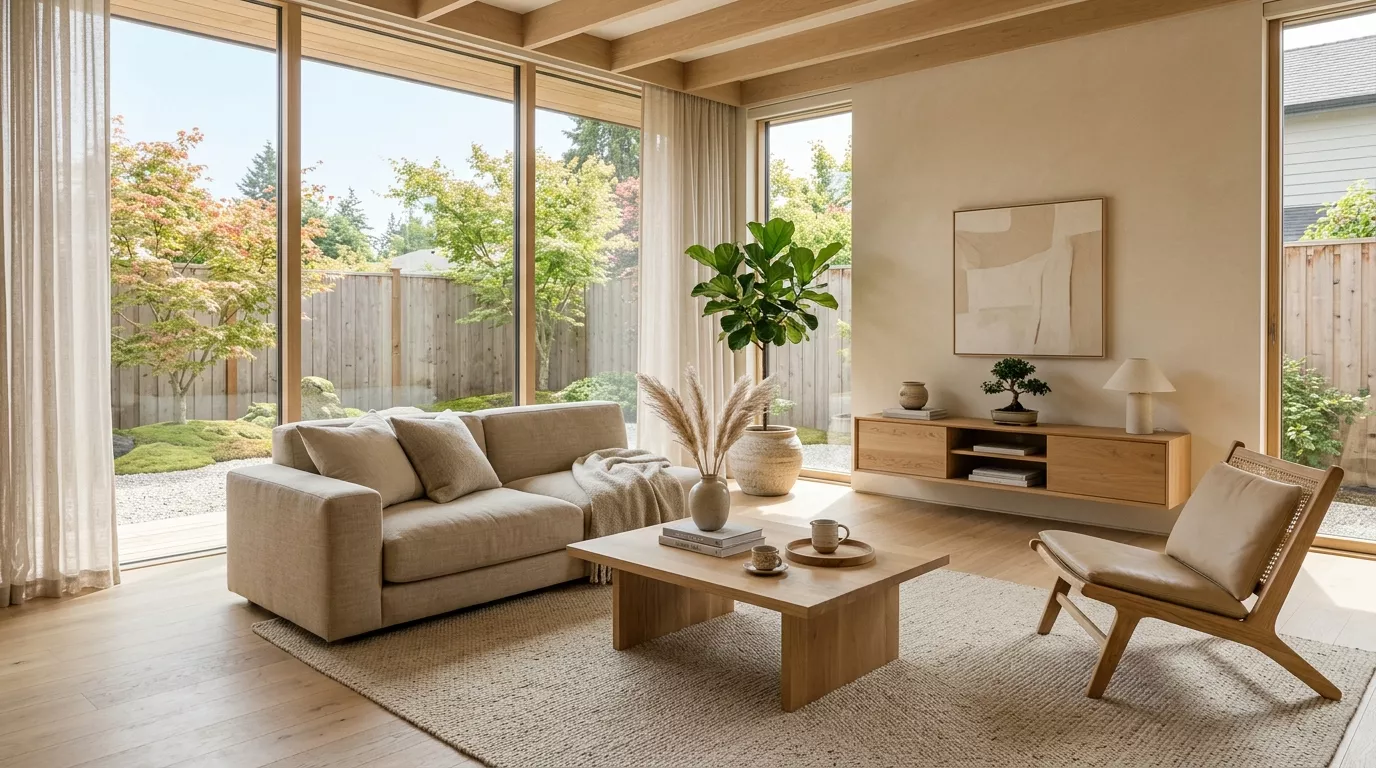
For curtains, always go sheer or semi-sheer. Heavy drapes block the natural light that makes coastal rooms feel so alive. White or cream linen panels that billow slightly in a breeze are the dream.
Lighting in a Coastal Living Room: Natural First, Warm Second

Natural light is your most powerful design tool. Keep windows as unobstructed as possible. If privacy is a concern, opt for light-filtering shades in white or natural linen rather than blackout curtains.
For artificial lighting, coastal rooms call for warm, relaxed illumination:
- Woven pendant lights: Rattan or seagrass pendant shades cast beautiful dappled light and are a signature coastal element
- Driftwood table lamps: Or ceramic lamps in soft blue or sandy tones with linen shades
- Floor lamps with natural bases: Bamboo, rattan, or whitewashed wood bases
- Candles: Always. Coastal living rooms love the warmth of candlelight, especially in the evenings
Avoid cold, harsh LED lighting. The coastal aesthetic is warm and golden, not clinical.
Coastal Living Room Ideas: Step-by-Step Transformation Guide
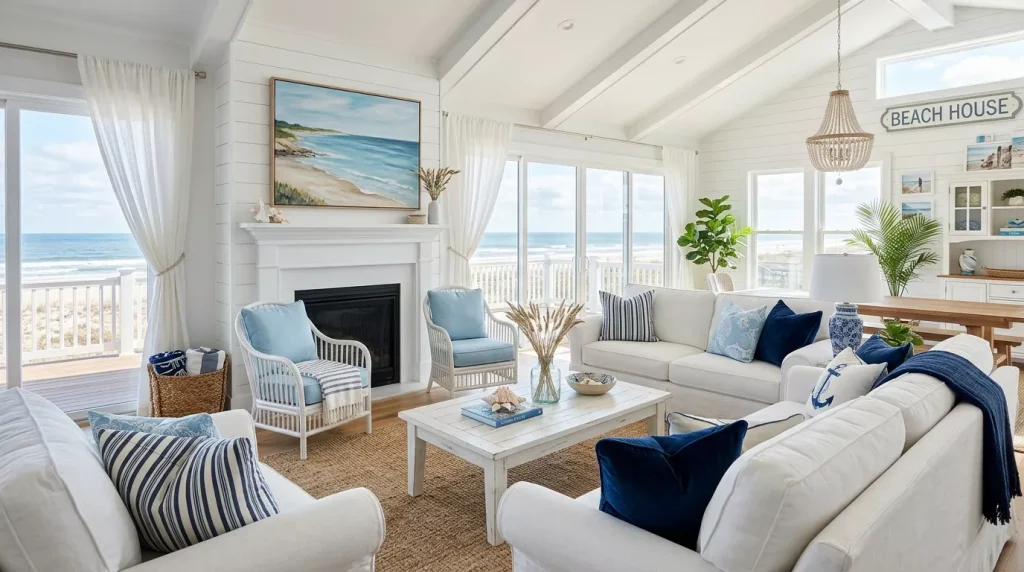
Whether you are starting from scratch or refreshing an existing room, this process will help you stay focused.
Step 1: Lighten the Walls If your walls are dark or heavily toned, repaint them. A warm white, soft cream, or very pale greige is your foundation. This single change will make the room feel immediately more open and coastal.
Step 2: Evaluate Your Existing Furniture What can stay? Anything in a neutral tone, natural material, or light wood can probably work. What needs to go? Dark, heavy, or ornate pieces that feel grounded and formal.
Step 3: Introduce a Natural Fiber Rug A jute, sisal, or seagrass rug is one of the most impactful and affordable coastal upgrades you can make. Choose a size that fits under the front legs of all your seating — this anchors the space.
Step 4: Update Your Soft Furnishings Swap cushion covers for linen, cotton canvas, or textured knits in ocean tones. Add a light throw in white, sandy beige, or soft blue. If your sofa is a dark color, consider a light slipcover.

Step 5: Hang Sheer Curtains Replace any heavy drapes with light, breezy linen or cotton curtains in white or cream. Hang them high — close to the ceiling — and wide — beyond the window frame — to maximize the sense of light and height.
Step 6: Add One or Two Rattan or Wicker Pieces An accent chair, a side table, a storage basket — any single rattan piece immediately reads “coastal” and adds fantastic texture.
Step 7: Curate Your Accessories Choose 5–8 meaningful accessories for the entire room. A driftwood bowl, a glass jar of sea glass, a large woven wall hanging, a palm plant, and two or three coastal-toned ceramics is genuinely all you need.
Step 8: Address Your Lighting Swap harsh ceiling fixtures for a woven pendant. Add a table or floor lamp with a natural base. Put candles on the coffee table. The room’s entire mood will shift.
Coastal vs. Other Popular Living Room Styles: A Comparison

| Style | Dominant Tones | Key Materials | Overall Feel |
|---|---|---|---|
| Coastal | Blues, whites, sandy neutrals | Linen, rattan, driftwood, jute | Breezy, relaxed, natural |
| Hamptons | Navy, white, grey | High-quality linen, polished wood | Elegant, refined coastal |
| Bohemian | Warm earth tones, rich colors | Rattan, macramé, silk, velvet | Eclectic, layered, free-spirited |
| Farmhouse | Warm whites, soft greens | Reclaimed wood, cotton, iron | Cozy, rustic, nostalgic |
| Japandi | Warm neutrals, deep accents | Oak, linen, ceramics | Minimal, calm, philosophical |
| Tropical | Bold greens, bright accents | Bamboo, banana leaf, bold prints | Vibrant, lush, exotic |
Coastal sits in a sweet spot between the elevated polish of Hamptons style and the carefree spirit of boho. It is one of the most accessible and family-friendly of all the design styles.
Pros and Cons of Coastal Living Room Style

✅ Pros
- Universally appealing: Few people feel stressed or uncomfortable in a coastal space. It is a crowd-pleasing aesthetic that works for almost everyone.
- Kid and pet friendly: The casual, relaxed nature of the style means it handles life — spills, sandy feet, muddy paws — with grace.
- Light and mood-boosting: The bright, airy palette genuinely lifts the energy of a room and the people in it.
- Flexible and scalable: You can go all-in with a full coastal renovation or simply add coastal accents to an existing room.
- Natural materials age well: Rattan, jute, and driftwood-style wood all look better with age and use.
❌ Cons
- Can feel too light in colder climates: Without careful layering, a very white-and-light coastal room can feel cold and unwelcoming in winter months.
- Slipcovers require maintenance: White linen slipcovers are beautiful but need regular washing.
- Can tip into cliché territory: Without restraint, it is easy to veer into over-themed “beach house gift shop” territory.
- Natural fiber rugs can be rough underfoot: Jute and sisal are not the softest underfoot, which matters if you have small children.
Tips for a More Polished Coastal Living Room

- Mix your blues. Rather than using one blue throughout, layer 2–3 shades — a soft powder blue cushion, a deeper navy throw, a slate-blue ceramic. This adds depth without visual chaos.
- Do not neglect the ceiling. Painting the ceiling a very soft sky blue or keeping it bright white makes the room feel taller and more open — a classic coastal trick.
- Use mirrors strategically. A driftwood-framed or whitewashed mirror reflects light and makes the room feel twice as large. Position it to bounce natural light from a window.
- Real plants over faux every time. Artificial plants break the natural, organic feeling instantly. If you cannot keep a plant alive, a simple dried pampas grass arrangement is a beautiful and low-maintenance alternative.
- Go big on the rug. Undersized rugs are one of the most common home decorating mistakes. In a coastal room, a generously sized jute rug grounds the whole space.
- Keep the floor visible. Light wood or whitewashed flooring showing around the edges of a rug reinforces the breezy, open feeling. Do not wall-to-wall carpet if you can help it.
Common Mistakes in Coastal Living Room Design

Mistake 1: Too Much Theme, Not Enough Style Filling a room with anchor prints, fish wall art, and “Seas the Day” signs makes a space feel like a souvenir shop rather than a home. One or two ocean-themed pieces — maximum. Let the colors and materials do the work.
Mistake 2: Using Cold, Stark White Instead of Warm White Not all whites are equal. A cool, blue-toned white will make a coastal room feel sterile and cold. Always choose warm whites, creamy whites, or whites with a slight yellow or beige undertone.
Mistake 3: Neglecting Texture A coastal room that relies only on color and ignores texture feels flat. The richness comes from layering jute, linen, rattan, wood grain, woven baskets, and ceramic surfaces.
Mistake 4: Poor Lighting Choices Installing bright, cool overhead lighting destroys the coastal atmosphere instantly. Layer warm lighting and prioritize natural light above everything else.
Mistake 5: Ignoring Scale A tiny rattan chair squeezed next to a giant sofa looks awkward. Make sure your furniture proportions work together — and never undersize your rug.
Mistake 6: Forgetting About Scent This is often overlooked but powerfully effective. A room that smells like the ocean — through candles, diffusers, or fresh air — completes the sensory experience in a way no amount of décor can.
FAQs About Coastal Living Room Ideas

Q1. Can I create a coastal living room without living near the beach?
Absolutely — and this is one of the great joys of coastal design. The style is about atmosphere and aesthetic, not geography. With the right palette, natural materials, and light management, you can bring the feeling of the coast to a city apartment, a countryside cottage, or anywhere in between. The ocean is just the inspiration; your living room is the canvas.
Q2. What is the best color for coastal living room walls?
Warm white or soft cream is the classic coastal choice for walls — it maximizes light reflection and creates a clean backdrop for ocean-toned accents. However, a very pale seafoam green or a soft, muted sky blue can also work beautifully as a feature wall if you want more color. Avoid very dark or saturated wall colors, which work against the airy quality of the style.
Q3. Is coastal style appropriate for small living rooms?
It is actually one of the best styles for small spaces. The light palette, emphasis on natural light, use of mirrors, and generally uncluttered aesthetic all make a small room feel noticeably larger and more open. The key in a small coastal room is to choose a slightly smaller scale of furniture, not to skip the style elements.
Q4. How do I add coastal style on a tight budget?
Start with paint — it is the most impactful and affordable change. Then focus on textiles: swap cushion covers, add a throw, change your curtains to sheer linen-look panels. Secondhand and thrift stores are fantastic for finding rattan pieces, wooden frames, and natural ceramics at low prices. A bag of shells displayed in a glass jar costs almost nothing and looks genuinely beautiful.
Q5. What plants work best in a coastal living room?
Plants that evoke tropical or coastal environments work best. Tall palms (like an areca palm or parlor palm), snake plants, bird of paradise, pothos, and succulents all fit naturally. For a less tropical and more restrained coastal look, a simple fiddle-leaf fig or even a large monstera works beautifully against a white coastal backdrop.
Q6. Can coastal style work in a north-facing room with limited natural light?
Yes, with some adjustments. Lean toward warmer whites and sandy neutrals rather than cool blues, which can feel cold without sunlight. Use warm-toned artificial lighting generously — table lamps, floor lamps, candles. Add mirrors to bounce what light there is. The richer textures of rattan and linen will carry warmth even when the light does not.
Q7. How is Hamptons style different from coastal style?
Hamptons is essentially a more polished, upscale version of coastal. It tends toward a navy and white palette, uses higher-quality and more formal materials (tailored upholstery, polished hardware, fine linen), and has a more structured, elegant feel. Coastal, by contrast, is more relaxed, more bohemian-friendly, more texture-heavy, and generally more accessible in terms of budget and lifestyle. Think of Hamptons as coastal in its Sunday best.
Conclusion: Bring the Shoreline Into Your Living Room
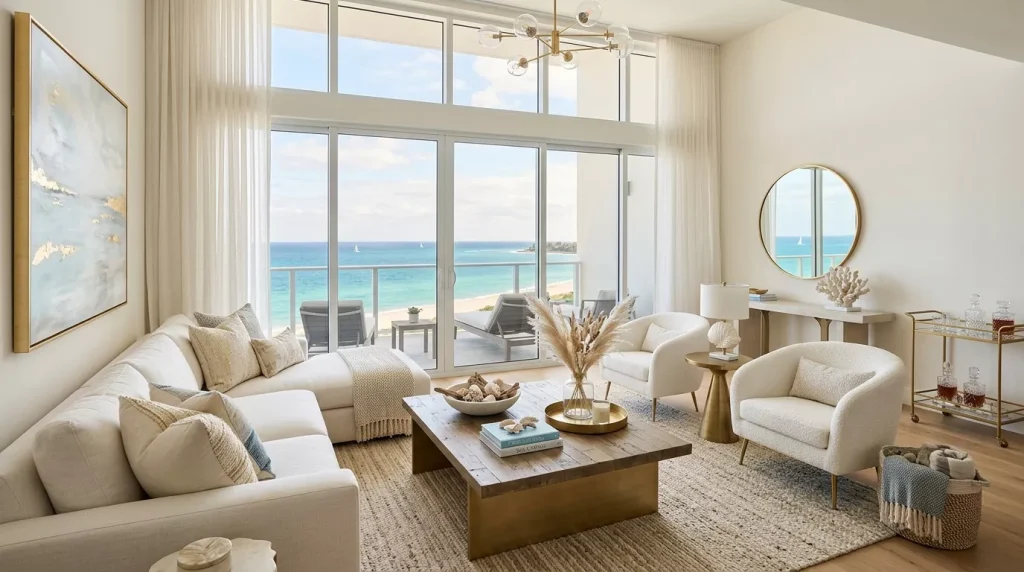
There is something timeless about the way a beautiful coastal living room makes you feel — open, relaxed, and gently reminded that life is meant to be enjoyed. The best part is, you do not need a beach house address or a designer’s budget to achieve it.
Start small if you need to. Repaint one wall. Swap your cushion covers. Roll out a jute rug. Bring in one rattan chair and a glass jar full of shells. You will be surprised how quickly a room begins to shift — how it starts to breathe differently, feel lighter, welcome you in a way it did not before.
Ready to create your own coastal retreat? Pick one room, choose your starting point from this guide, and begin. The coast is closer than you think.