Eclectic Living Room Ideas That Prove More Really Is More

Most design rules tell you to stick to one style, one era, one color story. Eclectic design throws those rules out the window — and somehow, it works brilliantly. Eclectic living room ideas are for the person who loves mid-century modern and Moroccan patterns equally, who can’t choose between vintage and contemporary, and who believes a space should feel like a world traveled rather than a catalog copied.
But here’s the thing — eclectic doesn’t mean chaotic. Done well, it’s the most intentional design style there is. Every choice matters precisely because there are no rigid formulas to fall back on.
This guide gives you everything you need to pull it off beautifully — from color strategy and furniture mixing to art, lighting, and the common mistakes that trip people up.
What Makes a Living Room Truly Eclectic?

Eclectic design is the art of combining elements from different styles, periods, and cultures in a way that feels cohesive rather than confused. The key word there is cohesive. It’s not about randomly piling things together — it’s about finding the visual threads that tie different elements into a unified, personal story.
Those threads might be color — a consistent warm tone running through otherwise very different pieces. Or material — natural wood showing up in a mid-century coffee table, a rustic carved frame, and an African stool simultaneously. Or scale — a bold oversized painting that anchors an otherwise varied wall display.
Eclectic design requires more thought, not less. But the reward is a room that is completely, authentically yours.
Eclectic vs. Other Mixed Styles — Understanding the Difference
| Style | How It Mixes | Rules It Follows | End Result |
|---|---|---|---|
| Eclectic | Periods, cultures, styles freely | Cohesion through color/texture/scale | Deeply personal, layered |
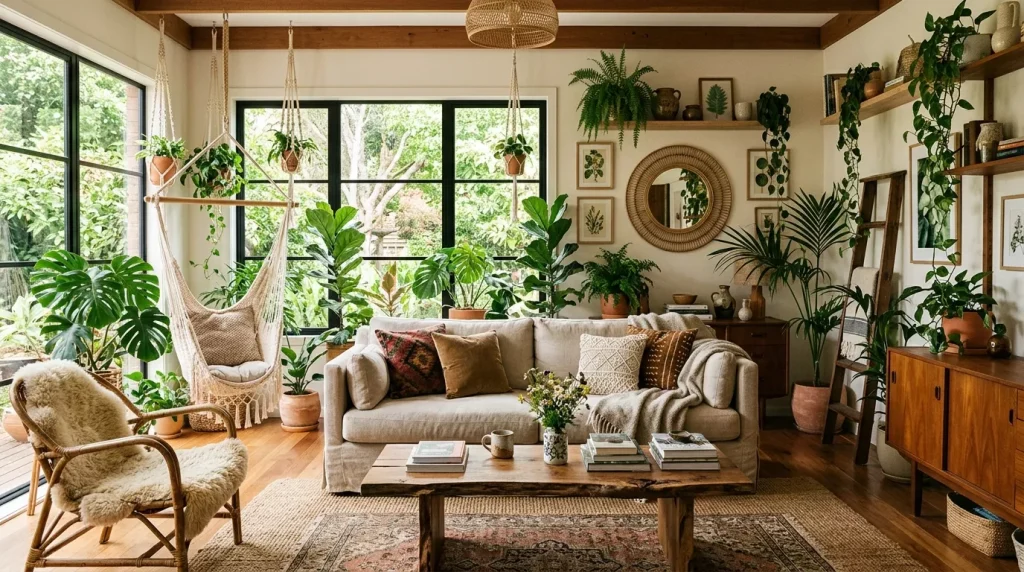
| Bohemian | Global textiles, natural materials | Earthy palette, organic feel | Free-spirited, relaxed |
| Transitional | Modern + traditional elements | Neutral palette, clean lines | Safe, balanced, elegant |
| Maximalist | More of everything | Pattern and color abundance | Bold, theatrical, loud |
| Collected | Curated objects over time | Object tells a story | Thoughtful, museum-like |

Eclectic borrows from all of these but commits fully to none. The distinguishing factor is the personal curation — an eclectic room reflects the specific individual who lives in it, not a trend or movement.
Eclectic Living Room Ideas: Building Your Design Foundation
1. Choose a Unifying Color Story — Your Secret Weapon
Here’s the most important truth about eclectic design: your color palette is what prevents the room from looking chaotic. It’s the invisible thread that ties a Japanese ceramic next to a Victorian armchair next to a Scandinavian side table into something that actually works.

Choose two or three colors that will appear consistently throughout the room — in different shades, materials, and proportions, but reliably present. Warm jewel tones are a popular eclectic choice: deep teal, burnt orange, mustard, and plum. Earthy neutrals also work beautifully as a base.
Eclectic color palettes that hold a room together:
- Warm neutrals (cream, camel, warm white) + jewel accents (emerald, sapphire, ruby)
- Deep charcoal base + warm brass + terracotta and rust accents
- Earthy ochre + cobalt blue + warm wood tones
- Soft blush and cream base + deep forest green + black iron accents
- Rich burgundy + mustard + natural rattan and linen


Whatever palette you choose, make sure it appears in at least 60% of the room’s surfaces and accents. The other 40% can introduce variety and surprise — but against a consistent color backdrop, those surprises read as intentional rather than random.
2. Mix Furniture Eras and Styles — The Bolder, the Better
The furniture in an eclectic living room should feel like it was collected across decades and continents — because ideally, it was. A mid-century modern sofa. A heavily carved antique side table. A sleek contemporary floor lamp. A low Moroccan pouf. All in the same room, all making sense together.
The way you make this work is through scale and material consistency. Keep your largest pieces (sofa, coffee table, bookcase) within a similar scale so the room feels balanced, then let the accent pieces be your wild cards.

Furniture combinations that define eclectic style:
- Mid-century modern sofa + antique carved wooden side table + contemporary marble coffee table
- Chesterfield sofa + industrial metal shelving + rattan accent chair
- Velvet maximalist sofa + sleek Scandinavian floor lamp + Moroccan pouf
- Victorian button-back armchair + modern acrylic side table + African wooden stool as a plant stand
- Streamlined contemporary sectional + heavily ornamented vintage mirror + woven jute ottoman

The coffee table is one of the best places to make an eclectic statement. An unexpected material — a hammered brass tray table, a reclaimed wood slab on iron hairpin legs, a stack of lacquered vintage suitcases — signals immediately that this room plays by its own rules.
3. Eclectic Living Room Pattern Mixing — The Rule-Breaking Art
If color is your safety net, pattern is where eclectic design gets to truly express itself. Mixing patterns is an art form — and when done well, it’s one of the most visually exciting things you can do in a room.

The trick is to vary the scale of your patterns. A large-scale geometric rug can co-exist beautifully with medium-scale floral cushions and a small-scale striped throw — because they’re different enough in size to not compete with each other.
Pattern mixing guide for eclectic rooms:
- Large scale: Geometric or abstract rug, large floral wallpaper, bold oversized print curtains
- Medium scale: Floral or botanical cushions, striped upholstery, check or plaid throws
- Small scale: Embroidered details, delicate tile-print accents, fine stripe or polka-dot liners
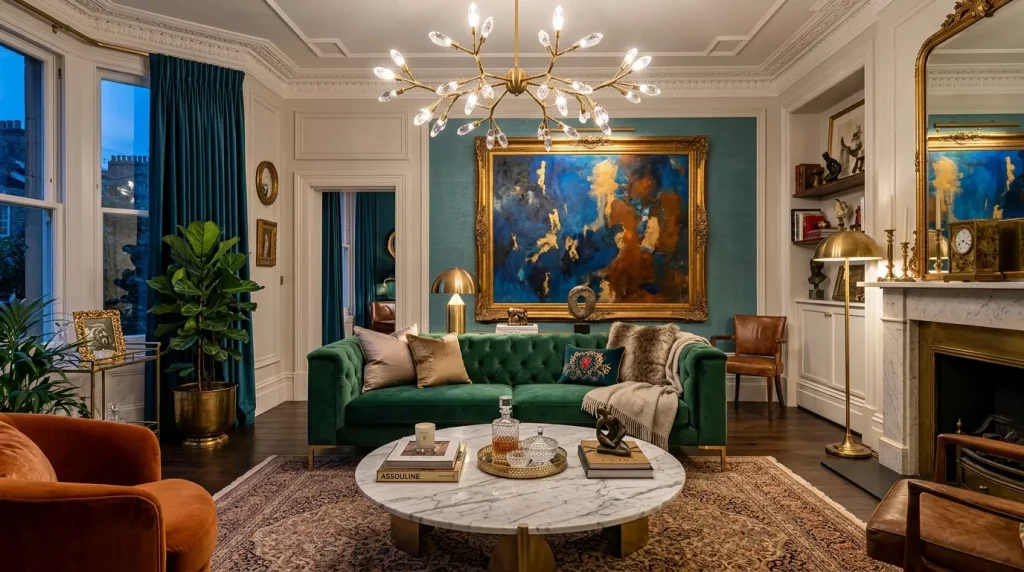
Pattern combinations that work:
- Geometric + floral + stripe (classic eclectic trio)
- Abstract + animal print + plaid
- Moroccan tile pattern + botanical print + solid velvet
- Ikat + buffalo check + paisley

Keep at least one solid element anchoring each major surface. Your sofa might be solid velvet — but the cushions go wild. Your curtains might be a large floral — but the rug stays geometric. That balance prevents overwhelm.
4. The Eclectic Gallery Wall — Where Your Story Lives
An eclectic gallery wall is different from a standard one. It doesn’t stick to one frame finish, one art style, or one color story. It mixes oil paintings with photography with hand-drawn illustrations with three-dimensional wall objects — and it looks intentional because the arrangement itself is thoughtful.

Building an eclectic gallery wall:
- Start by collecting pieces you genuinely love — don’t shop specifically for the wall
- Include varied media: a painted canvas, framed photography, a woven wall hanging, a decorative plate, a small mirror
- Mix frame finishes: aged gold, matte black, natural wood, no frame at all (canvas)
- Keep a consistent space between pieces (3–4 inches) for a clean arrangement
- Anchor with one large piece and build outward asymmetrically
- Add one three-dimensional element — a small shelf, a sconce, a sculptural object — for depth

The eclectic gallery wall works best on a large, open wall behind the sofa or as a full staircase feature. Give it room to breathe and tell its full story.
5. Global and Vintage Accents — The Soul of Eclectic Design
What separates a truly eclectic room from a merely mixed one is the presence of objects with genuine character — pieces that have traveled, aged, been handmade, or been inherited. These are the objects that give the room its soul.
Global and vintage accent ideas:
- Moroccan lanterns in hammered brass or colored glass
- African carved wooden stools used as side tables or plant stands
- Indian block-printed textiles as cushion covers or wall hangings
- Japanese ceramic vases with imperfect, wabi-sabi glazes
- Turkish kilim or Persian rug layered over a solid base rug
- South American woven baskets used for storage and display
- Vintage globes, maps, or travel ephemera framed as art
You don’t need to have actually visited every place these objects come from — but buy from artisans and makers who represent those traditions authentically. The story behind an object deepens its presence in the room.
6. Eclectic Living Room Lighting — Sculptural, Layered, Unexpected
In an eclectic room, light fixtures are not an afterthought. They’re statement objects in their own right — chosen for their sculptural quality as much as their function.
Mix your fixture styles just as you mix your furniture. A Moroccan lantern pendant above the coffee table. Industrial wall sconces flanking the gallery wall. A sleek arc floor lamp behind the reading chair. A collection of mismatched table lamps — one ceramic, one brass, one sculptural concrete.
Eclectic lighting ideas:
- Moroccan star lantern pendant (dramatic focal point)
- Industrial Edison bulb cage pendant
- Oversized rattan or woven pendant shade
- Vintage Hollywood regency table lamp with a fringed shade
- Sculptural ceramic table lamp in a bold color
- Mixed-metal floor lamp — brass base with a black iron arm
- LED strip lighting behind shelving for a contemporary contrast
The juxtaposition of traditional and contemporary in your lighting choices is very eclectic — and very striking.
Step-by-Step Guide: How to Design an Eclectic Living Room
Step 1: Define your anchor color palette. Pick two or three colors that will run consistently through the room. These become the invisible thread holding everything together.
Step 2: Choose your anchor furniture first. Start with your sofa — the largest piece. Pick a style, color, and era. Everything else will dialogue with it.
Step 3: Select your rug. In an eclectic room, the rug is often the most patterned piece. Choose it early — it will inform which other patterns and tones you bring in.
Step 4: Add furniture from different eras. Your coffee table, accent chair, and side tables should feel like they came from different decades or cultures — but share material, scale, or color DNA with your anchor pieces.
Step 5: Build your gallery wall. Collect pieces over time or pull from what you already own. Mix media, mix frames, mix scale. Arrange on the floor before committing to the wall.
Step 6: Layer your patterns. Introduce patterns through cushions, throws, and curtains in varying scales. Keep at least 40% of surfaces solid to avoid overwhelm.
Step 7: Add global and vintage accents. Style your surfaces with objects that have character — handmade ceramics, global textiles, vintage finds, family heirlooms, travel souvenirs.
Step 8: Layer your lighting. Add ambient, task, and accent lighting with fixtures from mixed styles and eras.
Step 9: Bring in plants. Oversized statement plants — a dramatic bird of paradise, a sprawling monstera — add scale and life. Mismatched pots from different cultures reinforce the eclectic narrative.
Step 10: Edit for intention. Walk away, come back with fresh eyes, and remove anything that doesn’t contribute to the color, story, or balance of the room. Eclectic is curated, not collected indiscriminately.
Pros and Cons of Eclectic Living Room Design
✅ Pros
- Completely personal — no two eclectic rooms look alike, ever
- No rules to break — it’s the most creatively liberated design style
- Evolves beautifully over time — new finds slot in naturally
- Second-hand and vintage-friendly — mismatched pieces are an asset
- Tells a real story — objects with history make rooms feel alive
- Budget-flexible — investment pieces mix with thrift finds seamlessly
- Never boring — there’s always something new to notice
❌ Cons
- Easy to tip into chaos — without a unifying strategy, it becomes visual noise
- Requires strong design instinct — harder to execute than a single-style room
- Time-consuming to curate — great eclectic rooms are built gradually, not overnight
- Can feel overwhelming in photography — harder to capture in listing photos if selling
- Needs regular editing — as you add pieces, old ones may need to be removed
- Not everyone’s taste — guests may love it or find it too busy
Common Mistakes That Kill Eclectic Design
1. Confusing eclectic with random. The biggest mistake. Eclectic requires intention. Before adding any new piece, ask: does this share a color, material, or story thread with what’s already here? If not, it’s clutter, not character.
2. Too many equal-weight patterns. When every surface fights for visual attention with an equally bold pattern, the room becomes exhausting. Let one pattern dominate, support it with medium ones, and use solids as breathing room.
3. Ignoring scale. Mixing styles works — mixing poorly scaled pieces doesn’t. A tiny side table next to a massive sofa, or a small artwork on a vast wall, breaks visual harmony regardless of how interesting the piece is.
4. Shopping “eclectically” all at once. Buying ten different-style pieces in one shopping trip creates a showroom, not a curated space. The best eclectic rooms are built over months and years — each piece genuinely discovered and chosen.
5. Forgetting negative space. Eclectic doesn’t mean every inch must be covered. Negative space — empty wall sections, clear shelf surfaces, breathing room around furniture — is what makes the curated pieces stand out.
6. Letting the palette go completely wild. You can mix every style and era in the world — but if the colors don’t share some relationship, the room won’t hold together. Limit your dominant tones even as you expand everything else.
Tips for Nailing Your Eclectic Living Room
- Start with what you love. Don’t try to engineer an eclectic room from scratch. Begin with the pieces you’re already attached to — a rug, a painting, a chair — and build the room around them.
- Use the “triangle trick” for color. Whatever accent color you introduce, repeat it in at least three places across the room. This creates visual rhythm without rigidity.
- Layer rugs for instant eclecticism. A geometric kilim layered over a natural jute rug is one of the quickest ways to introduce pattern, culture, and texture simultaneously.
- Don’t overlook books. Stacked books with beautiful spines, sorted loosely by color on shelves or coffee tables, add color, texture, and personality to any surface.
- Let one piece be the conversation starter. Every great eclectic room has one object that makes guests ask about it — a sculptural lamp, an unusual art piece, a handcarved stool. Lead with that story.
- Introduce plants generously. Oversized tropical plants in mismatched pots are deeply eclectic and add scale, life, and warmth to rooms that might otherwise feel like a collection of objects.
- Mix your metals confidently. Brass, black iron, copper, and chrome can all coexist in an eclectic room — as long as each finish appears more than once so it looks intentional.
Eclectic Living Room Design — Quick Reference Checklist
| Element | Eclectic Approach | Watch Out For |
|---|---|---|
| Color palette | 2–3 consistent anchor tones | Too many competing colors |
| Furniture | Mix of eras, styles, origins | Clashing scales |
| Patterns | Vary large, medium, small scale | All patterns at equal intensity |
| Art | Mixed media, mixed frames | All one style or all one size |
| Lighting | Sculptural, mixed-style fixtures | All matching fixtures |
| Plants | Varied, abundant, mismatched pots | Ignored or forgotten |
| Accents | Global, vintage, handmade | All from one store or era |
| Negative space | Intentional breathing room | Over-stuffed surfaces |
Frequently Asked Questions (FAQs)
Q1. What exactly are eclectic living room ideas?
Eclectic living room ideas refer to design approaches that intentionally mix furniture styles, periods, patterns, and cultural influences to create a highly personal, layered space. Unlike single-style rooms that follow rigid rules, eclectic design uses a unifying color palette or material thread to bring diverse elements into a cohesive whole that feels unique to the person who lives there.
Q2. How do I stop an eclectic room from looking messy?
The key is a consistent color palette running through the room, intentional editing, and respecting scale. Every piece you add should share at least one visual quality — color, material, or scale — with what’s already there. Regular editing is essential too: as you add new pieces, remove ones that no longer serve the room’s overall balance.
Q3. Can beginners pull off eclectic design?
Yes — but it takes patience. The best approach for beginners is to start with pieces they genuinely love, choose an anchor color palette early, and build gradually rather than trying to furnish the room all at once. Eclectic rooms that feel authentic are almost always built over time, not designed in a single shopping weekend.
Q4. What is the difference between eclectic and maximalist design?
Maximalist design intentionally fills every surface with color, pattern, and objects — more is more by philosophy. Eclectic design mixes styles and eras but doesn’t necessarily require abundance. An eclectic room can be relatively restrained — what makes it eclectic is the intentional mixing of different design languages, not necessarily the volume of what’s present.
Q5. How do I mix patterns in an eclectic living room without it looking wrong?
The golden rule is to vary the scale of your patterns. Pair a large-scale geometric rug with medium-scale floral cushions and a small-scale stripe throw — because they’re different in size, they complement rather than compete. Also anchor pattern-heavy areas with solid elements: a solid sofa lets the cushions and rug go wild without visual overload.
Q6. What furniture styles work best together in an eclectic room?
Mid-century modern pairs beautifully with antique, Scandinavian with global artisan pieces, and industrial with ornate Victorian — because the contrast itself creates the visual interest. The rule of thumb: pair at least one clean-lined contemporary piece with one more ornate or aged piece, and let your color palette and one shared material (wood, brass, natural fiber) tie them together.
Q7. Is eclectic design expensive?
It doesn’t have to be. In fact, eclectic design is one of the most budget-friendly approaches precisely because mismatched and second-hand pieces are not just acceptable — they’re ideal. Charity shops, vintage markets, estate sales, and online marketplaces are the perfect hunting grounds. Mix one or two investment pieces with thrifted finds and the result often looks more authentic than a fully purchased-new room.
Conclusion: Your Eclectic Living Room, Your Masterpiece
Eclectic living room ideas are ultimately a permission slip. Permission to love the Moroccan rug and the mid-century sofa and the antique oil painting and the modern floor lamp — all at the same time, all in the same room, all unapologetically yours.
The rooms that genuinely make people stop and stare are rarely the perfectly coordinated ones. They’re the rooms that feel lived-in, collected, personal, and layered — rooms that say something true about the person who designed them.
You already have the raw material: your taste, your travels, your memories, your finds. The framework in this guide gives you the strategy to bring it all together beautifully.
Pick one element — a rug, a gallery wall, a pattern-mixed cushion collection — and let that be your starting point. The rest of your eclectic living room will find its way to you.