Cottage Garden Ideas to Transform Your Outdoor Space

Cottage Garden Ideas to Transform Your Outdoor Space
At a Glance: Cottage garden ideas are all about layered planting, relaxed structure, and a riot of seasonal colour. Whether you have a sprawling backyard or a modest front plot, this guide will walk you through everything you need to create a garden that feels genuinely alive — and effortlessly beautiful.
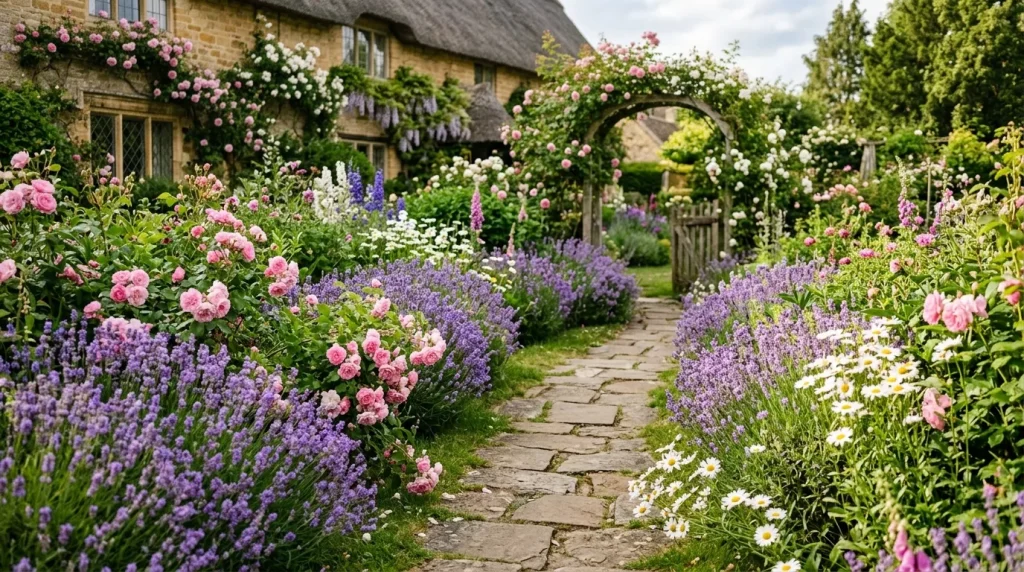
There’s something deeply satisfying about a well-planted cottage garden. It looks almost accidental — roses tumbling over fences, foxgloves standing tall between lavender clouds, bees going absolutely wild — but behind every great cottage garden is a set of deliberate choices made by someone who understood what they wanted and how to get it.
The good news? Cottage garden ideas are among the most forgiving in all of horticulture. This style actively celebrates imperfection. Plants are allowed to self-seed, paths can be wonky, and rules are more like suggestions. If you’ve been putting off creating your dream outdoor space because you thought it would be too complicated or expensive, a cottage garden might be exactly what you’ve been waiting for.
This guide covers everything — from the best plants and colour combinations to layout principles, step-by-step planning, common pitfalls, and practical tips that will save you time and money. Let’s dig in.
What Actually Makes a Cottage Garden a Cottage Garden?
Before you start ordering plants, it helps to understand what defines the style — because “cottage garden” means something quite specific, even if it looks gloriously chaotic at first glance.
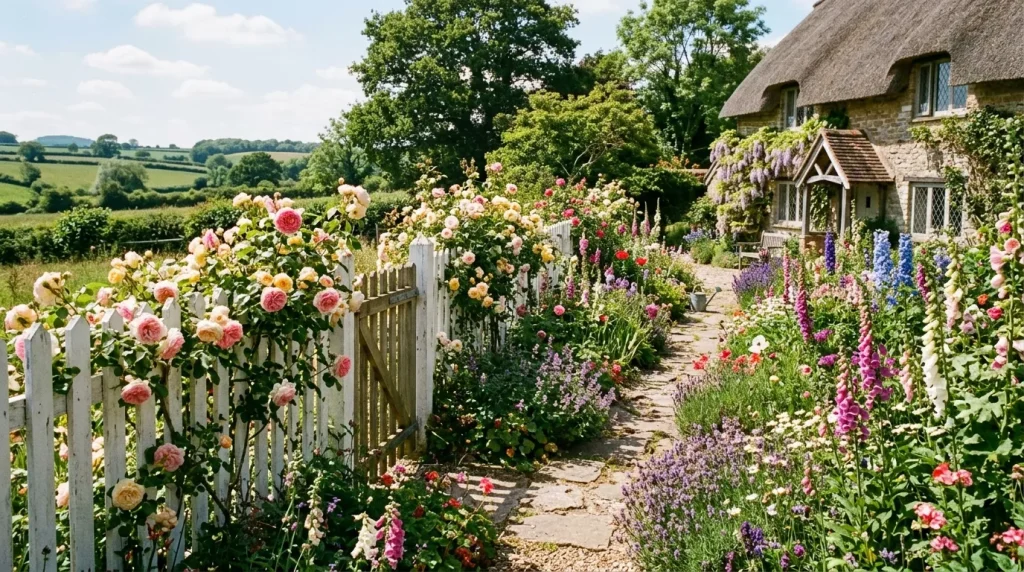
A true cottage garden is rooted in the English tradition of mixing flowers, herbs, fruit, and vegetables in a dense, informal layout. The style evolved in rural England where working-class families grew everything they needed in a small plot — practicality and beauty living side by side.
Today, the style is more about the aesthetic than the function, but its defining qualities remain:
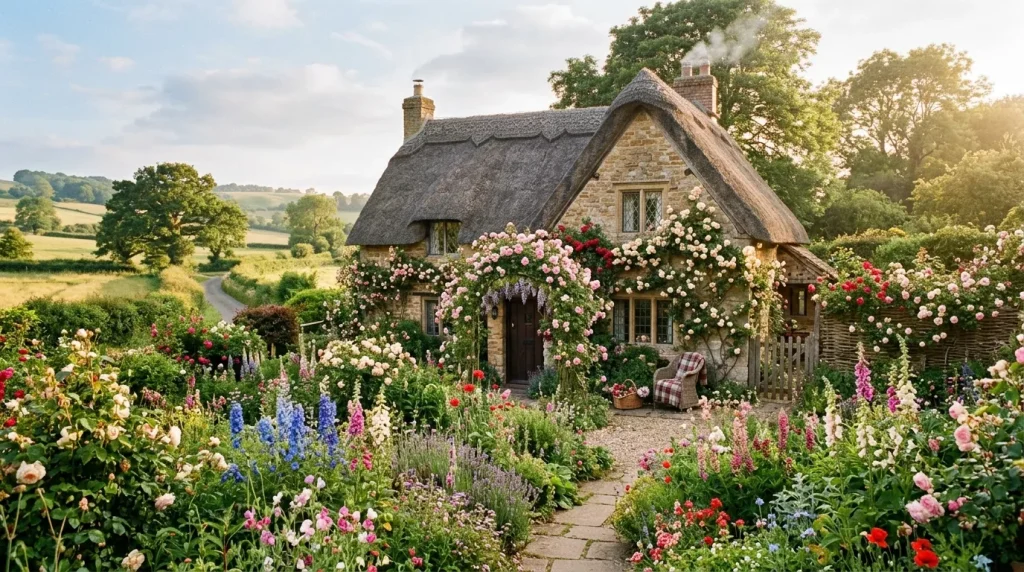
- Dense, layered planting with little bare soil visible
- A mix of annuals and perennials that provide seasonal succession
- Old-fashioned, romantic flowers as the backbone of the design
- Naturalistic growth allowed — plants lean, sprawl, and self-seed
- Structural elements kept soft: low picket fences, rustic arches, simple stone paths
- A sense of abundance rather than restraint
Crucially, cottage gardening isn’t about neglect. It’s about creating the conditions for plants to thrive and then stepping back to let them do their thing. There’s a skill to that — and this guide will help you build it.
Cottage Garden Ideas for Every Type of Space
One of the greatest things about this style is how well it scales. The principles remain the same whether you’re working with a generous rural plot or a tight urban front garden.
Small Front Garden Cottage Style
A small front garden is actually an ideal canvas for cottage planting. Scale is your friend here — smaller plants look proportionate, and even a modest 3×4 metre plot can hold an impressive variety of species if you plant densely.
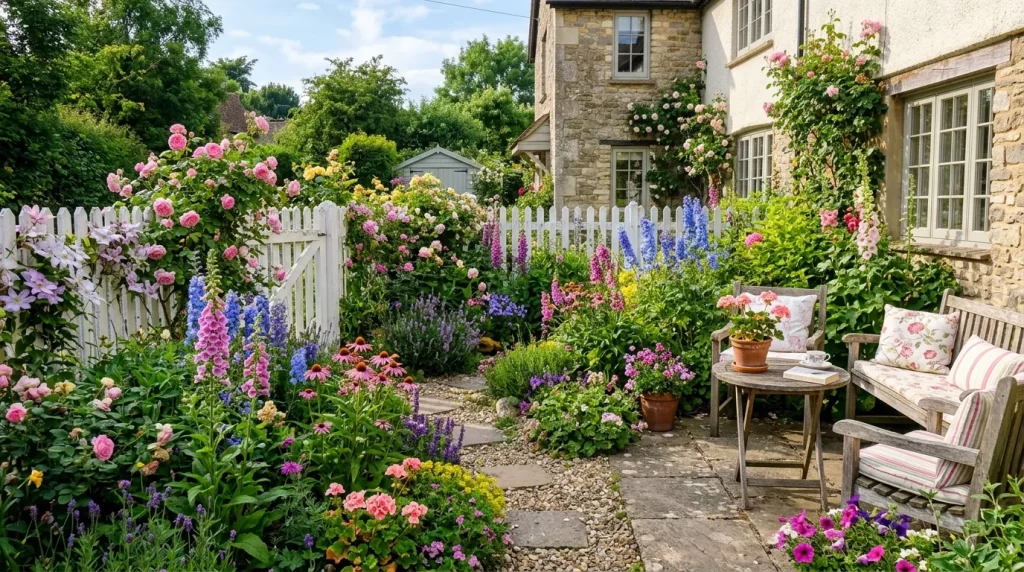
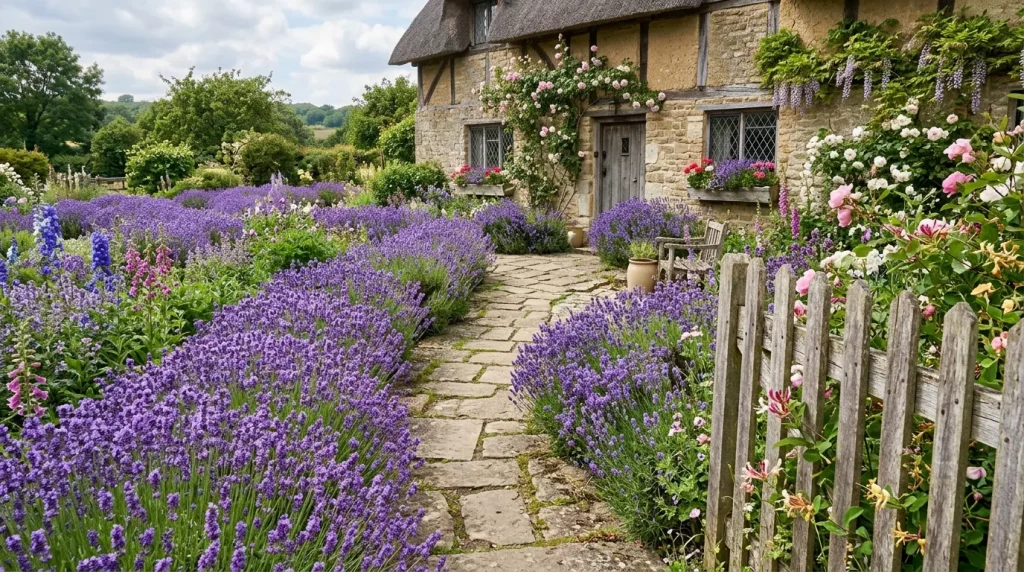
Focus on a simple path leading to the door, flanked by planting on both sides. Use climbers on the fence or wall to add vertical interest without eating into floor space. Roses, sweet peas, and clematis are all brilliant choices. Fill the borders with a mix of lavender, catmint, and hardy geraniums at the front, then foxgloves and hollyhocks toward the back.
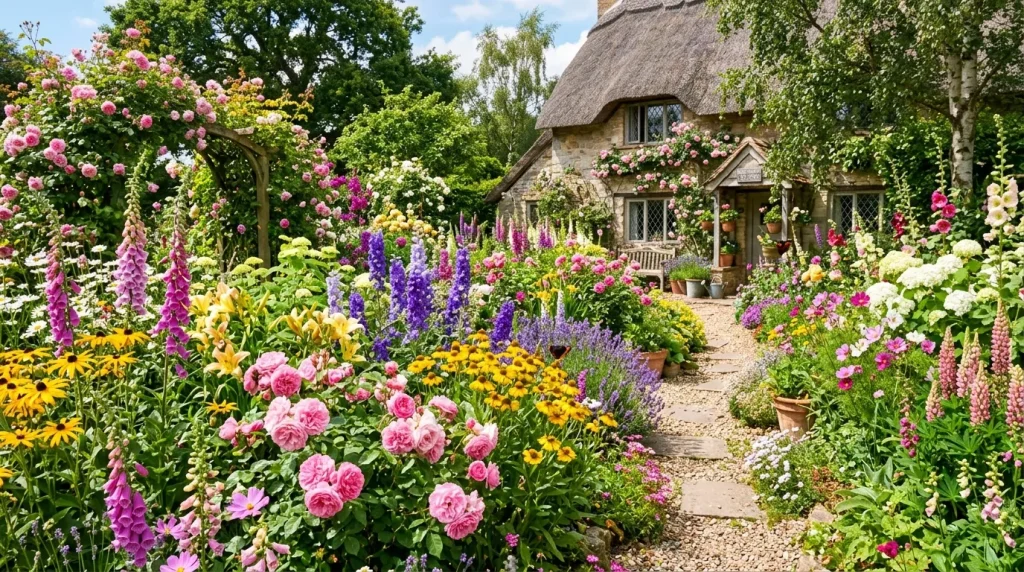
A small picket fence or low box hedge along the street edge finishes the look perfectly — it creates a gentle boundary without feeling unwelcoming.
Backyard Cottage Garden Ideas
A back garden gives you more room to play. Consider breaking the space into distinct zones: a central lawn or gravel area (which becomes the breathing space between your borders), deep planting beds along the boundaries, and perhaps a small seating area tucked into a corner where you can actually sit and enjoy what you’ve created.
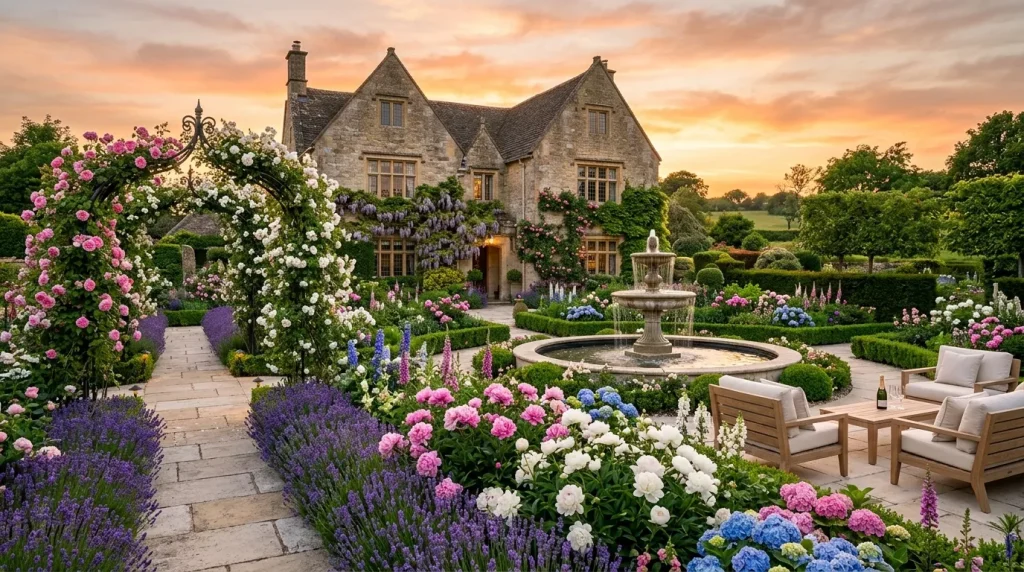
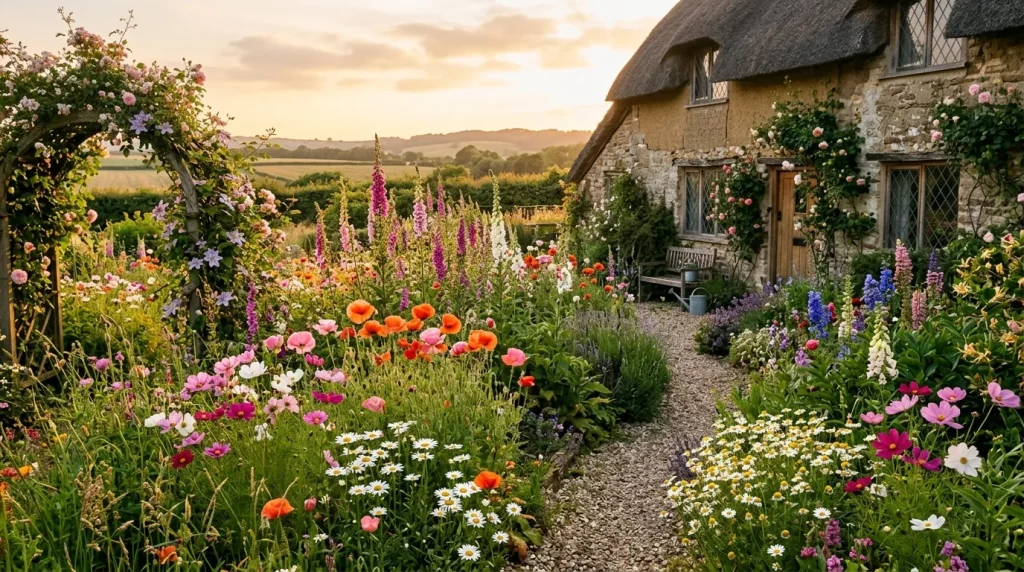
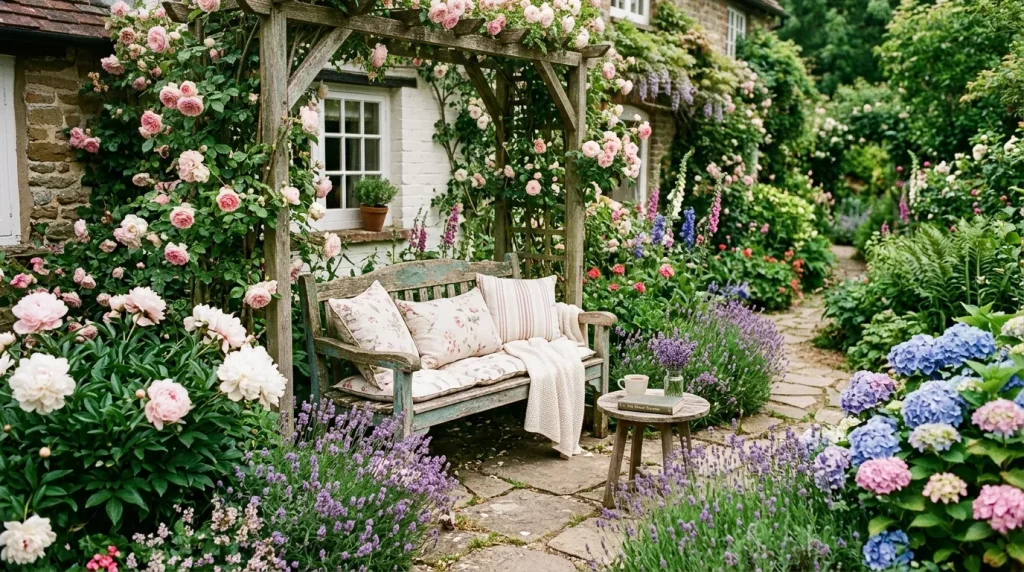
Use a garden arch or pergola draped in climbing roses as a focal point. This adds height and creates that romantic, enveloping feel that cottage gardens are known for. Rambling roses like ‘Veilchenblau’ or ‘Paul’s Himalayan Musk’ are perfect for this — they’re vigorous, fragrant, and spectacular in early summer.
Dealing With Shade in a Cottage Garden
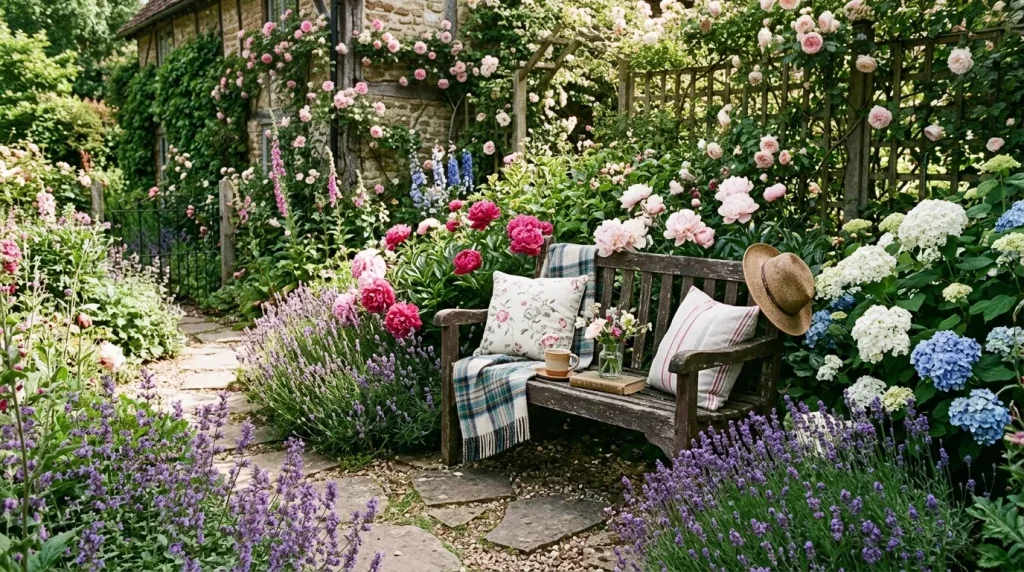
Shade doesn’t have to mean sacrifice. Plenty of classic cottage garden plants actually prefer it — or at least tolerate it happily. Foxgloves, astrantia, aquilegia, hardy ferns, and hostas all thrive in partial shade and fit naturally within the cottage aesthetic.
In deeper shade, focus on foliage interest alongside flowers. The contrast of large hosta leaves against delicate fern fronds creates texture that holds up even without constant bloom.
The Best Plants for Your Cottage Garden Ideas
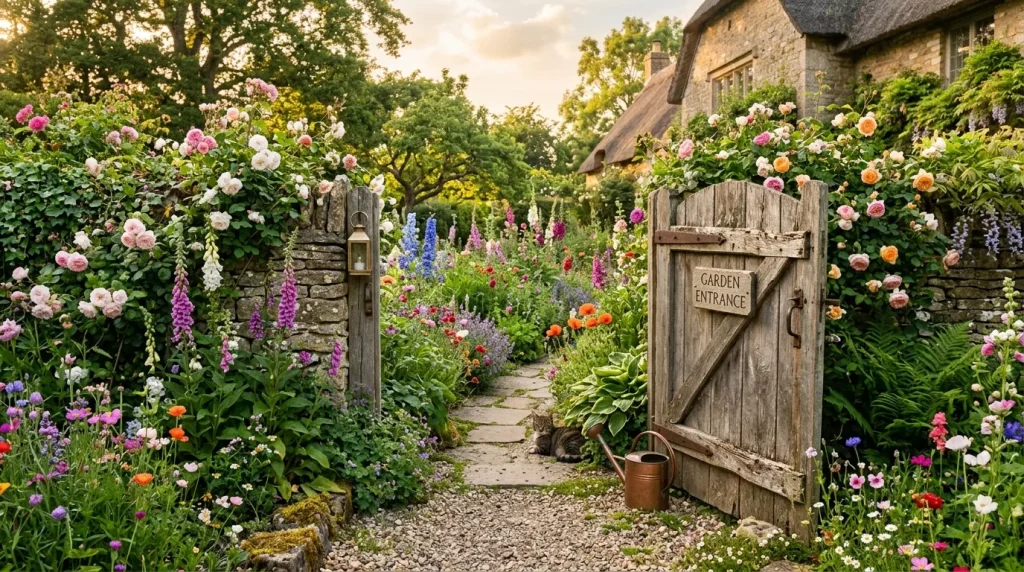
Plant choice is the heart of any cottage garden. You’re aiming for a mix of heights, bloom times, and textures — all working together to create something that looks full and flowing from early spring right through to autumn.
Here’s a curated breakdown of the essential plant categories:
Tall Backbone Plants (Back of Border)
Hollyhocks, delphiniums, verbascum, foxgloves (Digitalis), and ornamental grasses. These give vertical drama and create the backdrop everything else plays against.
Mid-Border Fillers
Roses, peonies, lavender, catmint, hardy geraniums, echinacea, and achillea. These are your workhorses — long-blooming, reliable, and beautiful.
Front Edge and Path Plants
Alchemilla mollis (lady’s mantle), violas, primroses, low-growing sedums, and thyme. These spill gently over path edges and soften hard lines brilliantly.
Climbers and Scramblers
Climbing roses, sweet peas, clematis (particularly the viticella types), and nasturtiums. These add the vertical dimension that makes a cottage garden feel truly lush.
When selecting plants, aim for a seasonal succession. You want something interesting happening from February (snowdrops, hellebores) right through to November (asters, sedums, ornamental grasses holding their form). The table below offers a practical seasonal guide:
Self-Seeders to Welcome
Aquilegia, nigella (love-in-a-mist), Verbena bonariensis, Californian poppy, and foxgloves. Allow these to move around your garden freely — they’ll fill gaps and create delightful surprises.
| Season | Key Plants | What to Expect |
|---|---|---|
| Early Spring | Snowdrops, hellebores, primroses, tulips | Delicate colour after winter; great under deciduous shrubs |
| Late Spring | Aquilegia, alliums, forget-me-nots, peonies | The garden wakes up properly; blues and purples dominate |
| Early Summer | Roses, foxgloves, delphiniums, sweet peas | Peak cottage garden season; maximum colour and fragrance |
| Midsummer | Lavender, echinacea, achillea, catmint | Heat-tolerant plants keep the show going; great for pollinators |
| Late Summer | Rudbeckia, Verbena bonariensis, dahlias, cosmos | Warm sunset tones; evening light makes these spectacular |
| Autumn | Asters, sedums, ornamental grasses, anemones | The garden winds down gracefully; structure holds through to winter |
How to Design a Cottage Garden: Step by Step
Planning matters here — even though the end result should look effortless. A little upfront thinking prevents the common problem of everything blooming at once in June and then going completely quiet for the rest of the year.
1 Assess your space and conditions
Before you buy a single plant, understand your soil type, sun exposure, and drainage. Most cottage garden plants prefer free-draining soil in full sun. If your soil is heavy clay, improve it with grit and organic matter before planting. Know which areas get morning sun, afternoon sun, or sit in shade — this changes your plant palette significantly.
2 Sketch a rough layout
You don’t need precise technical drawings. A rough sketch on paper that marks your existing features (paths, fences, sheds, trees) and where your planting beds will go is enough. In cottage garden design, winding paths work better than straight ones — they create a sense of discovery and make even a small garden feel larger than it is.
3 Build your structural bones first
Install any hard elements — paths, arches, fences, raised beds — before you plant. These are your permanent framework. A simple wooden arch over a path, a low wicker fence, or a dry-stone wall edging a bed adds structure without the formality of clipped hedging or rigid geometry.
4 Choose your colour palette
Cottage gardens work beautifully in either a harmonious palette (pinks, purples, and whites for a romantic feel) or a more exuberant mix of all colours. The key is repetition — repeat the same plant or colour in several spots to tie the planting together, rather than using each plant just once which creates a spotty, disjointed look.
5 Plant in odd-numbered groups
Groups of three, five, or seven of the same plant look far more natural than rows of two or four. Plant the tallest plants toward the back (or the middle of an island bed), graduating down to lower plants at the front. Leave a little more space than you think you need — plants fill in quickly.
6 Fill gaps with annuals in your first year
New perennials take a season or two to establish and fill their space. Don’t let bare soil sit — sow hardy annual seeds like nigella, cosmos, and cornflowers directly into gaps. They’ll grow quickly, suppress weeds, and make your new border look established while the perennials are getting their roots down.
7 Mulch, then step back
Apply a thick layer of garden compost or bark mulch around new plants to retain moisture and suppress weeds. Then — and this is the hardest part — resist the urge to constantly tidy. Allow self-seeding to happen. Let plants lean on each other. That relaxed, naturalistic effect you’re after develops when you stop fighting the garden’s natural inclinations.
Cottage Garden vs. Other Popular Garden Styles
Not sure if cottage garden is the right style for you? Here’s how it stacks up against other popular approaches:
| Style | Key Characteristics | Maintenance Level | Best For |
|---|---|---|---|
| Cottage Garden | Dense, informal, flower-rich, romantic | Medium (rewarding, not rigid) | Anyone who loves plants and colour |
| Formal Garden | Clipped hedges, symmetry, geometric beds | High (regular clipping essential) | Those who like order and precision |
| Contemporary/Minimalist | Clean lines, limited palette, structure-led | Low to medium | Modern homes, smaller plots |
| Wildlife Garden | Native plants, log piles, minimal intervention | Very low | Eco-conscious gardeners |
| Mediterranean Garden | Drought-tolerant, silvery foliage, gravel | Low (once established) | Sunny, dry gardens; low-water situations |
| Kitchen Garden | Edible plants, raised beds, productivity focus | High (ongoing harvesting and replanting) | Those who want homegrown food |
The honest verdict? Cottage gardening sits in the sweet spot for most home gardeners. It’s more forgiving than formal, more colourful than contemporary, and more immediately rewarding than a wildlife-first approach — especially in the first couple of years when you want to actually see results.
Pros and Cons of Cottage Garden Ideas
✅ Pros
- Forgiving of imperfection — self-seeding fills gaps naturally
- Huge biodiversity appeal: bees, butterflies, and birds love it
- Looks beautiful across multiple seasons with the right plant mix
- Incredibly fragrant — especially with roses, lavender, and sweet peas
- Can be done on a modest budget using seeds and divisions
- Endlessly customisable to any colour palette or size
- Genuinely enjoyable to maintain — not a chore-heavy style
❌ Cons
- Can look untidy in winter without structural evergreens
- Requires regular deadheading to prolong blooms
- Self-seeders can become invasive if not monitored
- Dense planting can sometimes encourage slugs and aphids
- Takes 2–3 seasons to reach peak maturity and fullness
- Not ideal for very formal or minimalist home settings
💡 Tips for a Cottage Garden That Genuinely Thrives
- Grow from seed where you can. Cottage garden plants like nigella, sweet peas, foxgloves, and cosmos are all brilliantly easy from seed and dramatically cheaper than buying plug plants. Start seeds in late winter indoors or direct sow outdoors in spring.
- Embrace the “wrong” plant in the right place. If a foxglove self-seeds somewhere unexpected and it looks great there, leave it. The garden often knows better than the plan.
- Deadhead regularly, but not everything. Deadhead roses and dahlias to extend flowering. But leave seedheads on nigella, aquilegia, and Verbena bonariensis — they self-seed freely and the seedheads are beautiful in their own right.
- Add a rose, always. No cottage garden feels truly complete without at least one rose. Even the smallest space can accommodate a compact shrub rose like ‘The Fairy’ or a single climbing rose trained against a fence.
- Use gravel paths, not decking. Gravel blends far more naturally into a cottage planting scheme than wooden decking. It also allows self-seeders to colonise the path edges in that characteristically charming, relaxed way.
- Plant in autumn if you can. Autumn-planted perennials and roses establish much better than spring-planted ones — they put roots down through the winter and hit the ground running come spring.
Common Mistakes to Avoid With Cottage Garden Ideas
- Planting everything at the same height: A great cottage border has a clear sense of layers — tall at the back, medium in the middle, low at the front. Without this, the planting looks flat and the individual plants compete rather than complement each other.
- Using only summer-blooming plants: Many beginners plant for June and wonder why the garden looks dull by August. Always think in seasons and make sure you have plants that carry colour from early spring through to late autumn.
- Over-tidying: Cutting everything down in autumn and clearing all seedheads is one of the most common mistakes. It removes food for birds, shelter for overwintering insects, and strips away the structural beauty that carries the garden through winter. Leave it until late February or early March.
- Ignoring soil preparation: Cottage garden plants are generous — but they aren’t magic. Thin, compacted, or waterlogged soil will always let you down. Dig in generous amounts of garden compost before planting and you’ll notice the difference in the very first season.
- Planting in straight lines: Regimented rows look nothing like a cottage garden. Plant in drifts — flowing, irregular groups that weave between each other. Think of how plants grow in nature rather than how they’re arranged in a garden centre.
- Buying too many different species: It’s tempting at a plant nursery to grab one of everything. But a border with fifty different plants used once each never settles into a coherent look. Choose twenty or so plant types and use multiples of each. Repetition creates rhythm.
Cottage Garden Ideas for a Wildlife-Friendly Space
One of the greatest side effects of cottage gardening is what it does for wildlife. The dense, varied planting that defines this style is exactly what pollinators need — and with insect populations under significant pressure, creating a garden that actively supports bees, butterflies, and beetles has never felt more worthwhile.
A few specific choices make a real difference:
- Single-flowered roses over double-flowered ones — bees can access the pollen in singles
- Lavender, borage, phacelia, and catmint are absolute pollinator magnets
- Leave hollow stems and log piles in quiet corners for nesting insects
- A small pond — even a half-barrel — dramatically increases the biodiversity of any garden
- Native species like field scabious, wild marjoram, and red valerian sit beautifully in a cottage scheme while providing maximum wildlife value
A wildlife-friendly cottage garden isn’t just good for the planet — it actively improves your garden. More pollinators means more fruit set, more natural pest control, and a garden that buzzes with energy from morning to evening.
Conclusion: Your Cottage Garden Starts Right Now
The best thing about cottage garden ideas is that there’s no single right answer. You don’t need the perfect plot, the perfect soil, or even a huge budget. You need a willingness to plant, to observe, and to gradually learn what works in your specific space.
Start with the plants that move you. A rose you’ve always loved, a patch of lavender you can’t resist brushing past, a handful of sweet pea seeds pressed into a pot on the windowsill in February. A cottage garden doesn’t happen all at once — it grows and evolves over years, getting richer and more beautiful with each passing season.
That’s actually what makes it so satisfying. Unlike a minimalist garden that looks finished from day one, a cottage garden is always becoming. And there’s something genuinely lovely about that.
Pick one corner. Plant it well. See what happens. That’s how every great cottage garden starts.
Frequently Asked Questions About Cottage Garden Ideas
1. What are the easiest cottage garden plants for beginners?
Some of the most beginner-friendly cottage garden plants include hardy geraniums, lavender, catmint, aquilegia, and foxgloves. All are easy to grow, reliably perennial in most climates, and look beautiful with very little care. For annuals, nigella (love-in-a-mist) and cosmos are both brilliantly easy from direct-sown seed and will flower generously right through summer and into autumn.
2. How do I start a cottage garden from scratch on a tight budget?
Growing from seed is by far the most budget-friendly route — a packet of seeds often costs less than a single plug plant and can produce dozens of plants. Additionally, many cottage garden perennials (hardy geraniums, achillea, hostas) can be divided from existing clumps. Ask neighbours and friends who garden — divisions and seed swaps are a long-standing tradition in the cottage gardening community and a wonderful way to acquire plants for free.
3. Can I create a cottage garden in a north-facing or shaded garden?
Absolutely. While many classic cottage garden plants prefer sun, a good number thrive in partial or even full shade. Foxgloves, astrantia, aquilegia, ferns, hostas, astilbes, and hellebores all perform well in shadier conditions. Focus on foliage contrast to compensate for fewer flowers, and you can still achieve that layered, lush cottage feel even without direct sunlight.
4. How do I stop a cottage garden from looking messy rather than charming?
The difference between “charming informal” and “neglected” usually comes down to a few key things: deadheading spent flowers regularly, keeping path edges relatively defined so there’s a clear contrast between planted area and walkway, pulling obvious weeds before they set seed, and including a few structural plants (roses, lavender, a small shrub) that hold their shape and provide year-round form. A little deliberate structure gives the eye something to rest on among the beautiful chaos.
5. What’s the best time of year to plant a cottage garden?
Autumn is ideal for planting perennials, roses, and bulbs — the soil is still warm, moisture is more reliable, and plants establish their root systems over winter before putting on growth in spring. Spring is the best time to direct-sow annual seeds like nigella, cornflowers, and cosmos. Container-grown plants can technically be planted at any time the ground isn’t frozen, but avoid midsummer planting unless you’re committed to watering very regularly.
6. Do cottage gardens require a lot of maintenance?
Compared to a formal garden, cottage gardens are relatively low-maintenance — but they’re not maintenance-free. Regular tasks include deadheading to extend flowering, staking tall plants like delphiniums before they collapse, cutting back finished perennials in late winter, and weeding before weeds set seed. The time investment is real but genuinely enjoyable rather than tedious. Most cottage gardeners describe it less as maintenance and more as an ongoing relationship with their garden.