Art Deco Bedroom Decor: Glamorous Design Ideas

Art Deco Bedroom Decor: Glamorous Design Ideas & Timeless Inspiration

There’s something irresistibly theatrical about an Art Deco bedroom. The bold geometric patterns, the glittering gold accents, the jewel-toned velvet, the dark lacquered furniture catching the light — it’s a design that makes absolutely no apology for itself. If you’ve ever walked into a room that felt like a glamorous 1920s Parisian hotel, you’ve experienced Art Deco bedroom decor at its most powerful.
This isn’t a style that sits quietly in the background. Art Deco demands to be noticed. Done well, it’s one of the most visually rich and sophisticated interior styles available — a full commitment to drama, luxury, and elegant excess that few design movements have ever matched.
But here’s what most people don’t realise before they start: Art Deco is far more achievable than it looks. You don’t need a grand apartment or an unlimited budget. You need the right elements, the right balance, and a clear understanding of what actually defines this style. This guide gives you all three.

What Is Art Deco — and What Makes It So Enduring?
Art Deco emerged in France in the early 1920s and swept through Europe and America over the following two decades. It was, in many ways, a deliberate reaction — a rejection of the soft organic curves of Art Nouveau in favor of something bolder, more geometric, and thoroughly modern.
The movement pulled from a remarkable range of influences: Egyptian and Aztec motifs, Cubist geometry, the speed and energy of the industrial machine age, and the opulence of ancient civilizations. The result was a design language that felt simultaneously ancient and futuristic — timeless and of its precise historical moment at once.

By the 1930s, Art Deco had touched everything: architecture, fashion, jewellery, film, ocean liners, and interior design. It was the aesthetic of the Chrysler Building in New York, the jazz clubs of Paris, and the Hollywood sets that defined an era of aspirational living.
Today, Art Deco bedroom decor brings that same energy into the home — updated for contemporary living but completely faithful to the spirit of restrained extravagance that made it iconic in the first place.
The Core Elements of Art Deco Bedroom Decor
Understanding what Art Deco actually looks like in practice is the foundation of getting it right. These are the defining characteristics that separate a genuine Art Deco bedroom from one that merely borrows a gold lamp and calls it done.

Geometric Patterns
Geometry is the heartbeat of Art Deco design. Zigzags, chevrons, sunbursts, fan shapes, stepped forms, hexagons, and bold triangles appear in wallpaper, upholstery, rugs, headboards, and architectural detail. Patterns are graphic and high contrast, often set against a deep background color that makes them vibrate with visual energy.
Rich, Saturated Color
Art Deco has no interest in pastels or muted neutrals. The palette is deliberately dramatic and deeply considered:

- Jewel tones — emerald green, sapphire blue, amethyst purple, ruby red
- Black and gold — the single most iconic Art Deco pairing across any room
- Champagne and ivory — for softer, more feminine interpretations of the style
- Ebony and cream — high contrast, classically glamorous, never out of fashion
- Bronze, copper, and warm metallics — adding warmth and depth to the shimmer
Metallic Accents That Command Attention
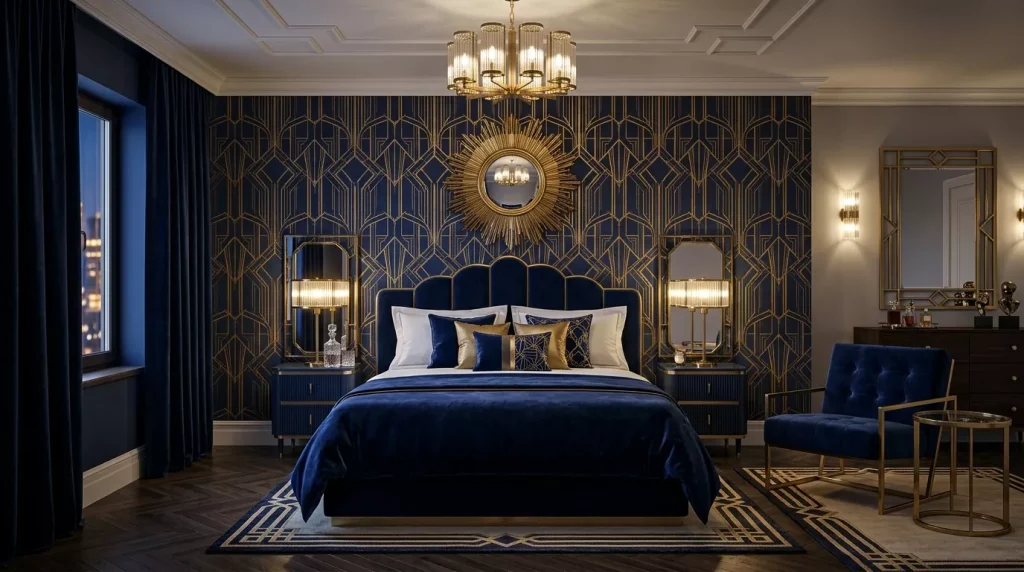
Gold, brass, chrome, and silver appear throughout the Art Deco bedroom — on lamp bases, bed frames, cabinet hardware, mirror frames, and decorative objects. These metallics are never intended to be subtle. They’re positioned to catch light and contribute to the room’s overall sense of shimmer, luxury, and theatrical richness.
Mirrored and Lacquered Surfaces
Mirrored furniture is almost synonymous with Art Deco bedroom design. Mirrored bedside cabinets, lacquered surfaces in black or deep jewel tones, high-gloss finishes on furniture — these reflective elements create the theatrical, layered quality that defines the style’s visual language.

Luxurious, Tactile Fabrics
Velvet, silk, satin, and faux fur. Art Deco favors the most opulent, sensory-rich fabrics available. A velvet headboard in deep teal or midnight navy, silk cushions in gold and black, a white faux fur throw across the foot of the bed — these textural contrasts are as important to the look as any piece of furniture.
Art Deco Bedroom Color Palettes: Choosing Your Scheme
The Art Deco palette is rich, intentional, and built for impact. Here are the most classic and workable color combinations for a bedroom:

| Color Scheme | Dominant Tones | Metallic Accent | Overall Mood |
|---|---|---|---|
| Black & Gold | Matte black, deep charcoal | Bright gold, champagne | Bold, theatrical, iconic |
| Emerald & Brass | Deep emerald green, ivory | Aged brass, warm gold | Rich, jewel-toned, luxurious |
| Navy & Chrome | Deep navy blue, ivory | Polished chrome, silver | Sophisticated, cinematic |
| Ivory & Rose Gold | Warm ivory, blush | Rose gold, soft pink | Feminine, glamorous, soft |
| Deep Purple & Gold | Amethyst, plum, ebony | Gold, bronze | Regal, dramatic, opulent |
| Teal & Black | Deep teal, black | Polished gold, brass | Jewel-toned, contemporary |
Choosing your scheme: The most important single decision is your dominant wall color. In an Art Deco bedroom, walls can — and should — handle drama. A deep forest green, a matte navy, a rich burgundy. If full-wall intensity feels too committing, apply the bold color only to the feature wall behind the bed and use a complementary, slightly lighter tone on the remaining walls.
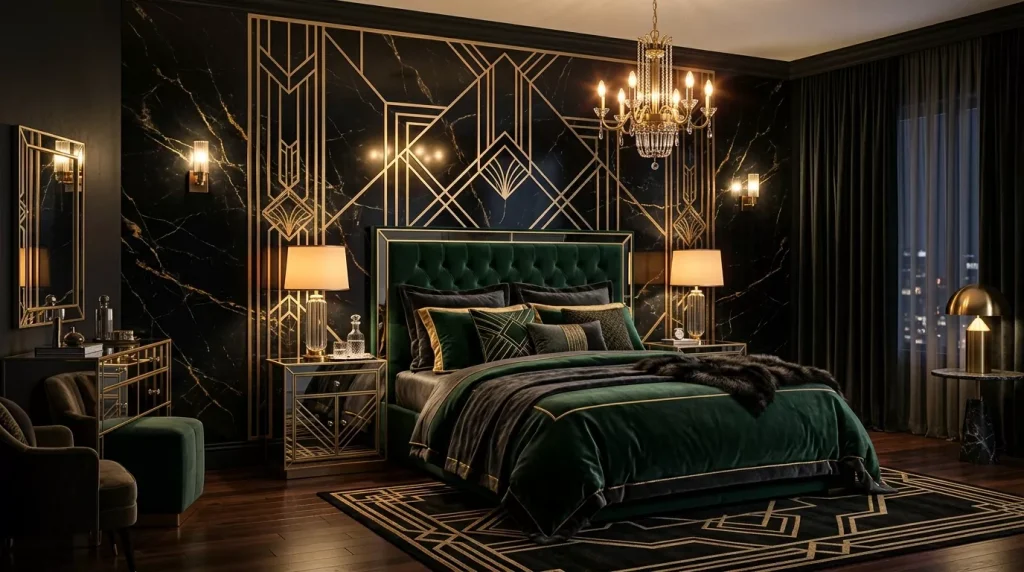
Art Deco Bedroom Furniture: What to Look For and Why
The Bed
The bed is the centrepiece, and in an Art Deco bedroom it must earn that position completely. Look specifically for:
- A tall upholstered headboard in velvet — deep teal, midnight blue, jewel green, or black
- Geometric button-tufting or structural channelling on the headboard face
- A bed frame with clean, stepped, or slightly curved lines and metallic detailing
- Platform-style frames with angular low bases in black lacquer or walnut with chrome or brass legs

Avoid overly ornate Victorian-style carved frames — they belong to a different movement entirely. Art Deco lines are precise and deliberate, not decoratively fussy.
Bedside Tables
Mirrored bedside tables are the classic Art Deco choice — they reflect light, add instant glamour, and reinforce the metallic, shimmering quality that runs through the style. Alternatively, lacquered tables in black, ivory, or a deep jewel tone with brass or chrome hardware achieve the same effect with a different kind of elegance.

Style surfaces deliberately: a brass lamp, a small geometric sculpture or crystal object, a single fresh bloom in a slim vase.
Wardrobes and Storage
Built-in wardrobes with mirrored panelled or sliding doors are the ideal solution. They reinforce the Art Deco aesthetic at scale while making the room feel significantly larger through reflection. For freestanding pieces, look for designs with stepped crown details, geometric inlay work, or deep lacquered finishes in the room’s dominant color.

The Dressing Table
A mirrored dressing table with a geometric frame, a triptych mirror, and a small upholstered stool in velvet is a quintessential Art Deco bedroom piece. It adds function, glamour, and a strong period reference in one compact item — worth including even in a modestly sized room if space allows.
Lighting in an Art Deco Bedroom: Drama Starts at the Ceiling

Lighting in an Art Deco bedroom is never treated as a functional afterthought — the fixtures themselves are decorative sculptures.
Chandeliers and pendants: A geometric crystal chandelier or a stepped glass pendant in chrome or gold is the single most impactful statement piece for an Art Deco bedroom. It sets the tone from the ceiling downward and transforms the room’s character even before the eye reaches the furniture below.
Wall sconces: Pairs of brass or chrome wall sconces flanking the headboard provide task lighting while creating a strong symmetrical architectural detail. Look specifically for fan-shaped, stepped, or geometric sconce designs rather than generic modern styles.

Table lamp bases: Angular or geometric bases in black lacquer, brass, or chrome — paired with cylindrical shades in black or ivory — are the definitive Art Deco bedside lamp.
The lighting rule: Every bulb in an Art Deco bedroom should produce warm white light in the 2700–3000K range. Warm light makes metallics shimmer and jewel tones glow. Cool white or daylight bulbs flatten the palette and drain the room of the drama you worked to create.
Art Deco Textiles and Soft Furnishings: Where Glamour Is Actually Felt

The fabrics in an Art Deco bedroom are where the tactile luxury of the style lives. Here’s what works and why:
- Velvet — the definitive Art Deco fabric; use it on the headboard, cushions, curtains, and an accent chair
- Silk and satin — for cushion covers and throw pillows; the sheen catches light in a way that reinforces the metallic theme throughout
- Geometric patterned rugs — a large rug in black, gold, and a deep jewel tone with a sunburst, chevron, or stepped diamond pattern is one of the most effective single Art Deco statements in the bedroom
- Faux fur throws — draped at the foot of the bed in white, ivory, or black; luxurious, tactile, and period-appropriate
- Heavy velvet or silk curtains — floor-to-ceiling, mounted close to the ceiling, in a deep jewel tone or black; add decorative brass or chrome holdbacks for the full effect
Art Deco Bedroom Decor on a Budget: High-Impact, Smart Choices

A full Art Deco transformation doesn’t have to mean dramatic expenditure. These targeted changes deliver the aesthetic at a fraction of the typical cost:
Feature wallpaper on one wall. A single wall of Art Deco geometric wallpaper — in black and gold, deep teal, or emerald green — transforms a room’s character more dramatically than almost any furniture change. It’s high impact, relatively affordable, and entirely reversible.
Replace lampshades. Swap basic shades with black or ivory cylindrical shades on existing bases. If the bases themselves are plain, metallic gold or matte black spray paint transforms them for the cost of a tin.
Add a geometric mirror. A sunburst mirror, a large hexagonal design, or an arched frame with stepped gold detail adds an immediate, recognizable Art Deco focal point to any wall with minimal investment.

Upgrade drawer hardware. Geometric brass or chrome bar pulls on an existing chest of drawers create an Art Deco detail that looks far more considered than its modest cost suggests.
Invest in velvet cushions. A set of four velvet cushions in deep jewel tones — emerald, sapphire, midnight blue — creates the color and tactile richness that defines the Art Deco bedroom feel on any existing bed.
Art Deco vs Other Glamorous Bedroom Styles: An Honest Comparison

Art Deco is frequently confused with neighboring glamorous design movements. Here’s how it genuinely differs:
| Style | Period Reference | Key Palette | Defining Element | Overall Mood |
|---|---|---|---|---|
| Art Deco | 1920s–1940s | Black, gold, jewel tones | Bold geometry + metallic shimmer | Theatrical, dramatic, opulent |
| Hollywood Regency | 1930s–1950s | White, black, bright pops | Mirrored furniture, exotic prints | Glamorous, playful, cinematic |
| Mid-Century Modern | 1950s–1960s | Mustard, olive, teak | Organic shapes, tapered legs | Retro, warm, functional |
| Contemporary Glam | 2010s–present | Blush, gold, grey | Velvet and metallics | Modern, feminine, soft |
| Victorian Glamour | 1837–1901 | Burgundy, deep navy, forest | Heavy carved wood, heavy florals | Dark, romantic, antique |
| Maximalism | No fixed period | Any | More of everything | Eclectic, expressive, personal |
Art Deco is distinguished from all of these by a specific combination: geometric pattern + high contrast palette + metallic accents + rigorous symmetry. It’s theatrical like Hollywood Regency but more architecturally structured. It’s richer in color than Mid-Century Modern and more controlled than general maximalism. If you love glamour but want discipline, Art Deco is the style.

Step-by-Step Guide: Building Your Art Deco Bedroom From the Ground Up
Step 1: Choose your dominant color Select the jewel tone or dark neutral that anchors the whole room — deep green, midnight navy, dramatic black, or plum. This becomes your feature wall and your velvet upholstery foundation.
Step 2: Select your metallic and commit to it Gold and brass suit warm Art Deco palettes (emerald, black, ivory). Chrome and silver suit cooler schemes (navy, cream, grey). Pick one primary metallic and use it from the chandelier down to the door handles — consistency is everything here.
Step 3: Source your statement bed A velvet-upholstered bed with a tall headboard and clean geometric lines is the most important single investment. Budget here before anywhere else.
Step 4: Introduce your geometric pattern Apply it on one or two surfaces — a feature wall of patterned wallpaper, a large geometric rug, or heavily patterned curtains. Geometric pattern on every surface simultaneously creates visual overload rather than elegance.
Step 5: Build your metallic layer Add gold or chrome through lamp bases, mirror frames, picture frames, hardware, and decorative objects. Brass candleholders, a chrome bedside lamp, a gold-framed sunburst mirror — layer these gradually.
Step 6: Hang floor-to-ceiling window treatments Velvet or heavy silk curtains in a deep jewel tone or black. Mount the rod as close to the ceiling as possible. Add brass or chrome holdbacks for the full period effect.
Step 7: Style every surface with intention Mirrored bedside tables with a brass lamp, a crystal object, and one small geometric sculpture. Tray styling — a mirrored or lacquered tray holding accessories — is the Art Deco approach to surface curation. Nothing accidental, nothing cluttered.
Pros and Cons of Art Deco Bedroom Decor
✅ Pros
- Visually striking and memorable — few styles command a room with equal authority
- Creates a strong sense of personality and character that generic design never achieves
- Highly photogenic — deep colors, metallics, and bold patterns photograph extraordinarily well
- Individual Art Deco elements elevate even otherwise plain, contemporary rooms
- Genuinely timeless — Art Deco has been revived multiple times because its energy is enduring
- Works spectacularly in period properties with high ceilings and original architectural detail
❌ Cons
- Deep tones and heavy fabrics can feel oppressive in small, low-ceilinged rooms without careful editing
- Dark walls absorb light — the style requires strong, layered artificial lighting to prevent gloominess
- Mirrored and metallic surfaces show fingerprints and require more frequent cleaning
- An over-committed Art Deco bedroom can feel like a themed hotel suite rather than a personal home
- Strong color and pattern choices are harder and more expensive to reverse than neutral design decisions
Common Mistakes That Undermine an Art Deco Bedroom
1. Mixing Too Many Metallic Finishes Gold, silver, chrome, and rose gold used simultaneously in the same room look chaotic and uncommitted. Choose one primary metallic — warm gold or brass for warmer palettes, chrome or silver for cooler ones — and maintain it throughout every room element.
2. Applying Geometric Pattern to Every Surface Geometric pattern is essential to Art Deco, but layering it onto the wallpaper, rug, curtains, headboard, and cushions simultaneously creates visual overload. Choose two statement surfaces for bold pattern and let the rest stay tonal and relatively quiet.
3. Underestimating the Ceiling Art Deco was originally expressed in architecture, and ceilings were always part of that architectural vocabulary. A geometric plaster medallion, a stepped cornice, or a dramatic pendant that draws the eye upward dramatically improves the authenticity and impact of an Art Deco bedroom.
4. Choosing Pale or Pastel Tones Soft blush and powder blue are simply not Art Deco. The style depends entirely on depth and contrast. Committing to Art Deco aesthetics but executing them in washed-out, light tones produces something that looks confused and unresolved rather than glamorous and considered.
5. Poor or Insufficient Lighting A single ceiling downlight in cool white destroys an Art Deco bedroom. Layer warm light sources — wall sconces, a chandelier on a dimmer, bedside table lamps, perhaps an accent floor lamp — and always use warm-white bulbs throughout.
6. Ignoring Symmetry Art Deco is a rigorously symmetrical style. Matching bedside tables, matching lamps, centered headboards, balanced wall sconces — this visual order is fundamental to the style’s sense of elegant control. Asymmetry reads as casual and unresolved in an Art Deco context.
Tips for Nailing the Art Deco Bedroom Aesthetic
- Start with a statement mirror — a large sunburst, arched, or stepped-frame mirror in gold or brass immediately signals the Art Deco aesthetic and anchors any wall
- Use black as your grounding neutral — in Art Deco, black works the way white does in Scandinavian design: it makes every other color more vivid and intentional
- Layer curtains in two depths — a sheer linen layer beneath heavy velvet drapes lets you modulate both light and privacy with real theatrical effect
- Use a tray for surface styling — a mirrored or black lacquer tray on each bedside table, holding a lamp, a crystal object, and one small decorative piece, corrals accessories beautifully and looks curated
- Add architectural detail with paint — a step-and-shadow cornice or picture rail painted in your metallic accent color adds a genuine period detail at minimal cost
- Introduce fragrance deliberately — black crystal candle holders with warm, complex scents (amber, oud, sandalwood, vetiver) complete the multisensory Art Deco bedroom experience in a way that purely visual styling cannot
Conclusion
Art Deco bedroom decor is one of those styles that refuses to disappear entirely — and it resurfaces in every generation precisely because the combination of bold geometry, metallic glamour, jewel-toned richness, and theatrical symmetry simply does not age the way trend-driven designs do. It has the confidence of something that knows exactly what it is and makes no effort to be anything else.
Whether you commit fully — dark walls, velvet everything, a crystal chandelier, mirrored bedside tables, a geometric rug — or begin more modestly with a velvet headboard, a brass lamp, and a sunburst mirror, the Art Deco bedroom aesthetic rewards every bit of intention you bring to it. Each element should feel chosen, placed, and considered. That deliberateness is the style itself.
Your bedroom is the most private room in your home. The Art Deco bedroom decor philosophy says it should also be the most beautiful — without apology, without restraint, and without anything dull.
Ready to begin your Art Deco transformation? Start with one statement piece today — a velvet-upholstered headboard, a geometric wallpaper panel behind the bed, or a brass sunburst mirror on an empty wall. Let that one decisive choice guide everything that follows. Great design rarely happens all at once; it happens one confident, deliberate decision at a time.
Frequently Asked Questions (FAQs)
Q1: What is the easiest way to introduce Art Deco decor into a bedroom without a full redesign?
The three quickest and most impactful entry points are: a geometric patterned wallpaper on the wall behind the bed, a large sunburst or stepped-frame mirror in brass or gold, and velvet cushions in deep jewel tones on an existing bed. Any one of these creates an immediate, recognizable Art Deco statement without requiring structural changes or significant budget. All three together will transform the room’s character entirely even if the remaining furniture is contemporary and neutral.
Q2: What colors are most authentic to the Art Deco bedroom style?
The most historically authentic Art Deco palette is built around high contrast pairings: black and gold, deep jewel tones (emerald, sapphire, amethyst, ruby) against ivory or cream, and warm metallic accents in brass, chrome, or gold throughout. Pale or pastel tones are not authentic to the style. Art Deco was born from a desire for boldness and luxurious self-expression, and its palette reflects that confidence directly. If you want a softer entry point, use champagne and ivory as a base with gold and blush accents rather than diluting the jewel tones into pastels.
Q3: Does Art Deco bedroom decor work in a small room?
Yes, but with specific adjustments. In a small bedroom, apply the deep jewel tone to one feature wall rather than all four. Use mirrored furniture and a large wall mirror to expand the perceived space through reflection. Limit the geometric pattern to one statement surface — wallpaper on one wall or a large rug — rather than layering it across multiple surfaces simultaneously. Strong, warm layered lighting is especially critical in a small Art Deco bedroom: without it, the darker palette can feel heavy rather than glamorous.
Q4: What type of flooring works best with Art Deco bedroom decor?
Dark hardwood or herringbone parquet flooring is the most historically authentic choice — it grounds the room, adds warmth underfoot, and complements the deep tones of walls and furnishings naturally. A large geometric Art Deco rug in black, gold, and a jewel tone, placed beneath the bed and extending outward on both sides, adds pattern and warmth at floor level regardless of the underlying floor finish. In homes with lighter or contemporary flooring, the rug becomes an even more critical element for anchoring the Art Deco aesthetic.
Q5: How do I prevent my Art Deco bedroom from feeling like a themed hotel room?
Selective commitment rather than total immersion is the key. Choose three or four genuine Art Deco signature elements — a velvet headboard, a geometric rug, a brass chandelier, a mirrored bedside table — and let the surrounding furniture and surfaces be quieter and more personal. Your own books, meaningful objects, plants, photographs in simple frames — these lived-in details prevent the room from feeling like a period recreation and make it feel like your home. The style should feel inhabited and personal, not curated for display.
Q6: What Art Deco patterns are most commonly used in bedroom design?
The most widely used Art Deco patterns in bedroom contexts are: chevron and zigzag (particularly effective on rugs and wallpaper), sunburst and fan shapes (on mirrors, light fixtures, and headboard detailing), stepped or pyramid forms (on furniture silhouettes and decorative objects), hexagonal and diamond repeats (on wallpaper and feature tiles), and stylised exotic motifs — peacock feathers, bold florals, palm fronds — used as accent pattern on cushions or framed art. The most versatile and immediately recognisable starting point is a chevron or stepped diamond pattern on a rug, which reads clearly as Art Deco from across the room.
Q7: Can Art Deco bedroom decor work in a contemporary or modern home?
Absolutely — and it often works especially well. Modern homes with open-plan layouts, high ceilings, and clean architectural lines provide an excellent canvas for Art Deco elements, which carry their own geometric confidence. The approach in a contemporary home is to choose modern interpretations of Art Deco furniture — pieces that reference the style through form and material rather than being period reproductions. A sleek velvet platform bed with brass legs, a bold geometric pendant light, and a statement rug bring Art Deco’s essential energy into a modern setting without making it feel like a period property impersonating something it isn’t.