Sage Green Bathroom Decor: Fresh Design Ideas

Sage Green Bathroom Decor: Fresh Design Ideas for a Nature-Inspired Retreat
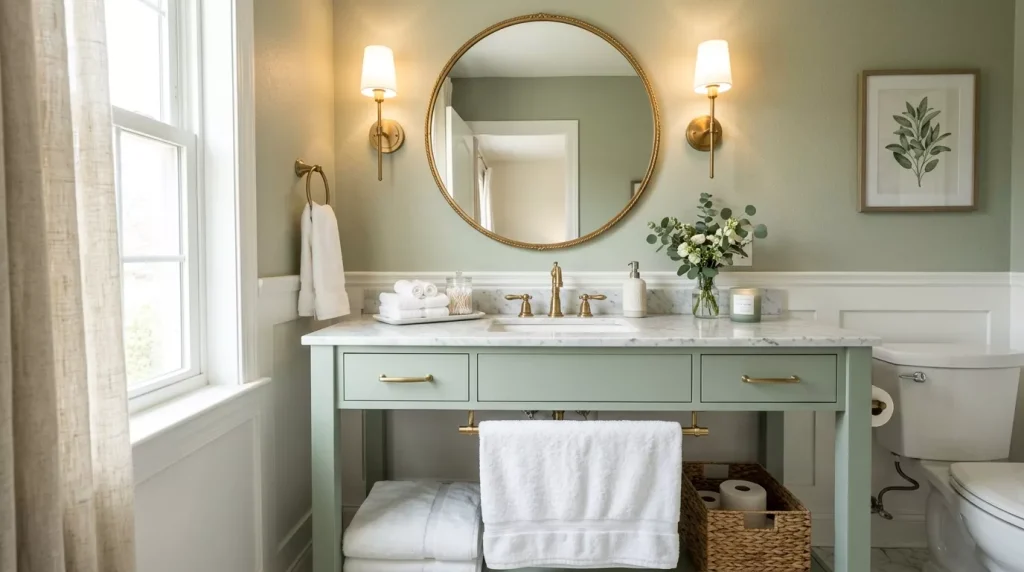
Walk into a sage green bathroom and you feel it before you consciously register what you’re actually looking at. There’s something about that muted, slightly grey-green tone that lands somewhere between a forest floor and a eucalyptus grove — deeply calming, quietly alive, and effortlessly elegant. Sage green bathroom decor has moved steadily from trend status to genuine design staple, and the more you understand why it works, the easier it becomes to get it right.
Unlike brighter, more saturated greens that can feel jarring or unexpectedly clinical, sage sits in a sweet spot — enough color presence to add warmth and character, but muted enough to function almost as a neutral in most spaces. It photographs beautifully, pairs with a genuinely wide range of tones, and creates a consistently spa-like atmosphere that very few other bathroom colors can match.
This guide covers everything: understanding the color itself, the best pairings, tile choices, fixtures, accessories, design styles, budget tips, and every common mistake that consistently undermines what could be a beautiful sage green bathroom.
Understanding Sage Green: Why This Color Belongs in a Bathroom
Sage green isn’t one specific color — it’s an entire family of muted, slightly grey-green tones that sit closer to the earthy, dried-herb end of the green spectrum than the bright leafy end. Think eucalyptus leaves, sun-faded olive, lichen on limestone, dried rosemary — natural, organic, gentle.
What makes sage particularly well-suited to bathrooms comes down to color psychology. Green is consistently the color most associated with nature, calm, and restoration — qualities that align precisely with what a bathroom should provide. The muted quality of sage specifically reduces visual stimulation without the coldness that a grey or bright white can introduce.
It works across different bathroom sizes and light levels, but the specific shade you choose matters significantly depending on your room’s conditions.
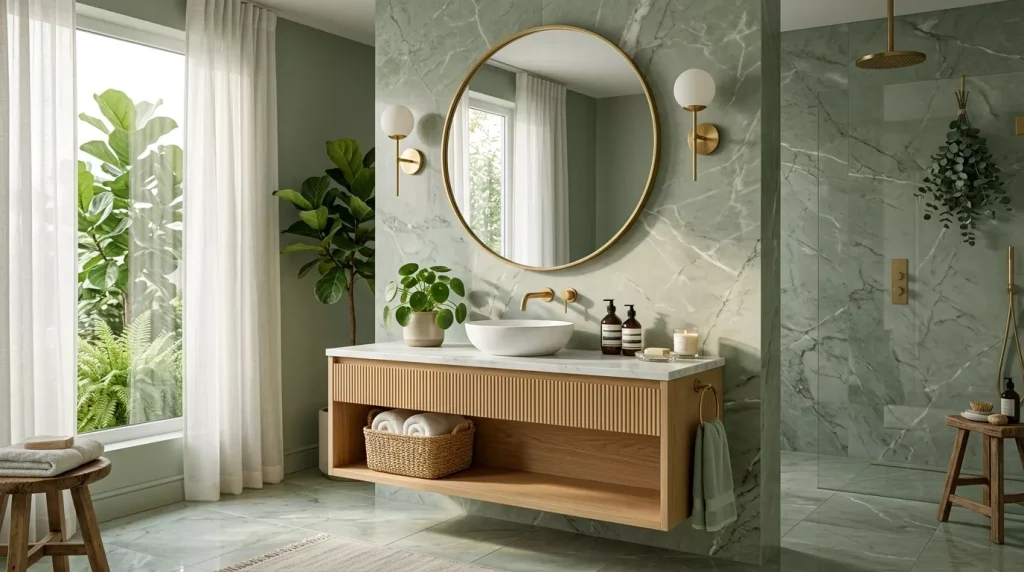
The sage green family includes:
- Classic sage — the archetypal muted grey-green, balanced and broadly appealing
- Warm sage — slightly yellow-green, olive-leaning, beautiful with wood and brass
- Cool sage — slightly blue-green, more spa-like, suits stone, marble, and chrome
- Dusty sage — almost grey, very quiet and low-key, works in virtually any space
- Deep sage / eucalyptus — richer and more saturated, for those ready to commit fully
Understanding which version of sage you’re working with shapes every other decision — hardware finish, tile tone, wood species, and accessory palette.
Sage Green Bathroom Color Pairings That Always Deliver
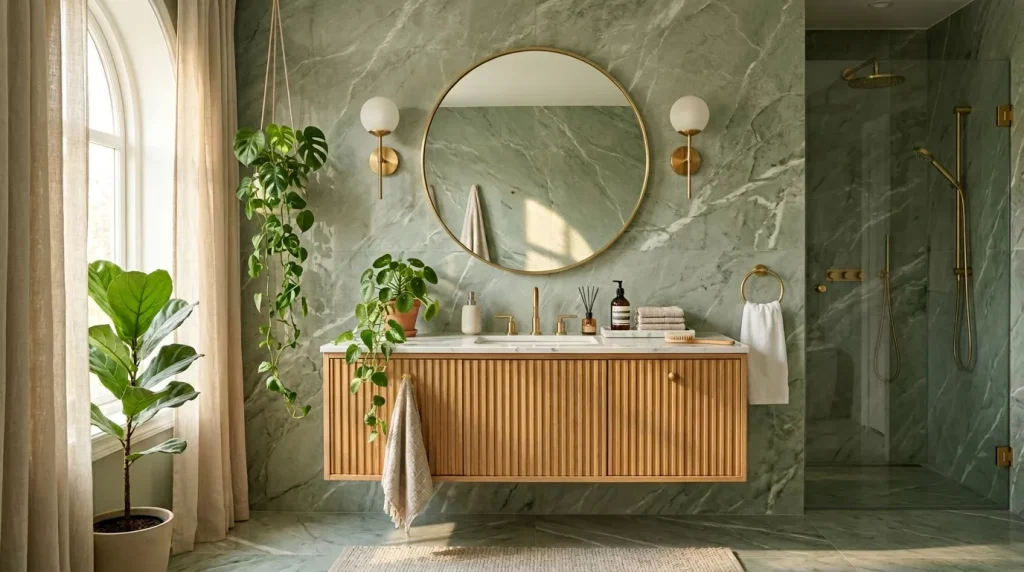
Sage green is one of the most versatile bathroom colors available. It partners naturally with a remarkably broad range of tones, giving you genuine flexibility rather than forcing you into a single design direction.
| Color Pairing | Visual Effect | Best Used In |
|---|---|---|
| Sage + Warm White | Soft, clean, effortlessly spa-like | Wall color + vanity combination |
| Sage + Natural Oak / Walnut | Warm, organic, beautifully grounded | Vanity unit, shelving, accessories |
| Sage + Brushed Brass | Warm luxury, botanical glamour | Taps, towel rails, mirror frames |
| Sage + Terracotta | Earthy Mediterranean warmth | Plant pots, accent tiles, towels |
| Sage + Blush Pink | Soft, romantic, gently feminine | Towels, accessories, small art pieces |
| Sage + Charcoal / Slate | Sophisticated, modern, bold contrast | Grout color, floor tile, fixtures |
| Sage + Crisp White | Fresh, clean, classically timeless | Subway tiles, basin, bath surround |
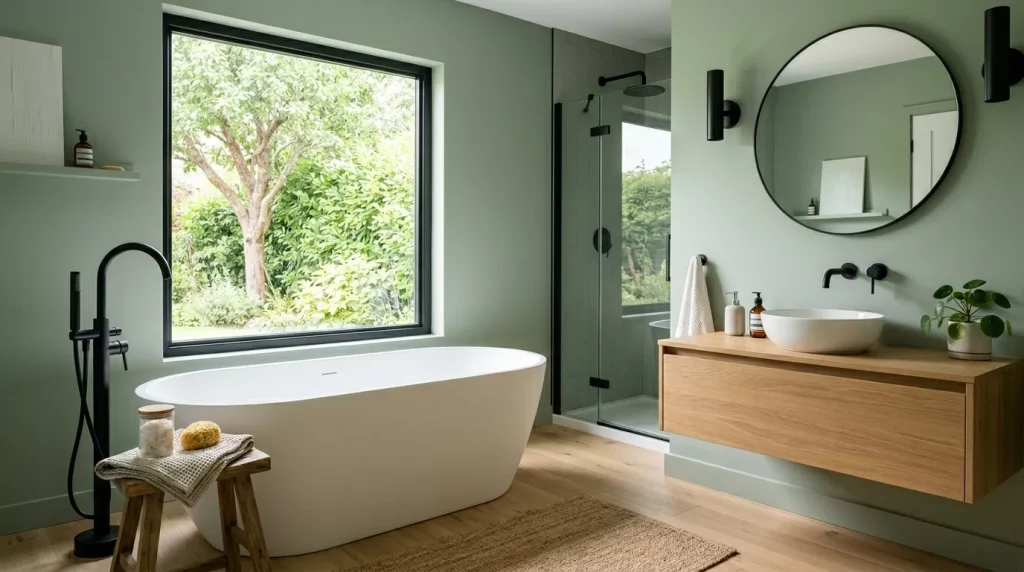
| Sage + Matte Black | Bold, contemporary, design-forward | Feature tiles, mirror frame, hardware |
The most naturally harmonious combinations are sage with warm wood and sage with brushed brass — both reinforce the botanical, organic character of the color. The most visually striking contrast comes from pairing sage with black or charcoal grout, which makes the green feel deliberate and design-led rather than merely decorative.
Sage Green Bathroom Tile Ideas: Laying the Foundation Right
Tiles carry the most visual weight in any bathroom, and in a sage green space they can either be the star of the show or the quiet, considered backdrop that lets other elements breathe. Both approaches work — the choice depends on how committed you want to be.
Full Sage Green Tiled Walls
The boldest approach: tiling the entire bathroom envelope in sage green. This works best with large-format tiles in a matte or honed finish — the surface quality prevents the color from feeling flat or monotonous. A 60x120cm stone-effect tile in dusty sage creates a completely enveloping, spa-like atmosphere that feels simultaneously dramatic and serene.
Sage Green Feature Wall
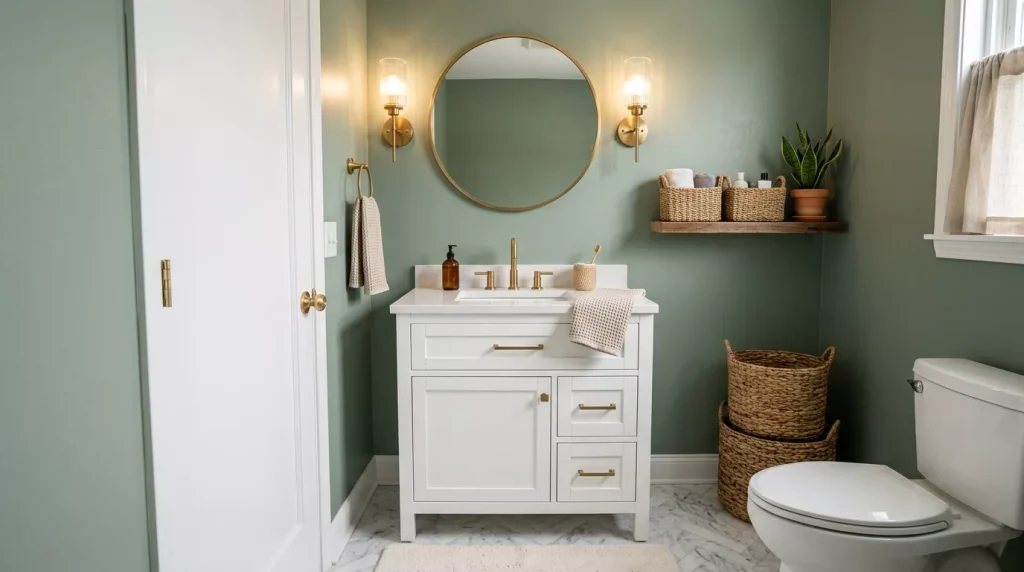
A single feature wall — behind the vanity or the main shower wall — in a sage tile, with warm white or neutral tiles on the remaining three surfaces. This is more accessible, easier to budget for, and simpler to change later, while still creating a strong, memorable sage green statement.
Zellige and Handmade Tiles
Handmade zellige-style tiles in sage green are one of the most visually interesting tile choices available. Their slight surface variation, irregular edges, and organic glaze quality give the color a depth and liveliness that machine-made tiles simply cannot replicate. Even a small zellige feature wall creates an artisanal richness that elevates the entire bathroom.
Sage Green Subway Tiles
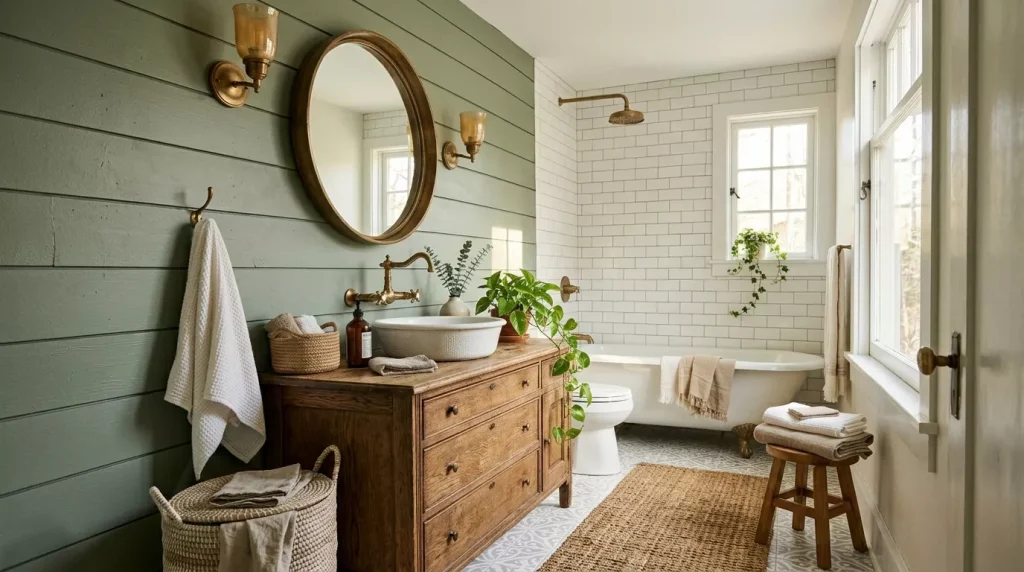
Classic subway tiles in sage — particularly in a vertical stack or herringbone layout — offer a fresh contemporary take on a genuinely timeless format. Pair with warm white grout for a softer, more organic feel, or charcoal grout for a graphic, high-contrast result that reads as intentionally designed.
Patterned Floor Tiles With Sage as the Accent
For personality and geometric interest, a patterned floor tile featuring sage green as the dominant or accent tone — encaustic cement tiles in sage and ivory, or vintage-style hexagonal patterns — anchors the room beautifully without committing the walls entirely to the color.
Sage Green Bathroom Decor Styles: Finding Your Design Direction
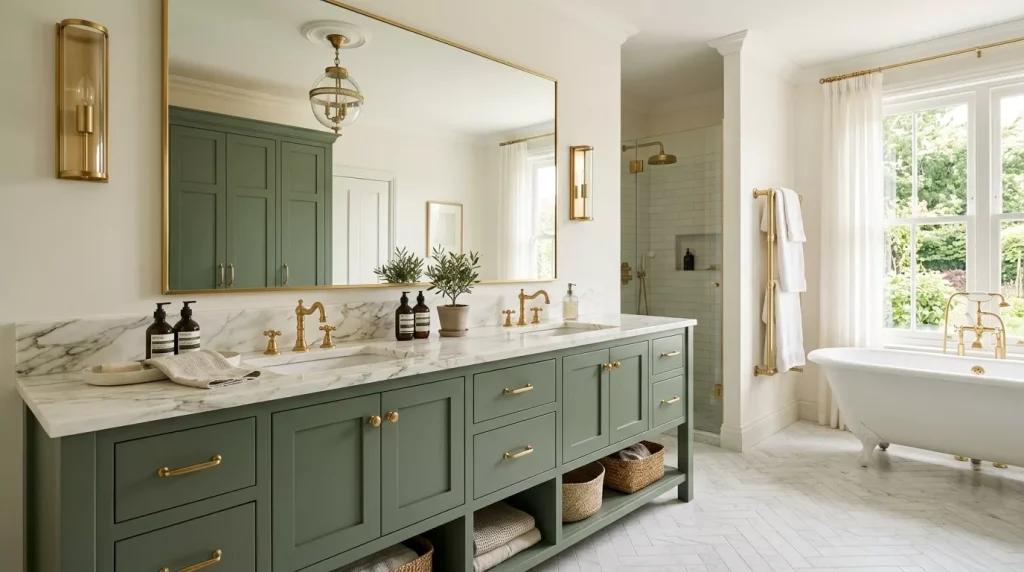
The sage green color family sits comfortably within several distinct interior aesthetics. Here’s how it expresses itself differently across each one:
Organic Modern
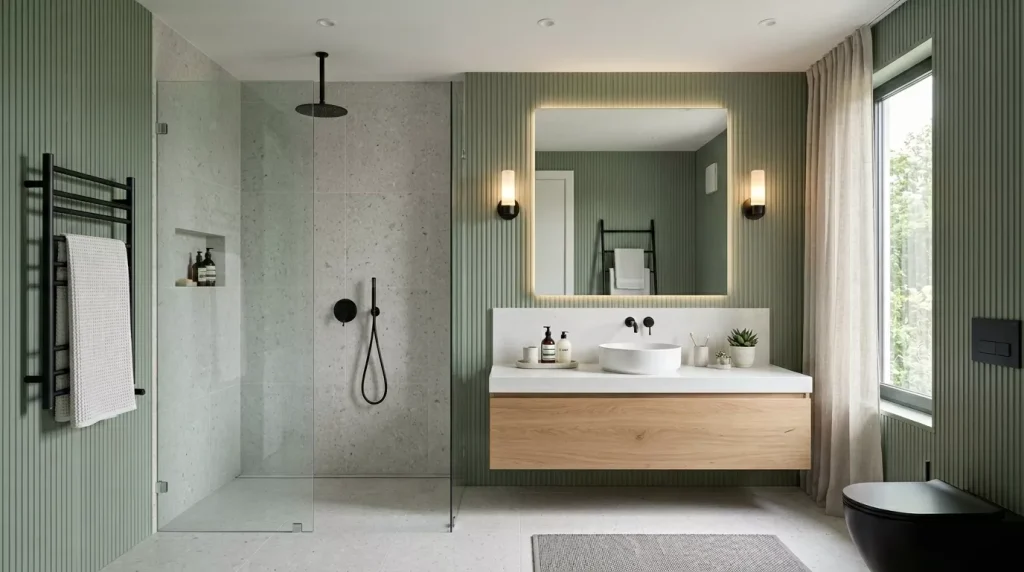
Clean lines, natural materials, and deliberate restraint. Sage green here serves as the grounding color — on a painted vanity or large-format wall tiles — against warm white walls, a natural oak floating shelf, and brushed brass fixtures. The effect is effortlessly calm, contemporary, and completely liveable.
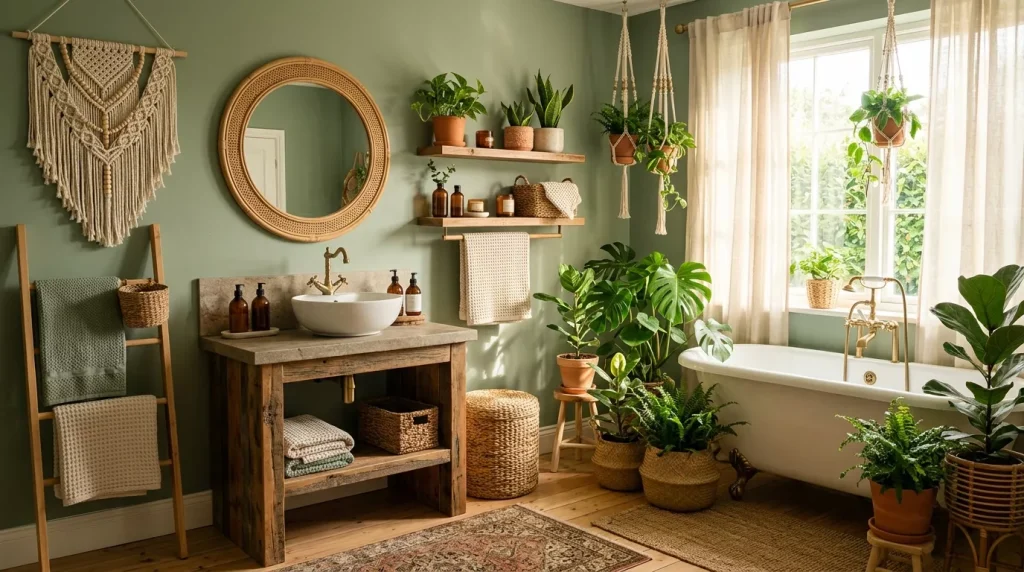
Botanical and Biophilic
This style leans fully into the connection between a bathroom and the natural world. Sage green walls or tiles, abundant trailing plants in terracotta pots, woven rattan baskets, wooden bath accessories, and linen towels in earthy tones. The bathroom becomes a genuinely living space — green, growing, and restorative in a way that few other rooms achieve.
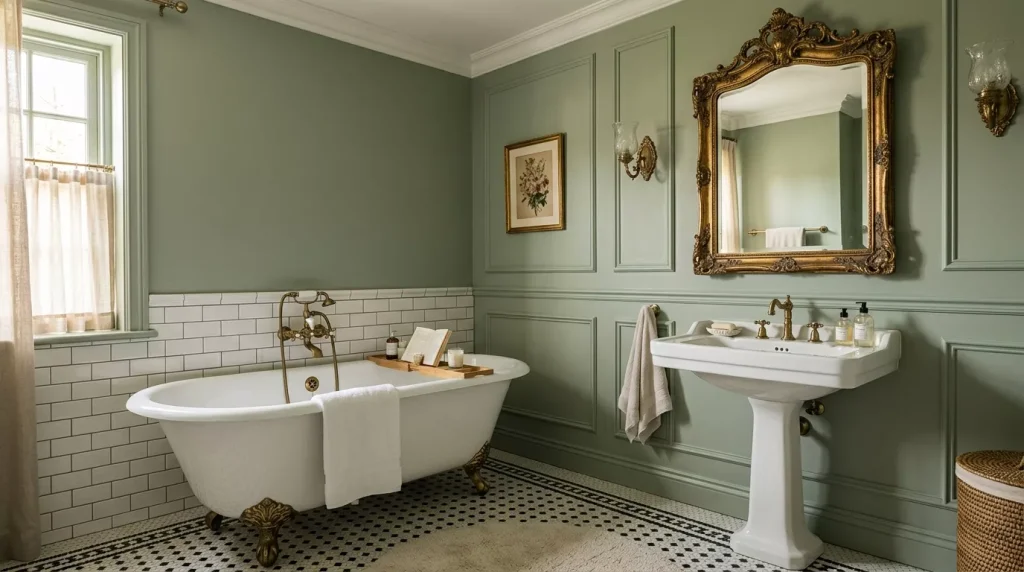
Vintage and Cottagecore
Sage green carries strong vintage associations — it was popular in mid-century bathrooms and sits naturally in period homes. Sage green subway tiles with a black-and-white hexagonal floor, a ceramic pedestal basin, exposed brass pipework, a wooden-framed mirror, and woven storage baskets. Charming, characterful, and genuinely comfortable to use every day.
Japandi Calm
The Japanese-Scandinavian approach takes sage green to its quietest, most meditative expression. Dusty sage walls, a natural stone or concrete basin, pale oak cabinetry, a single branch in a ceramic vase, matte chrome fixtures, and absolutely nothing unnecessary. Every element has a purpose. The sage green simply exists as a colour that breathes.
Contemporary Spa Bathroom
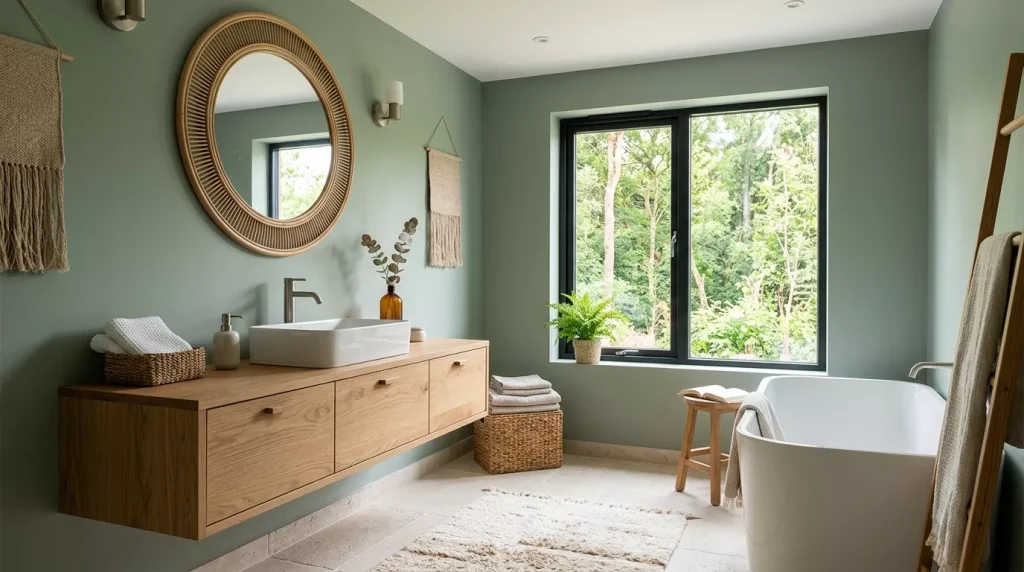
This is the luxury wellness hotel approach. Deep sage or eucalyptus green large-format tiles, a freestanding stone resin bath, polished brass fittings, pristine white linen towels, a recessed tile niche, and layered warm ambient lighting. The bathroom becomes a genuine private retreat, and sage green is the color that makes it feel authentically restorative rather than merely styled.
Fixtures and Hardware: What Actually Works With Sage Green
The hardware choices you make in a sage green bathroom either enhance the color’s natural warmth or work quietly against it. Getting this right is one of the most impactful decisions in the whole design.
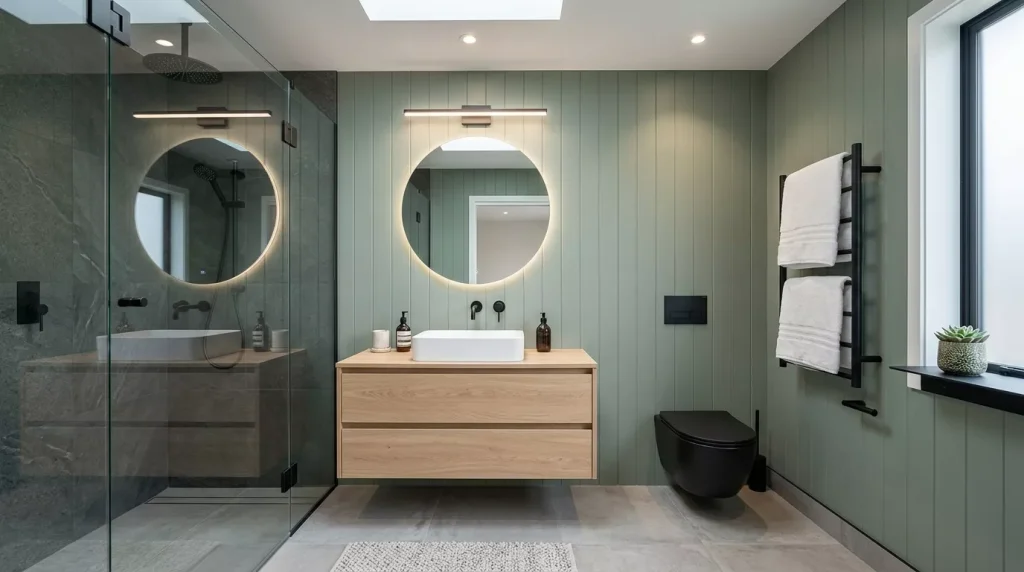
Taps and shower fittings: Brushed brass and brushed gold are the most naturally harmonious choices — they reinforce the warm, botanical quality of sage and add quiet luxury without competing. Matte black creates a bold contemporary contrast that works exceptionally well with deeper sage tones and dark grout. Polished chrome suits cooler sage greens alongside white marble or stone for a more clinical, spa-style result.
Vanity and basin: A wall-hung or freestanding vanity in natural oak or warm walnut is a beautiful partner for sage green walls. A painted vanity in warm white or ivory creates a softer, layered approach. For a bold tonal statement, a sage green painted vanity against white tiles makes the color the room’s unambiguous focal point.
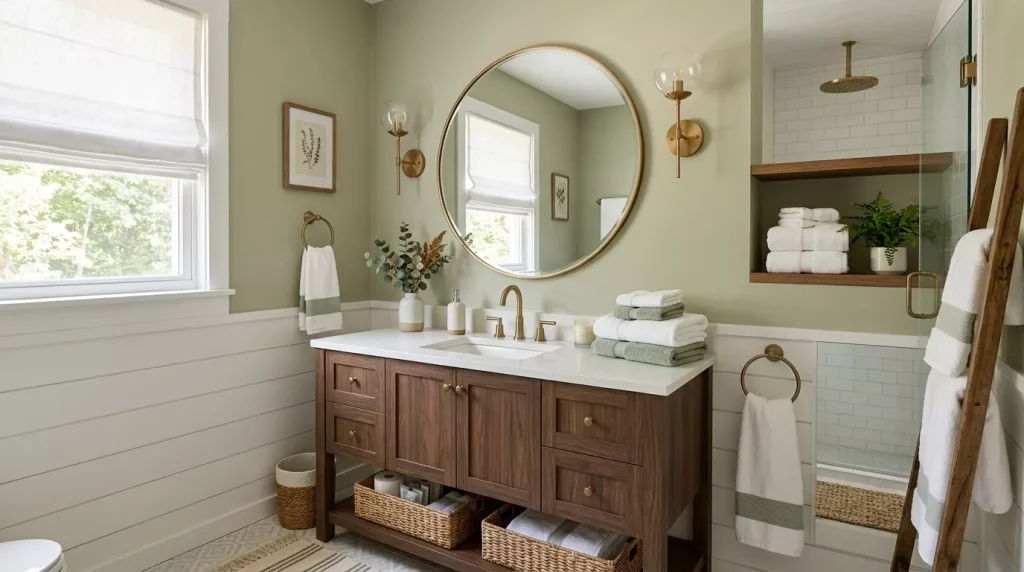
Mirrors: A round or arched mirror in aged brass, brushed gold, or natural rattan perfectly suits the organic quality of sage green. Avoid very industrial metal frames — they work against the warmth and softness this color introduces to a space.
Bath and shower: A freestanding bath in matte white or stone resin looks stunning against sage green walls. Frameless glass shower screens maintain visual openness and allow sage tiles to read as a continuous, uninterrupted surface.
Sage Green Bathroom Accessories and Soft Furnishings
Accessories are where personality enters the room — and where thoughtful styling either pulls a sage green bathroom together or leaves it feeling unfinished.
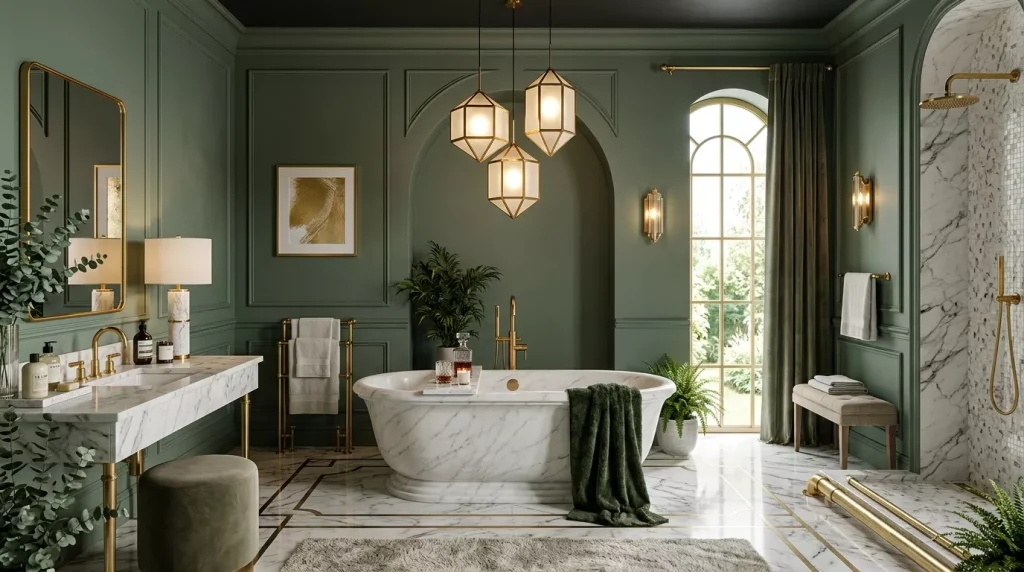
Textiles that work:
- Waffle-weave or linen towels in oatmeal, warm white, or terracotta
- A cotton loop or jute bath mat for earthy texture underfoot
- A natural linen shower curtain in ivory for a softer, more organic alternative to glass
Plants — essential, not optional: A sage green bathroom practically invites greenery. A trailing pothos on an open shelf, a peace lily on the windowsill, string of pearls in a small hanging planter, or simply a bunch of dried eucalyptus hung behind the shower head — plants intensify the botanical, restorative quality of the color in a way no manufactured accessory can replicate.
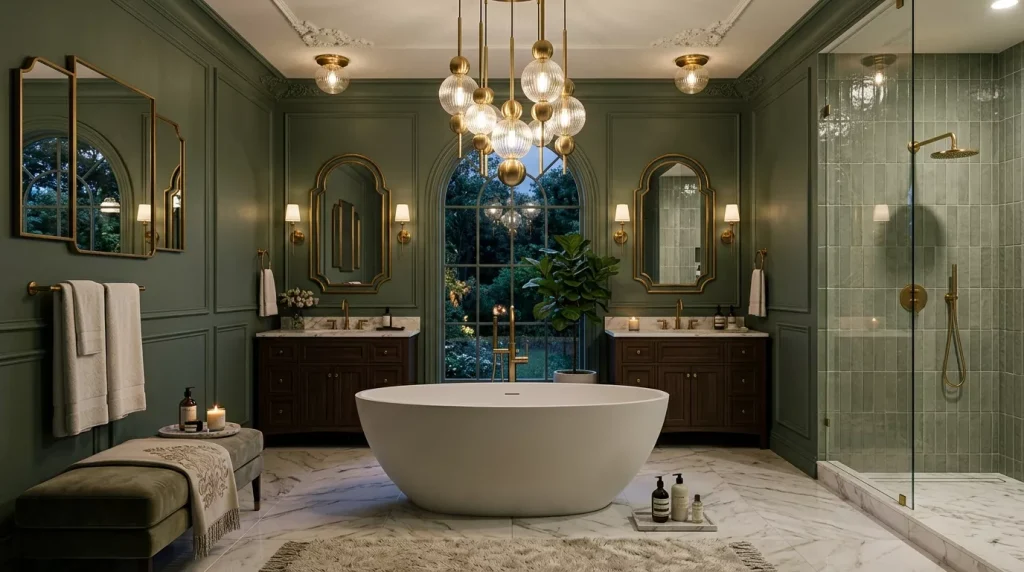
Storage and surface accessories:
- Rattan or wicker baskets for towel storage
- Wooden or bamboo bath tray across the tub
- Ceramic or stoneware soap dishes, toothbrush holders, and dispensers in warm cream tones
- A brass candle holder with a warm, earthy fragrance (sandalwood, cedar, eucalyptus)
Sage Green Bathroom Decor on a Budget: Real Impact, Sensible Spend
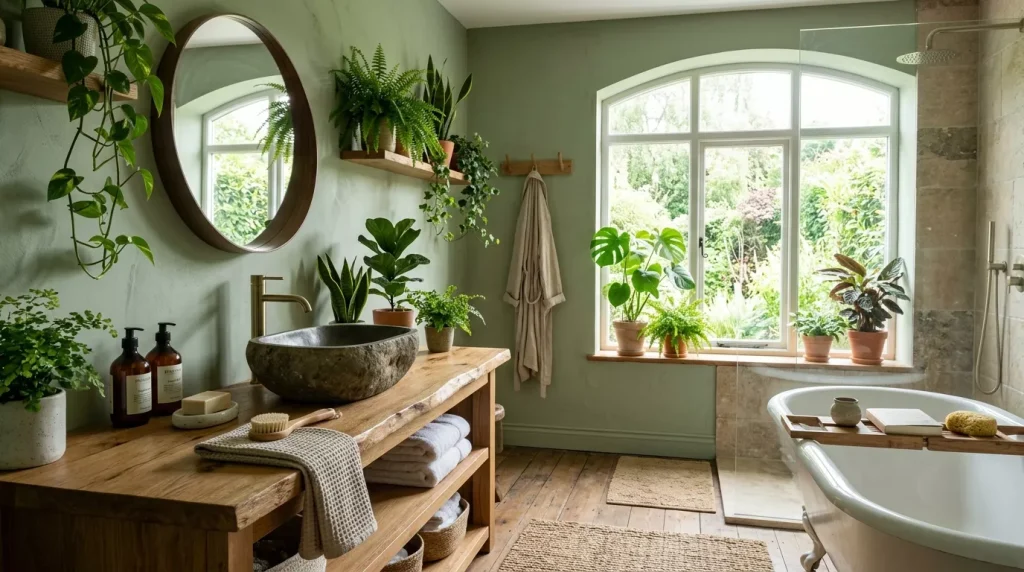
A full renovation is absolutely not the only route to a beautiful sage green bathroom. These targeted changes create genuine visual transformation at minimal cost:
Paint the walls or vanity. Moisture-resistant sage green paint on the walls — or simply on the vanity cabinet — is the most accessible and reversible single change available. One tin, one weekend, completely different room.
Swap your towels and bath mat. A coordinated set of linen or waffle-weave towels in oatmeal, warm white, or terracotta alongside a jute or cotton loop bath mat creates an instantly cohesive, intentional result against sage green walls.
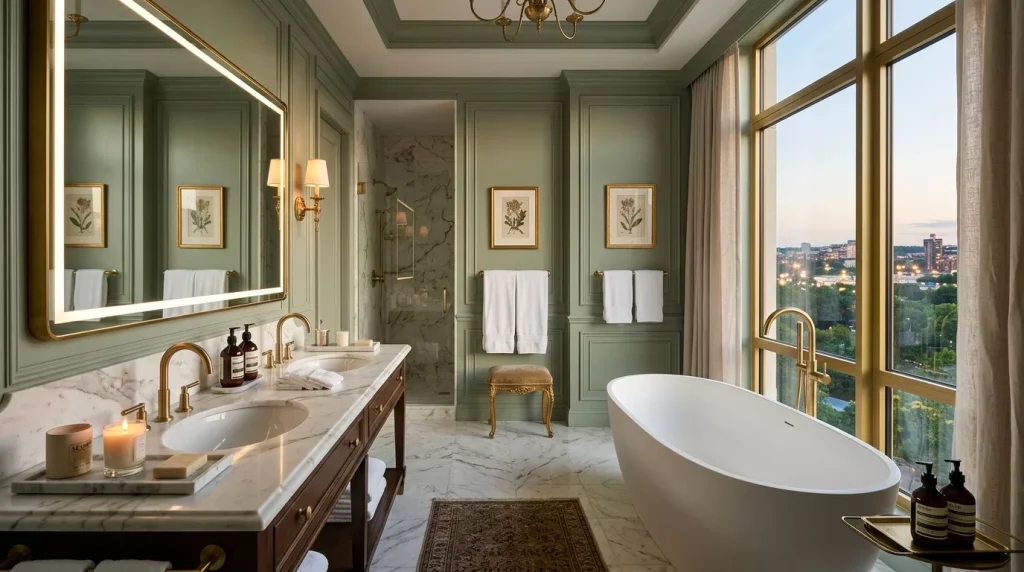
Upgrade your hardware. Replace chrome or plastic towel rails, toilet roll holders, and robe hooks with brushed brass equivalents. A full matching set costs surprisingly little and changes the room’s finish dramatically.
Add a rattan mirror. A round rattan-framed mirror is widely available, inexpensive, and perfectly suited to the botanical character of a sage green bathroom.
Bring in real plants. A single well-positioned trailing plant reinforces the entire green, organic theme and adds warmth and life that no other accessory achieves at any price point.
Sage Green vs Other Green Bathroom Tones: A Clear Comparison
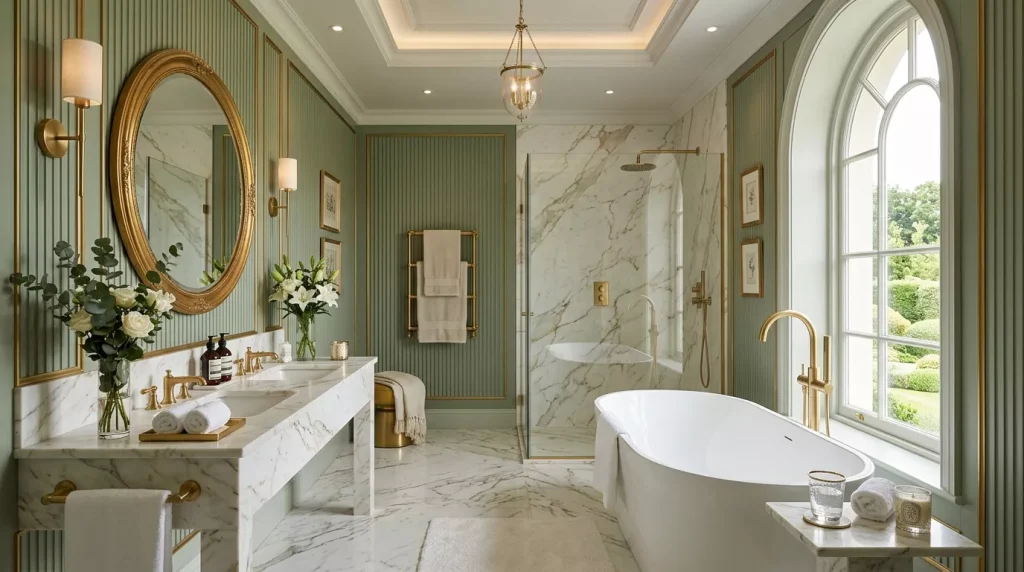
Sage green is one of several green tones used in bathroom design, and knowing exactly how it differs from its closest relatives helps you choose with genuine confidence:
| Green Tone | Character | Best Style Match | Key Difference From Sage |
|---|---|---|---|
| Sage Green | Muted, grey-green, soft, organic | Almost all bathroom styles | — |
| Olive Green | Warm, yellow-green, earthy | Rustic, Mediterranean, boho | More yellow-toned and intense |
| Eucalyptus | Cool blue-green, richer | Spa, luxury, contemporary | Cooler, deeper, more saturated |
| Mint Green | Pale, fresh, retro | Small bathrooms, vintage | Far brighter and more playful |
| Forest Green | Deep, bold, jewel-toned | Statement, maximalist, dramatic | Much darker and more dominant |
| Hunter Green | Rich, dark, sophisticated | Art Deco, traditional | Deeper and significantly heavier |
| Sage-Terracotta | Warm earthy green-brown blend | Vintage, boho, Mediterranean | Sage element in a mixed palette |
The clear conclusion: Sage green occupies a uniquely comfortable position in the green family — warm enough to feel welcoming, muted enough to feel timeless, and distinctive enough to have genuine character without ever being overwhelming. It’s the most broadly versatile green for bathroom use across styles, sizes, and light conditions.
Step-by-Step Guide: Designing Your Sage Green Bathroom
Step 1: Choose your specific sage shade Decide whether you want warm sage (embrace wood and brass), cool sage (lean into stone and chrome), or dusty sage (the quietest, most universally flattering option). Test large paint or tile samples under your bathroom’s actual lighting — sage green shifts more noticeably between light conditions than most people expect.
Step 2: Decide how much sage green you’re committing to Full tiled walls, painted walls, painted vanity only, or a single feature wall? Each creates a different level of commitment and a different visual result. Know your answer before buying anything.
Step 3: Lock in your tiles if applicable Choose format, finish, and pattern before selecting any other element. Tiles set the room’s visual weight and texture. Every subsequent decision responds to them.
Step 4: Select your hardware finish Brushed brass for warmth and botanical character, matte black for contemporary graphic contrast, polished chrome for a cooler spa look. One finish only — used without exception across every fitting in the room.
Step 5: Choose your vanity Natural wood for organic warmth, painted white or ivory for softness and contrast, painted sage for a confident tonal statement. This is the second most dominant element after tiles.
Step 6: Plan your lighting deliberately Warm white bulbs only — 2700–3000K. A backlit mirror or LED vanity strip for task lighting, recessed warm ceiling lights for ambiance. Good lighting makes sage green glow with warmth; poor or cold lighting makes it look flat and grey.
Step 7: Layer textiles, plants, and accessories last Add these gradually — towels first, then bath mat, then plants, then ceramics and fragrance accessories. Step back and edit before adding anything else. Sage green bathrooms breathe best when they’re not overcrowded.
Pros and Cons of Sage Green Bathroom Decor
✅ Pros
- Genuinely timeless — the muted quality means it ages far better than saturated or highly trend-dependent color choices
- Creates an immediate sense of calm, natural warmth, and connection to the organic world
- Versatile in the best possible way — pairs with warm wood, crisp white, brass, terracotta, blush, and black
- Works across multiple distinct design styles — from vintage cottagecore to contemporary spa to Japandi minimalism
- Performs well in both spacious and smaller bathrooms when the right specific shade is chosen
- Easy to introduce without renovation — paint, towels, and accessories can achieve meaningful results
❌ Cons
- In rooms with poor or cool lighting, sage green can read as flat grey and lose its character entirely
- Darker sage and eucalyptus tones can feel heavy in compact, windowless bathrooms
- Undertone sensitivity — choosing a shade with the wrong undertone for your light conditions can look murky
- Requires careful sample testing; the color is notably more light-sensitive than most neutrals
- Very light sage can appear washed out in rooms with very strong or direct sunlight
Common Mistakes That Undermine a Sage Green Bathroom
1. Skipping the In-Room Sample Test Sage green is one of the most lighting-sensitive colour families in interior design. A shade that reads as perfect dusty sage in a bright showroom can appear pale grey, khaki, or even faintly blue-purple on your bathroom wall under artificial light. Always test a large sample — ideally A3 size or bigger — on the actual wall under your real lighting conditions before purchasing.
2. Pairing Sage Green With Brilliant White Stark, cool brilliant white alongside sage green creates a harsh contrast that makes the green appear washed out and cheap. Warm white, off-white, or soft ivory are consistently more complementary — they reinforce the organic warmth the colour naturally carries rather than fighting it.
3. Choosing Cold Hardware in a Warm Sage Bathroom Cool polished chrome paired with a warm, yellow-leaning sage creates a visual disconnection that undermines palette cohesion. Match the warmth of your hardware finish to the warmth of your specific sage tone — brushed brass for warm sage, chrome for cooler sage.
4. Overcrowding With Accessories A sage green bathroom is at its most beautiful when it has breathing room — clear countertops, uncluttered shelves, open corners. Over-accessorizing introduces visual noise that works directly against the calm, restorative atmosphere the colour so naturally creates.
5. Getting the Grout Color Wrong Bright white grout with sage green tiles is perfectly acceptable. But warm stone, sand, or charcoal grout makes the tiled surface feel more intentional, more cohesive, and noticeably more premium. It’s one of the smallest decisions with one of the largest visual impacts in a tiled bathroom.
6. Using Artificial Plants Real plants are one of the most powerful and affordable tools in a sage green bathroom. Artificial ones undermine the organic authenticity the colour establishes. Even dried eucalyptus, a preserved fern, or a single real succulent makes a far more honest and beautiful statement than any silk or plastic alternative.
Tips for Elevating Your Sage Green Bathroom Further
- Hang fresh or dried eucalyptus from the shower head — it creates a spa-like fragrance that activates with steam and visually reinforces the botanical theme without any ongoing effort
- Layer your greens tonally — a slightly deeper shade in a plant pot, a slightly lighter tone in a folded towel edge creates depth within the green family without introducing new colors
- Match your grout to your accessory tone — a subtle echo between the grout color, a ceramic vase, and a linen towel creates a cohesive, professionally considered feel
- Choose matte finishes wherever possible — matte tiles, matte ceramics, matte hardware all reinforce the natural, organic quality of sage green more authentically than gloss alternatives
- Add one warm light source at low level — a candle or a small warm lamp at counter height adds significant atmosphere in a sage green bathroom during evening hours
- Keep one surface completely clear — whether it’s the vanity top or a shelf, one deliberately empty, styled surface acts as a visual breath that makes the whole room feel more spacious and considered
Conclusion
Sage green bathroom decor occupies a genuinely special position in the world of interior design — warm enough to feel welcoming, muted enough to feel timeless, nature-connected enough to feel restorative, and versatile enough to adapt to almost every home and every style of living.
From full sage-tiled walls in a contemporary wellness bathroom to a single painted vanity in a vintage-inspired space, this colour has an extraordinary ability to transform a bathroom into somewhere you actually want to spend time — not simply pass through on your way to somewhere else.
Get the shade right for your specific light conditions, choose hardware that reinforces your sage tone’s warmth, layer textures and natural materials thoughtfully, and never underestimate what a single well-placed plant can do for the botanical atmosphere sage green so naturally creates.
Your bathroom has the potential to be the most calming room in your home. Sage green bathroom decor is one of the most reliable, beautiful ways to make that happen. Start with a paint sample today — hang it on the wall, live with it through different lights and times of day, and let the colour show you exactly what it can become.
Frequently Asked Questions (FAQs)
Q1: Is sage green a good color choice for a small bathroom?
Yes — particularly in its lighter, dustier variations. Dusty sage and pale sage retain their character without the visual heaviness that deeper greens can introduce in compact spaces. To maximise the effect in a small bathroom, pair sage walls with a large mirror, warm white tile, and well-layered artificial lighting. Avoid deep sage or eucalyptus tones in a very small or windowless bathroom — they absorb light and can make a compact space feel enclosed rather than intimately spa-like.
Q2: What colors go best with sage green in a bathroom?
The most naturally harmonious pairings are warm white (for freshness and gentle contrast), natural wood tones in oak or walnut (for organic warmth), and brushed brass (for quiet botanical luxury). Terracotta is a beautiful earthy partner that adds Mediterranean warmth. Blush pink introduces a soft romantic quality. For a more contemporary result, charcoal or matte black in grout and fixtures creates graphic contrast that makes the sage feel design-led and intentional. Avoid cool grey alongside warm sage — the undertone conflict tends to read as muddy rather than sophisticated.
Q3: Is sage green bathroom decor a passing trend or a lasting choice?
It’s a lasting choice — and the reasons are rooted in the colour itself rather than fashion. Sage green sits in the muted, nature-inspired zone of the green family, which gives it far greater longevity than bright or highly saturated colors. It appeared consistently in high-quality interior design throughout the mid-century period, retreated for a time, and has returned with sustained strength because it genuinely fulfils something people want from a bathroom: calm, organic beauty that doesn’t demand constant attention or seasonal updating.
Q4: What is the best paint finish for sage green bathroom walls?
A satin or eggshell finish is the standard recommendation for bathroom walls — it handles the moisture and condensation of a bathroom environment while still reading as relatively matte from a distance. Full matte paint is not suitable for bathrooms as it resists cleaning poorly and marks easily. For a vanity cabinet or freestanding furniture piece, a furniture-grade satin or semi-gloss is the most durable option. Always use a moisture-resistant formulation, especially in bathrooms without mechanical ventilation.
Q5: How do I stop my sage green bathroom from looking grey?
This is the most common challenge, and it comes down to two factors: shade selection and lighting. Choose a sage green with a slightly warmer, yellow-green lean rather than a cool blue-grey lean — warm sage retains its green character better under artificial light than cool sage does. Use warm-white bulbs throughout the bathroom (2700–3000K) — cool daylight bulbs actively strip the warmth and green quality from sage and shift the eye toward grey. Maximising natural light through a clear or frosted window and using a large mirror to distribute it also significantly helps.
Q6: What hardware finish works best with sage green bathroom tiles?
Brushed brass and brushed gold are the most consistently successful choices — they complement the organic, botanical warmth of sage green and add a sense of quiet luxury that chrome rarely achieves with this colour family. Matte black works exceptionally well with deeper sage tones and dark grout for a bold contemporary finish. Polished chrome suits cooler sage greens alongside white marble or stone. Whatever you choose, maintain it absolutely consistently — using one hardware finish across every tap, rail, hook, and frame is one of the most impactful decisions in a bathroom’s overall coherence.
Q7: Can I combine sage green with other accent colors, or should I keep it simple?
Both approaches work beautifully — it comes down to personal preference and how much visual complexity you want. The simplest and most sophisticated option is sage green with warm white and natural wood only — a complete, calming palette that needs nothing added. For more warmth and character, a terracotta accent in plant pots and towels, or a blush note in small accessories and art, adds depth without overwhelming the sage’s natural quietness. The practical rule is to introduce accent colors only through small, changeable items — accessories, towels, plants — rather than fixed surfaces, so the palette stays flexible and easy to refresh over time.