Lavender Bathroom Decor: Ideas & Inspiration

Lavender Bathroom Decor Ideas & Inspiration for a Truly Serene Space

There’s something about lavender that makes people slow down. It’s the color of early morning fields, of bath soaks and candlelight, of rooms that feel genuinely restful. Which makes lavender bathroom decor one of the most natural and rewarding choices when redesigning or refreshing a bathroom.
This guide walks you through style directions, color pairings, practical decor ideas, common pitfalls, and a step-by-step approach to pulling the whole look together.
Why Lavender Works So Well in Bathroom Design
Bathrooms are fundamentally transitional spaces — you enter stressed and leave refreshed, or start slow in the morning and build into the day. Lavender, with its deep connection to relaxation and aromatherapy, reinforces that restorative function better than almost any other color.

From a design perspective, lavender sits comfortably in the cool-toned part of the spectrum. It pairs naturally with white, grey, soft blush, sage green, and warm gold — all of which are already popular bathroom staples. That built-in compatibility means lavender doesn’t require you to overhaul an existing palette; it can slide in and elevate what’s already there.
Lavender also reflects light in a way that reads as clean and airy rather than cold and clinical. In a room where white tiles and chrome fixtures can feel sharp and sterile, lavender softens everything without making the space feel dark or enclosed.
Lavender Bathroom Decor Ideas for Every Style
1. Soft Lavender and White — The Classic Combination
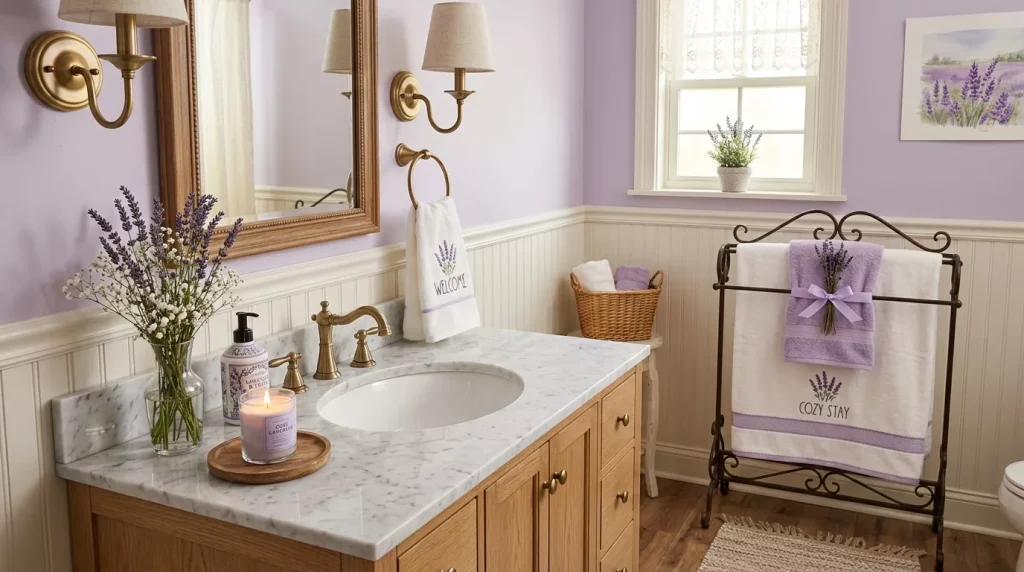
This is the most universally appealing take on lavender bathroom decor. The contrast between lavender and white is gentle enough to feel cohesive but distinct enough to look intentional.
Think white subway tiles with lavender grout, or a white freestanding bathtub against lavender-painted walls. White marble surfaces with lavender accessories — soap dispensers, towels, a diffuser — tie the palette together effortlessly. This combination works especially well in smaller bathrooms because white keeps the space feeling open while lavender adds warmth and interest.
2. Lavender and Grey — The Modern Elevated Look

If the classic lavender and white feels too soft for your taste, pairing lavender with cool grey creates a more sophisticated, contemporary result. This combination has quiet confidence — nothing loud, but clearly considered.
Use grey as your primary tile or wall color and let lavender appear through painted cabinetry, a statement wall, or textiles. Matte grey floor tiles with lavender walls, or a grey vanity with lavender towels and accessories, creates a layered look that feels polished and very current. Brushed nickel or chrome fixtures keep the metal tones cool and consistent.
3. Bohemian Lavender Bathroom
If your home leans eclectic, a boho lavender bathroom lets you play with pattern, texture, and mixed materials freely. Use lavender as the color story — walls, tiles, or textiles in varying purple and lilac tones — then layer in:
- Macramé wall hangings in cream or natural fiber
- Patterned floor tiles in terracotta, cream, and lavender
- Rattan accessories — a small shelf, a storage basket, a mirror frame
- Trailing plants like pothos or ivy in ceramic pots
- Vintage glass bottles in purple-tinted shades on the windowsill
The boho approach welcomes imperfection and personality, making it the most forgiving style if your bathroom has quirks or older fixtures you can’t easily replace.
4. Lavender and Gold — The Glamorous Approach
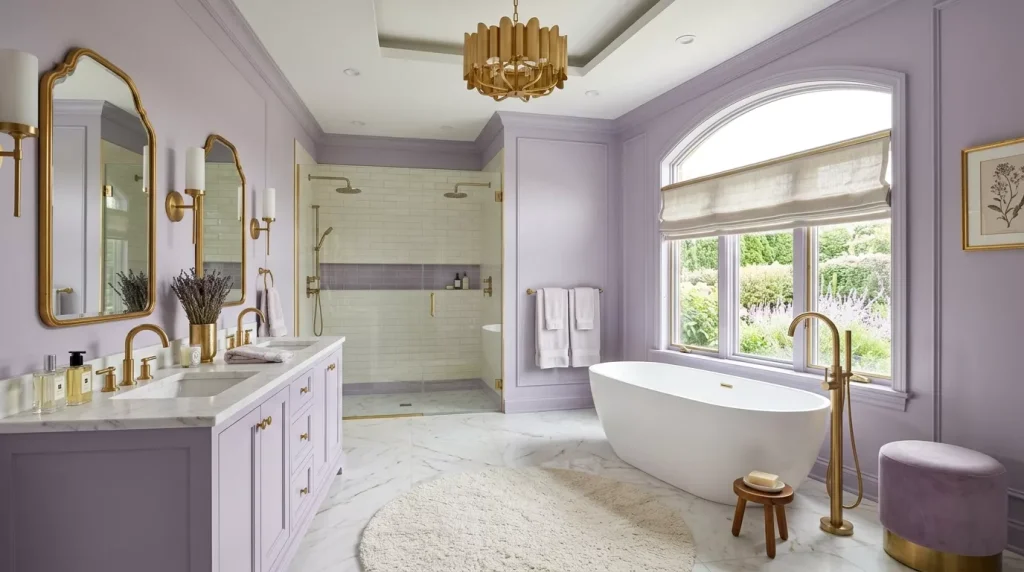
For a bathroom that feels genuinely luxurious, pairing lavender with warm gold or brushed brass elevates the palette from soft and romantic to richly elegant.

Lavender walls or tiles with gold-toned fixtures — a brass faucet, gold towel rings, a gilded mirror — create a combination that feels almost jewel-like. Add a deeper aubergine accent in artwork or a small vase, and the room takes on a genuinely opulent quality. This style works best in larger bathrooms or spaces with architectural detail like a claw-foot tub or decorative tile work.
How to Add Lavender Bathroom Decor Without Remodeling
Not everyone can retile or repaint — especially renters or those on a tight budget. The good news is that lavender bathroom decor translates beautifully through accessories alone.
Towels and bath mats are the single easiest swap. A set of soft lavender towels and a matching bath mat changes the color temperature of an entire bathroom immediately. Choose textured cotton or waffle-weave for a spa-like quality.

A lavender shower curtain is your biggest single-piece color statement. It’s visible from the moment you enter and sets the tone for everything else. A linen-look fabric reads elegant; a botanical print with lavender and green reads garden-inspired and fresh.
Candles and diffusers do double duty — they reinforce the color palette and literally scent the room with lavender, amplifying the spa atmosphere.
Soap dispensers, toothbrush holders, and small trays in lavender or soft purple create a cohesive accessory story on your vanity without a single tile change.
A framed botanical print featuring lavender sprigs adds wall interest and ties the palette together with zero permanent commitment.

Step-by-Step Guide to Decorating Your Lavender Bathroom
Step 1: Decide Your Lavender Intensity Lavender exists on a wide spectrum — from barely-there lilac to rich purple. Decide where you want to land before buying anything. A soft, dusty lavender creates a delicate spa feel; a deeper purple-lavender reads more dramatic and moody. Pull a few paint swatches and hold them against your existing surfaces to see which works.
Step 2: Choose Your Lavender’s Main Role Where will lavender appear most prominently? Options include wall paint, wall tiles, an accent wall, major textiles, or cabinetry. Pick one dominant application and build everything else around it. Applying lavender everywhere at once usually results in an unbalanced room.

Step 3: Set Your Secondary Palette White is the safest and most flattering secondary color. Grey gives a modern, elevated feel. Sage green creates botanical harmony. Warm gold adds glamour. Choose one or two secondaries and maintain them consistently throughout.
Step 4: Address Walls or Major Surfaces First If you’re painting or retiling, always do this before purchasing any accessories. Color looks completely different once surrounded by your bathroom’s specific lighting, flooring, and existing fixtures. Test on the actual wall, not a sample card.
Step 5: Choose and Layer Your Textiles Bring in towels, a bath mat, a shower curtain, and soft furnishings in coordinating lavender and neutral tones. They don’t all need to be the exact same shade — variation within the lavender family (lilac, dusty purple, soft violet) reads more interesting than a rigid color match.

Step 6: Add Fixtures and Hardware Where Possible Swapping old chrome fixtures for brushed nickel or brass makes a significant difference in how refined the finished bathroom feels. Even new towel rings or a new mirror can update the space substantially.
Step 7: Layer in Accessories and Finishing Details Candles, a soap dish, a small plant, a framed print, an apothecary jar with bath salts. These final details are what make the space feel genuinely personal. Edit ruthlessly — in a bathroom, a few well-chosen objects look far better than a crowded collection.
Lavender Bathroom Decor Elements at a Glance

| Element | Lavender Application | Best Pairing Color | Effect |
|---|---|---|---|
| Wall Paint | Soft lavender or lilac | White trim, white tiles | Open, airy, spa-like |
| Wall Tiles | Lavender subway or hex tiles | White or grey grout | Elegant textured depth |
| Shower Curtain | Solid lavender linen | Chrome or gold rings | Soft, strong focal point |
| Towels & Bath Mat | Dusty lavender cotton | White walls, grey floor | Affordable color anchor |
| Vanity Cabinet | Painted lavender | White countertop, brass hardware | Curated, elevated look |
| Accessories | Lavender soap dispenser, tray | Gold or white surfaces | Cohesive vanity styling |
| Artwork | Botanical lavender print | White frame on white wall | Personal, finished feel |
| Plants | Green plants in lavender pots | Any surface | Life, contrast, texture |
| Candles | Lavender or soft purple tones | Natural or white holders | Warmth and scent layering |
Lavender vs. Other Popular Bathroom Color Palettes

| Color Palette | Mood | Best For | Limitation |
|---|---|---|---|
| Lavender | Calm, romantic, spa-like | Most bathroom sizes and styles | Can feel dated if overdone |
| All White | Clean, crisp, timeless | Small bathrooms needing light | Feels clinical without texture |
| Navy & White | Bold, classic, structured | Traditional or coastal styles | Heavy in small spaces |
| Sage Green | Natural, grounded, restful | Botanical and organic aesthetics | Tricky to pair with warm tones |
| Blush Pink | Soft, romantic, feminine | Powder rooms and small bathrooms | Can feel too sweet without contrast |
| Charcoal & White | Sleek, modern, dramatic | Larger bathrooms with good light | Feels cold without warm accents |
Lavender delivers one of the most broadly flattering bathroom palettes available. It’s colorful without being overwhelming, feminine without being exclusively so, and calming without veering into blandness.

Pros and Cons of Lavender Bathroom Decor
✅ Pros
- Genuinely calming — lavender’s psychological association with rest makes it a perfect bathroom color choice
- Pairs with many colors — white, grey, gold, sage green, and blush all work harmoniously alongside it
- Accessible at every budget — lavender towels and accessories achieve the look without any structural changes
- Photographs beautifully — lavender reads warm and soft in photos, perfect for well-styled interior shots
- Timeless in muted tones — dusty, greyed-out lavender has an enduring quality that trendier colors lack
- Gently brightens rooms — light lavender reflects light with warmth, avoiding the harsh edge of pure brilliant white


❌ Cons
- Can feel dated if oversaturated — heavy, bright purple applied to every surface reads as an earlier era of design
- Tricky in dark bathrooms — without enough light, lavender can read as flat grey rather than a clear, soft purple
- Requires careful shade selection — the wrong lavender (too blue, too pink) can make the space feel unintentionally off-balance
- Less universally appealing at resale — more personal than white or grey, which may matter when selling the home
- Can clash with warm-toned existing fixtures — very warm yellowed tiles or orange-toned wood can fight with cool lavender tones

Common Mistakes to Avoid
1. Using too many shades of purple at once. Lavender, lilac, violet, mauve, and deep purple all read very differently. Mixing too many creates visual noise rather than a cohesive palette. Choose one or two tones and maintain them consistently.
2. Ignoring the undertone. Lavender can lean blue, pink, or grey. If your bathroom has warm fixtures or flooring, a pink-leaning lavender integrates better than a cool blue-lavender, which will create tension with existing warm elements.
3. Skipping contrast entirely. A bathroom that’s entirely lavender with no white, grey, or neutral counterpart feels overwhelming and closed-in. Always include enough of a grounding neutral to give the lavender space to breathe.

4. Choosing the wrong lighting. Cool fluorescent lighting turns soft lavender flat and grey. Warm lighting at 2700K–3000K makes lavender glow with softness and depth. Always assess your color choices under the actual lighting you’ll use in the room.
5. Over-accessorizing with purple. If the walls, towels, shower curtain, soap dish, and candles are all lavender, the room loses dimension. Let lavender dominate in one or two places and support it with neutrals elsewhere.
Pro Tips for a Stunning Lavender Bathroom
- Test paint swatches at different times of day. Lavender shifts dramatically between morning sun, afternoon light, and evening lamp light. Always check across all three conditions before committing to a full room.
- Use lavender as a statement rather than a base. One lavender accent wall or one lavender vanity has more visual impact than lavender applied to every surface at once.
- Bring in natural greenery. Plants are the best companion to lavender — green and purple is a harmony found throughout the natural world and reads as immediately balanced and refreshing.
- Add scent to reinforce the palette. A lavender diffuser or a glass jar of bath salts on the vanity turns a visual color story into a full sensory experience.
- Choose matte or satin finishes. Glossy lavender tiles or paint can look plasticky. Matte or satin finishes keep the palette looking refined and intentional.
Conclusion
Lavender bathroom decor is one of those choices that rewards you every single time you walk into the room. It creates the kind of space that genuinely makes you want to linger — to take the bath instead of the quick shower, to light a candle on a regular Tuesday evening, to treat the bathroom as the self-care sanctuary it was always meant to be.
Whether you go all-in with lavender walls and coordinating tiles or start simply with a new shower curtain and a set of fresh towels, this palette has a way of transforming the energy of a bathroom like few other colors can.
The key is choosing the right shade for your space and light conditions, building a cohesive secondary palette to support it, and resisting the urge to saturate every surface with purple. Restraint and thoughtful layering are what separate a bathroom that feels beautifully designed from one that just feels heavily decorated.
Ready to bring this calming, elegant color into your home? Start with one lavender element today — a candle, a towel set, a shower curtain — and see how quickly the idea grows into a bathroom you genuinely love stepping into.
Frequently Asked Questions (FAQs)
Q1: What colors go best with lavender in a bathroom?
White is the most universally flattering partner — it keeps the space clean, airy, and bright. Soft grey creates a more sophisticated, contemporary pairing. Sage green adds botanical harmony that feels very current. Warm gold or brushed brass makes the palette feel luxurious. Dusty blush works for a softly romantic look. Avoid very warm yellows, oranges, or dark woods unless your lavender has enough pink in it to bridge the tonal gap.
Q2: Is lavender a good color for a small bathroom?
Absolutely — with the right approach. Lighter, more muted lavender shades reflect light and create an airy feel in compact spaces. Balance the lavender with enough white or light grey to prevent the room feeling enclosed. In very small bathrooms, avoid deep, saturated purples — stick to soft, dusty lavender tones and let white be your dominant wall or tile color.
Q3: What shade of lavender paint works best in a bathroom with no natural light?
Choose the lightest, most muted lavender available — something that appears almost more white than purple in natural daylight. This prevents the color reading as flat or dingy under artificial lighting. Pair it with the warmest possible bulbs (2700K) and use mirrors generously to maximize light reflection throughout the space.
Q4: How do I update a bathroom to a lavender theme without spending much?
The most cost-effective moves are: a new lavender shower curtain, lavender towels and a bath mat, a lavender-scented candle or diffuser, and a plant in a lavender or purple pot. A single tin of lavender paint used on one wall or on cabinet fronts also makes a dramatic difference for very little outlay.
Q5: Will lavender bathroom decor feel too feminine for a shared bathroom?
Not necessarily. A dusty lavender or lavender-grey tone paired with white tiles, grey stone surfaces, and brushed nickel fixtures reads as contemporary and broadly appealing rather than exclusively feminine. The more muted and less pink-leaning the lavender, the wider its appeal becomes. It’s primarily the bright, candy-purple or heavily floral applications that read as strongly feminine.
Q6: How do I stop lavender looking dated in a bathroom?
Choose muted, dusty, or greyed-out lavender tones rather than bright, saturated purple. Pair lavender with contemporary finishes — matte black or warm brass fixtures, large-format tiles, linen-look textiles, simple framed mirrors — to anchor it in a current aesthetic. Avoid overly decorative, frilly, or matching-set approaches, which give a dated feel regardless of the specific color being used.