Bathroom Mirror Ideas to Elevate Any Style

Bathroom Mirror Ideas to Elevate Every Style of Bath Space

Few things change the feeling of a bathroom as immediately and affordably as replacing or upgrading the mirror. It’s one of those changes that sounds minor until you actually make it — and then you can’t believe how long you lived with the old one. The right mirror adds light, depth, character, and proportion to a bathroom. The wrong one makes even the most beautifully tiled space look unfinished. That’s why exploring bathroom mirror ideas before committing to a purchase is time genuinely well spent.
This guide walks through every major style, shape, and functional mirror type — along with sizing guidance, placement tips, lighting considerations, and honest pros and cons — so you can make a decision you’ll still love years from now.
Why the Bathroom Mirror Matters More Than Most People Realize
The bathroom mirror is almost always the first thing you see at eye level when you walk into the space. It sits above the vanity — the room’s functional focal point — and it reflects light, multiplies the perceived space, and frames the entire aesthetic of the room.
A mirror that’s too small makes the vanity below look orphaned. One that’s too large can overwhelm a compact bathroom. The wrong frame clashes with the fixtures. The right choice, though, pulls everything together in a way that makes the whole room feel intentional.

There’s also the practical dimension. You use your bathroom mirror multiple times a day — getting ready in the morning, winding down at night. Lighting quality relative to the mirror, the height at which it’s hung, and whether it provides a true or slightly distorted reflection all affect the quality of your daily experience in ways that might seem trivial until you’re applying makeup under a poorly lit mirror mounted two inches too high.
All of this is to say: the bathroom mirror decision deserves genuine thought, not a last-minute choice driven by what’s in stock.
Types of Bathroom Mirrors: A Complete Style Guide
1. Framed Bathroom Mirrors
A framed mirror is exactly what it sounds like — a reflective surface surrounded by a decorative frame in wood, metal, resin, or other materials. This is the most versatile category in bathroom mirror design because the frame itself carries so much of the aesthetic weight.
The same basic mirror shape in a distressed wood frame, a brushed gold metal frame, and a matte black thin-profile frame will read as three completely different design statements. This flexibility makes framed mirrors the go-to choice for anyone who wants their mirror to actively contribute to the room’s style rather than just reflecting it.

Most popular framed mirror styles right now:
- Thin metal frames in matte black or brushed brass — clean, modern, pairs beautifully with contemporary vanities
- Wide ornate frames in antique gold or silver — traditional and maximalist, excellent in vintage-inspired bathrooms
- Natural wood frames in walnut or oak — warm, Scandinavian-influenced, connects organically to wood vanity tones
- Reclaimed or distressed wood frames — farmhouse and rustic character, adds tactile warmth
- Resin frames with carved detail — traditional and coastal styles, available in painted finishes
Best for: Every bathroom style — the frame does the design work
2. Frameless Bathroom Mirrors
A frameless mirror — a clean sheet of glass with polished or beveled edges and no surrounding frame — is the minimalist’s first choice. Without a frame to draw the eye, the mirror recedes into the wall and reads as architectural rather than decorative.
This quality makes frameless mirrors excellent in very contemporary or minimalist bathrooms where every element is deliberately reduced to its most essential form. They’re also a smart choice in bathrooms with very busy tile work, bold wallpaper, or strong architectural detail — they reflect without competing.

The absence of a frame does mean the mirror itself can look cold or clinical in warmer, more layered bathroom styles. In those contexts, a framed option almost always serves the room better.
Best for: Minimalist, contemporary, and industrial bathroom styles
3. Backlit and LED Bathroom Mirrors
Backlit mirrors have moved from a high-end luxury feature to a genuinely accessible option in recent years, and their popularity reflects just how much they improve the daily bathroom experience. An LED mirror emits diffused light from behind or around the mirror’s edge — creating a glowing halo effect that provides even, flattering facial illumination.
For anyone who applies makeup, grooms facial hair, or simply wants to see their face accurately without harsh overhead shadows, a backlit mirror is a functional upgrade that pays off every single day.
Modern LED mirrors also commonly include:

- Dimmer controls — adjustable from bright task lighting to soft ambient glow
- Color temperature settings — switch between cool daylight and warm white light
- Defog/demist function — a heated element prevents steam condensation
- Touch or motion-sensitive controls — frameless operation for a clean look
- USB charging ports — built into the mirror frame for device charging
The style tends toward the contemporary and minimalist — most LED mirrors have frameless or thin-profile designs — but they work in any bathroom where modern functionality is a priority alongside aesthetics.
Best for: Modern, contemporary, and any bathroom where lighting quality matters most
4. Arched and Curved Bathroom Mirrors
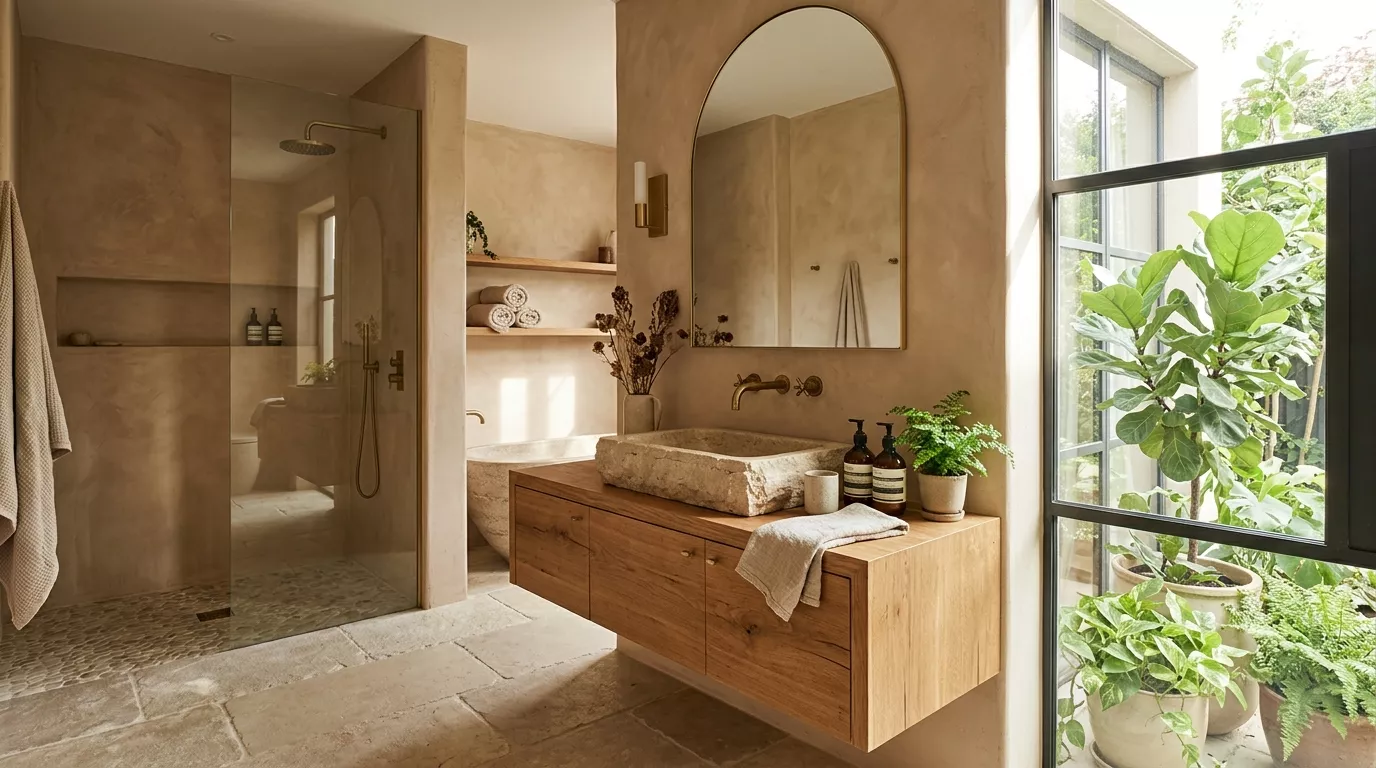
The arched mirror has become one of the most recognizable shapes in current interior design — and bathrooms are one of the best places to use it. The curved top softens the angular geometry that characterizes most bathrooms (rectangular tiles, square-cornered vanities, linear fixtures) and introduces a graceful, almost architectural quality.

Arched mirrors work across a surprisingly wide range of styles:
- In a modern bathroom, a thin black metal arched frame reads as graphic and deliberate
- In a Mediterranean or Spanish-influenced bathroom, a wide arched mirror with ornate details feels completely at home
- In a minimalist bathroom, a frameless arched mirror is quietly beautiful
- In a vintage or antique-inspired bathroom, an arched mirror with a brass or antiqued silver frame adds period-appropriate character
The height-to-width ratio of the arch matters. A tall, narrow arch reads as elegant and cathedral-like. A wide, shallower arch reads as warmer and more casual. Choose based on the proportions of the wall and the feeling you want the room to convey.
Best for: Modern, transitional, Mediterranean, and maximalist bathroom styles
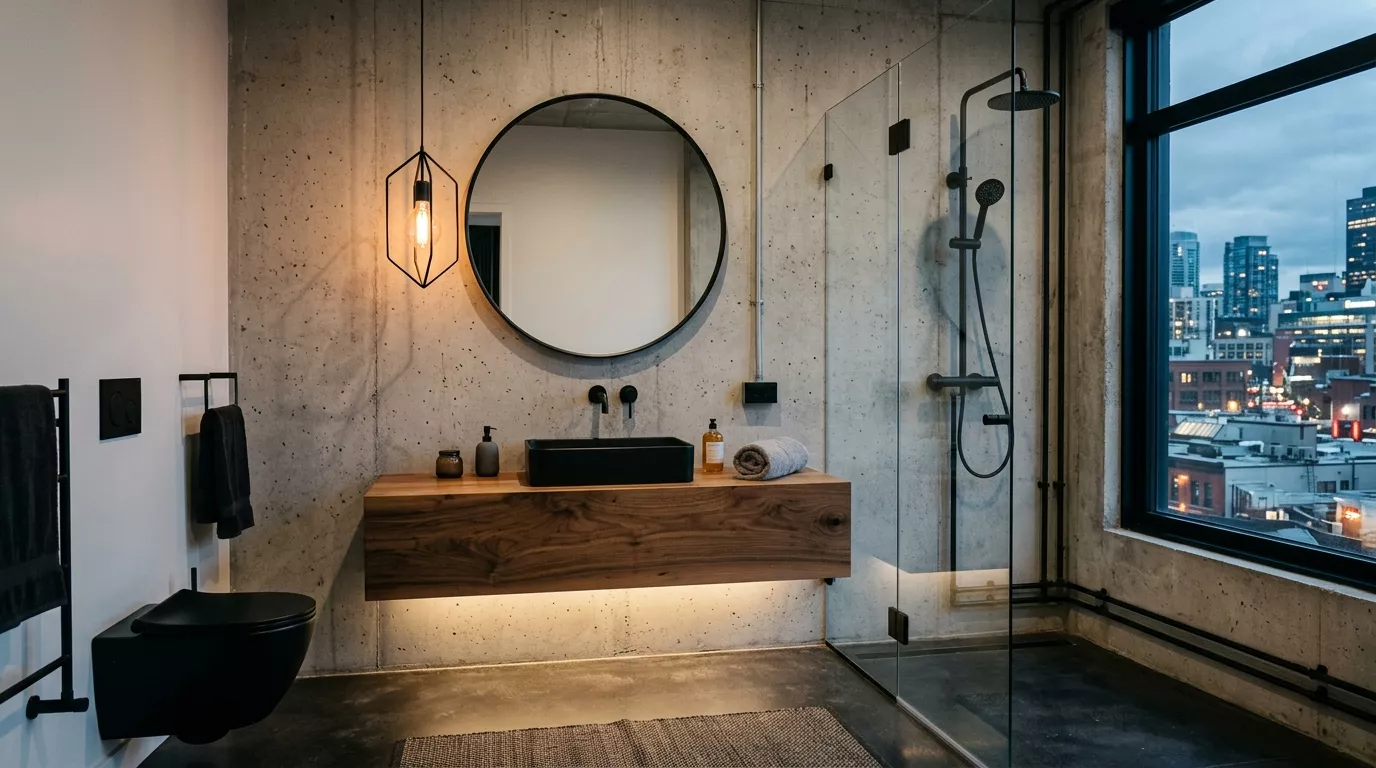
5. Round and Oval Bathroom Mirrors

Round and oval mirrors serve much the same softening function as arched mirrors but in a more compact, self-contained way. They’re particularly effective in bathrooms with a lot of hard right angles — a round mirror above a rectangular vanity creates a pleasing geometric conversation that neither shape could achieve alone.
Round mirrors work beautifully as accent pieces in larger bathrooms — perhaps a pair of round mirrors above a double vanity rather than one long rectangular mirror — and as a primary mirror in smaller bathrooms where their compact format fits naturally.
Best for: Contemporary, eclectic, coastal, and boho-inspired bathrooms; double vanity configurations
6. Medicine Cabinet Mirrors
The medicine cabinet mirror solves a problem that purely decorative mirrors don’t address: storage. A recessed or surface-mounted medicine cabinet with a mirrored door provides bathroom counter-clearing storage for medications, skincare, and grooming products while fulfilling the mirror’s reflective function.

Modern medicine cabinet designs have evolved significantly — many are now frameless or thin-framed, some with interior lighting, and available in sizes that approach the visual impact of a decorative mirror. For bathrooms where counter and under-sink storage is limited, a well-chosen medicine cabinet mirror earns its place both functionally and aesthetically.
Best for: Small bathrooms, practical-priority spaces, powder rooms
7. Full-Length Bathroom Mirrors
In larger bathrooms and master bath suites, a full-length mirror adds both practical function and visual drama. Leaned against a wall, mounted vertically on a door, or hung floor-to-ceiling on a blank wall, a full-length mirror amplifies light and creates the impression of significantly more space.
A full-length mirror paired with good lighting transforms a master bathroom into something that functions like a dressing room — an increasingly popular design choice in primary suite renovations.
Best for: Master bathrooms, larger bath spaces, primary suite renovations
Step-by-Step Guide: How to Choose the Perfect Bathroom Mirror

Step 1 — Measure the Vanity and the Wall
The mirror’s width should relate directly to the vanity below it. The most reliable guideline: the mirror should be the same width as the vanity or up to two inches narrower on each side. This creates visual alignment between the two pieces.
Never hang a mirror wider than the vanity below — it looks unanchored and disrupts the proportional relationship between the two pieces.
Step 2 — Determine the Right Height for Hanging
The center of the mirror should be approximately at eye level for the adults using the bathroom most frequently. A general starting point: the bottom of the mirror should sit 5–10 inches above the backsplash or vanity top. This leaves room for lighting, faucets, and visual breathing space between the counter and the mirror.
Step 3 — Match the Mirror Style to Your Existing Fixtures
Your mirror frame’s metal finish should coordinate with the existing hardware in the bathroom — faucet handles, towel bars, drawer pulls, and light fixture finishes. You don’t have to match exactly (mixing metals is acceptable in the right context) but the mirror’s dominant metal tone should feel intentionally connected to the room’s fixture palette.

Step 4 — Decide on Lighting Placement Relative to the Mirror
| Lighting Placement | Effect | Best Mirror Type |
|---|---|---|
| Above the mirror | Common but casts downward shadows | Traditional and transitional bathrooms |
| Side sconces (flanking) | Most flattering, even facial illumination | Framed and frameless mirrors |
| Integrated LED (backlit) | Soft, even glow from behind | LED/backlit mirrors |
| Side + above combination | Maximum illumination, minimal shadow | Larger mirrors in master baths |
Lighting flanking the sides of a mirror at face level is the most flattering option — it eliminates the shadows cast by overhead-only lighting. If you can only choose one lighting type, side sconces at eye level win.

Step 5 — Consider the Frame Material in Context of Humidity
Not every frame material holds up equally in a bathroom environment. Humidity and steam affect some materials more than others.
| Frame Material | Humidity Resistance | Maintenance Level |
|---|---|---|
| Metal (powder-coated) | Excellent | Very low |
| PVC/resin | Excellent | Very low |
| Teak and moisture-resistant wood | Good | Low-medium |
| Standard MDF with paint | Moderate | Medium |
| Unfinished or natural wood | Poor — warps and peels | High |
For bathrooms without good ventilation, prioritize metal, resin, or moisture-resistant wood frames over standard wood or MDF.

Step 6 — Hang It at the Right Height and Level
Use a spirit level — always. A mirror hung even slightly off-level is immediately noticeable and surprisingly difficult to un-notice once you’ve spotted it. For heavier mirrors, locate wall studs or use appropriate wall anchors rated for the mirror’s weight. A falling bathroom mirror is both a safety risk and an expensive replacement.
Bathroom Mirror Comparison: Single Large vs. Two Smaller Mirrors
| Feature | Single Large Mirror | Two Smaller Mirrors |
|---|---|---|
| Visual impact | Strong, unified, expansive | More personal and layered |
| Best for vanity type | Single sink or long double vanity | Double sink configurations |
| Flexibility | Less — one large format | More — shape/size variety per sink |
| Cost | Usually lower (one piece) | Can be lower or higher depending on style |
| Installation | One hanging point (heavier) | Two separate hangings |
| Style effect | Clean and minimal | Curated and intentional |
| Works in small baths | Yes (amplifies space) | Can feel busy in very small spaces |
For a double vanity, two mirrors — one per sink — almost always looks more intentional and personal than one long mirror spanning both. For a single-sink bathroom, a single large mirror maximizes reflected light and visual expansion.

Pros and Cons of Popular Bathroom Mirror Types
Framed Mirror
Pros: Huge style variety, adds warmth and character, works in any bathroom aesthetic
Cons: Frame material needs to withstand humidity, can look dated if style changes
Frameless Mirror
Pros: Timeless, minimal, never clashes, easy to clean
Cons: Less personality, can feel cold in warmer bathroom styles
LED Backlit Mirror
Pros: Superior lighting quality, flattering illumination, modern and spa-like
Cons: Higher upfront cost, requires electrical installation, limited style range

Arched Mirror
Pros: Instantly adds architectural interest, versatile across styles, on-trend without being trend-dependent
Cons: Some arch shapes don’t suit all vanity configurations
Medicine Cabinet Mirror
Pros: Adds storage, practical, works in small bathrooms
Cons: More limited aesthetic options, surface-mounted versions add visual bulk
Common Bathroom Mirror Mistakes to Avoid
1. Choosing a Mirror That’s Too Small
This is the single most common bathroom mirror mistake. A small mirror above a large vanity looks like an afterthought. When in doubt, go larger — mirrors that genuinely span the width of the vanity (or close to it) always look more intentional than ones that float apologetically above it.

2. Hanging It Too High
Hanging a mirror so that only tall family members can see their full face comfortably is a surprisingly common error. The center of the mirror should fall at approximately eye level for the primary users — which for most adults means roughly 57–65 inches from the floor.
3. Mismatched Metal Finishes
A chrome faucet, brushed nickel towel bar, and gold mirror frame in the same bathroom reads as incoherent. Commit to one or two coordinating metal tones and carry them consistently throughout the room’s hardware and fixtures.
4. Ignoring Humidity Resistance in Frame Choice
A wood or MDF-framed mirror in a bathroom without adequate ventilation will peel, warp, or grow mold within months. Always check the frame material’s suitability for humid environments before purchasing.
5. Hanging Without Proper Wall Support
A heavy framed or oversized mirror that falls from a wall is a genuine safety hazard and an expensive replacement. Always locate studs or use appropriate anchors — and check the anchor weight rating against the mirror’s actual weight before hanging.

6. Choosing Style Over Practicality
A beautiful mirror that fogs immediately in a hot shower and has no defog function, provides poor lighting for morning grooming, or is mounted too high for comfortable daily use becomes a source of daily frustration. Balance aesthetic ambition with practical functionality — the best bathroom mirrors deliver both.
Quick Tips for a Better Bathroom Mirror Decision
Tip 1: Measure the width of your vanity before shopping for a mirror — write the number down and keep it with you. Mirror shopping without knowing your vanity width leads to expensive sizing mistakes.
Tip 2: If you’re choosing a medicine cabinet, opt for a recessed version over surface-mounted wherever the wall construction allows. Recessed cabinets sit flush with the wall and look dramatically cleaner.
Tip 3: A round mirror above a rectangular double vanity in a smaller bathroom often looks more intentional than two mirrors — the singular circular shape creates a focal point that two competing mirrors sometimes can’t.
Tip 4: Install a dimmer switch for any lighting adjacent to or above your bathroom mirror. The ability to adjust lighting between bright task light and soft ambient sets the difference between a bathroom that only works for one purpose and one that works for all of them.
Tip 5: Wipe bathroom mirrors with a small amount of shaving cream buffed to a clear finish — it reduces fogging and is far cheaper than chemical defog sprays.
Tip 6: For master bathrooms, consider lighting the mirror from three sides — above and both flanking — for the most complete and flattering illumination possible. This is the setup found in professional makeup studios for good reason.
FAQs: Bathroom Mirror Ideas
Q1. How big should a bathroom mirror be relative to the vanity?
The most reliable proportion guideline is that the mirror should be the same width as the vanity or up to two to four inches narrower on each side. For example, a 48-inch vanity is best served by a 44–48-inch mirror. Going wider than the vanity makes the mirror look unanchored and disproportionate. In terms of height, most bathroom mirrors work best at 28–36 inches tall for a single sink bathroom — though taller mirrors can be used with intentional effect in larger spaces.
Q2. What type of bathroom mirror is best for small bathrooms?
For small bathrooms, two principles guide mirror selection: go larger than feels comfortable (a bigger mirror amplifies light and creates the perception of more space) and choose a style with minimal visual weight. A large frameless mirror or a thin metal framed mirror in a light finish expands a small bathroom more effectively than a smaller mirror with a heavy ornate frame. An arched mirror is also excellent in a compact bath — its vertical height draws the eye up and makes low ceilings feel taller.
Q3. Should bathroom mirror frames match vanity hardware?
They should coordinate, though they don’t have to match exactly. The most important alignment is the dominant metal tone — a matte black faucet and drawer pulls should ideally be echoed in the mirror frame, whether exactly matched or paired with a complementary dark metal. Mixing metals intentionally (brushed gold with matte black, for instance) is a legitimate design choice when done consistently throughout the room. What doesn’t work is accidental mismatching — chrome here, brass there, nickel somewhere else — which reads as unconsidered rather than eclectic.
Q4. Are LED bathroom mirrors worth the extra cost?
For most people who use the bathroom mirror daily for grooming, skincare, or makeup, the answer is yes. LED mirrors provide significantly more flattering and even facial illumination than overhead-only lighting, and the color temperature control (warm vs. cool white) allows you to see how your face looks in different lighting conditions before leaving home. The defog function alone is a quality-of-life improvement that most users would not willingly give up once they’ve had it. The upfront cost is higher, but the daily functional benefit is genuine.
Q5. How high should a bathroom mirror be hung?
The bottom of the mirror should sit approximately 5–10 inches above the vanity backsplash or countertop — enough clearance for lighting, faucet operation, and visual breathing room. The center of the mirror should land roughly at eye level for the primary users of the bathroom. For most adults, this places the mirror center between 57 and 65 inches from the floor. In bathrooms used by adults of significantly different heights, centering at the midpoint between their eye levels is the most practical compromise.
Q6. What’s the most timeless bathroom mirror style?
A simple frameless mirror or a thin metal-framed mirror in a brushed finish is the most reliably timeless choice — it coordinates with any vanity style, any fixture finish, and any bathroom aesthetic without competing. Ornate or heavily trend-specific frames date more noticeably as design trends shift. If you want longevity from a single purchase, a clean, proportionally correct mirror with minimal frame detail in a neutral finish will serve any bathroom well for decades regardless of what decorating trends come and go.
Conclusion: The Right Bathroom Mirror Transforms the Whole Space
A well-chosen bathroom mirror is never just a reflective surface. It’s an architectural element, a light amplifier, a style statement, and a functional tool that you interact with multiple times every day. Getting it right — the right size, the right style, the right finish, hung at the right height with the right lighting beside it — changes the entire quality of the space in a way that is disproportionate to both the effort and the cost involved.
Start with your measurements. Know your vanity width and your wall space before you look at a single mirror. Then decide what the mirror needs to do: purely decorative, maximum light amplification, added storage, superior lighting quality. Let those functional requirements narrow your style options, then choose the most beautiful version within that shortlist.
The bathroom you’ve been wanting — calm, well-lit, finished and intentional — often needs nothing more than the right mirror to get there.
Ready to make the change? Measure your vanity today, note your existing fixture finishes, and use this guide to find the mirror that finally makes your bathroom feel complete.