Shaker Cabinet Kitchen Ideas for Every Style

Shaker Cabinet Kitchen Ideas for Every Home Style and Budget
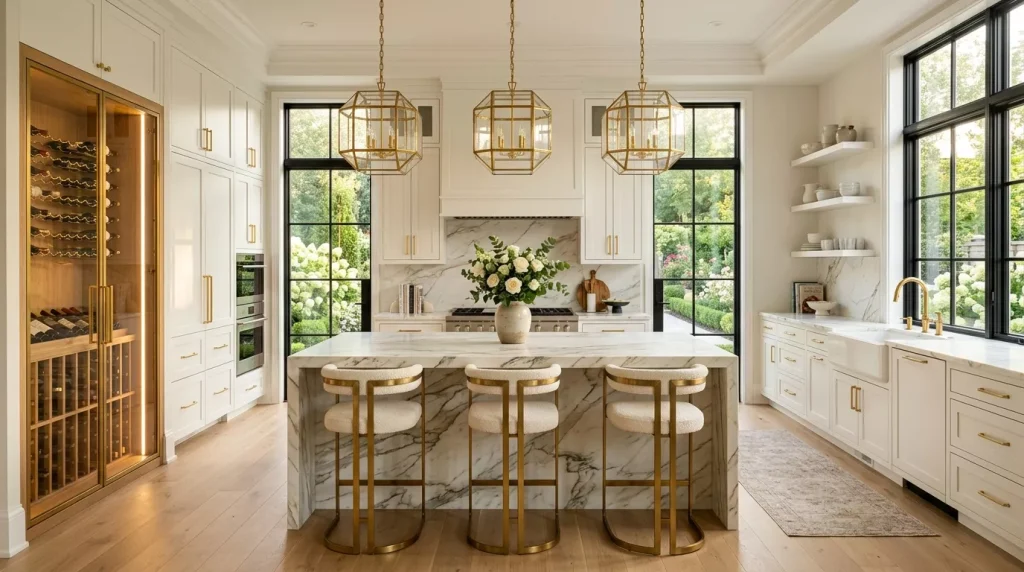
Ask ten interior designers to name the most enduringly popular kitchen cabinet style in residential design and at least nine of them will say the same thing: shaker. There’s a reason for that. Shaker cabinet kitchen ideas have driven kitchen renovations for decades not because they’re trendy but because the exact opposite is true — they’re not. The clean recessed-panel door, the honest use of material, the quiet restraint of the design — these qualities don’t age the way more decorative styles do.
But “shaker kitchen” is a much broader category than it first appears. From stark white minimalist to deeply moody navy, from farmhouse rustic to sleek contemporary, the shaker cabinet is a remarkably flexible canvas. This guide covers every dimension of that flexibility — colors, hardware, countertops, layouts, and the practical decisions that separate a kitchen that looks beautiful in photos from one that functions brilliantly every single day.
What Makes a Cabinet a Shaker Cabinet?
Before getting into design ideas, it helps to understand what actually defines the shaker style — because the term gets applied somewhat loosely and the distinction matters when you’re making purchasing decisions.
A true shaker cabinet door has five components: four flat rails (the surrounding frame) and one recessed center panel. That’s it. No raised ornamentation, no routed detail, no carved embellishment — just a clean frame around a flat inset panel.
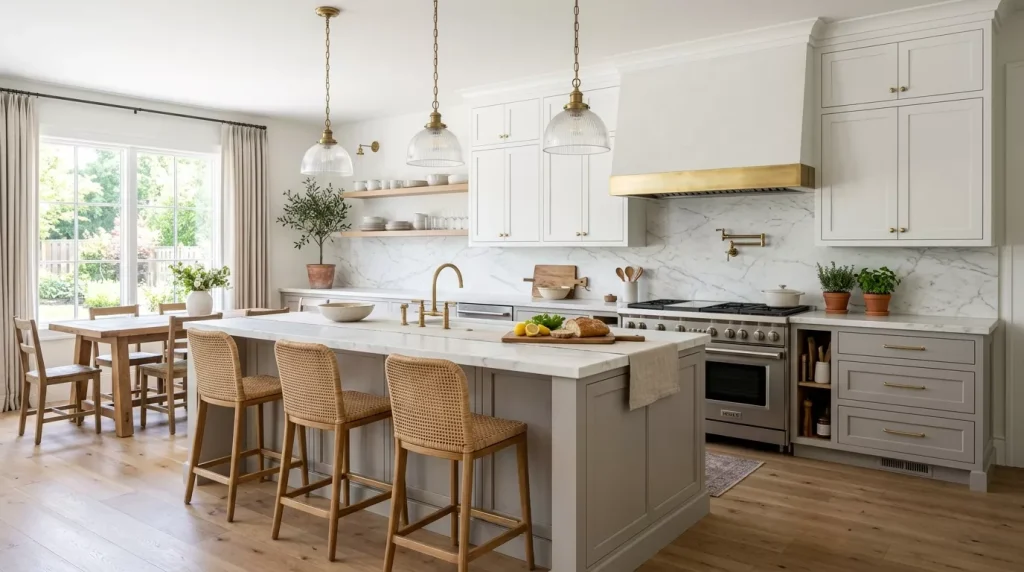
This design originates from the Shaker religious community of the 18th and 19th centuries, whose design philosophy centered on functional simplicity, honest materials, and the elimination of decoration that served no practical purpose. The result was furniture and cabinetry that looked refined without being ornamental — and that quality has proven remarkably timeless.
What the shaker door isn’t is a flat-front slab door (which is modern/minimalist) or a raised-panel door (which is more traditional and ornate). Understanding that distinction helps you avoid choosing something that’s marketed as shaker but is actually something else.
Why Shaker Cabinets Work in So Many Kitchen Styles
The shaker cabinet’s enduring design dominance comes down to one thing: it’s a strong shape without being a loud statement. The recessed panel gives the door visual structure and depth, which prevents it from looking flat or cheap — but there’s nothing about the shape that commits you to a specific era, color, or aesthetic.
That neutrality is the superpower. Pair shaker cabinets with:
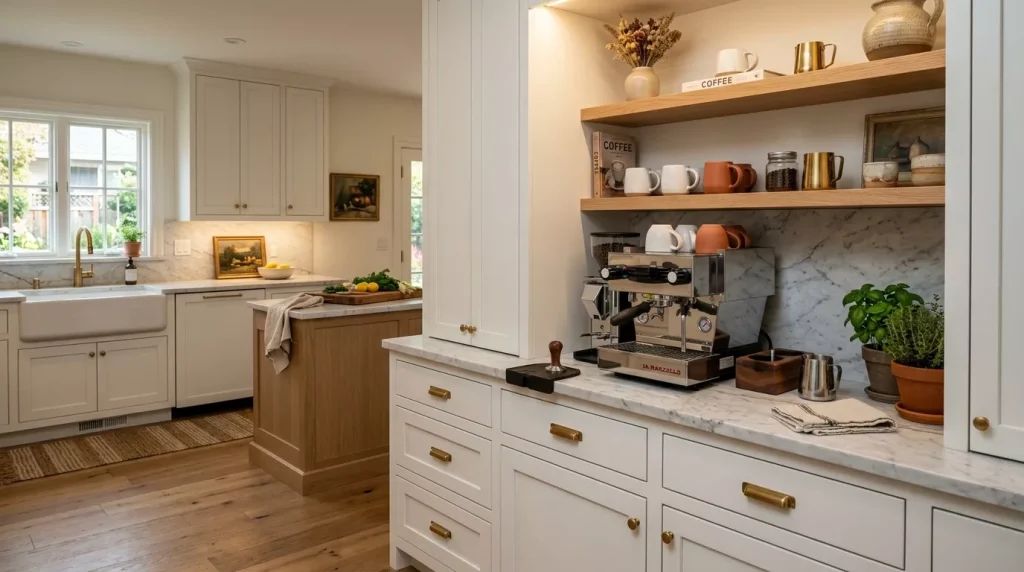
- White or cream paint and chrome hardware → classic traditional kitchen
- Navy or forest green paint and brass hardware → bold, sophisticated modern kitchen
- Natural wood finish and matte black hardware → warm Scandinavian or farmhouse kitchen
- Two-tone configuration with dark lower and light upper cabinets → transitional contemporary kitchen
- All-black with black hardware → dramatic modern kitchen
- Sage green with unlacquered brass → English country or cottagecore kitchen
Each of these reads as a completely different design language — and every single one uses the same underlying cabinet door profile. That range of expression from a single silhouette is genuinely unusual in design, and it’s why shaker cabinets have outlasted every trend cycle they’ve existed through.
Shaker Cabinet Color Ideas: From Classic to Bold
White and Off-White Shaker Cabinets
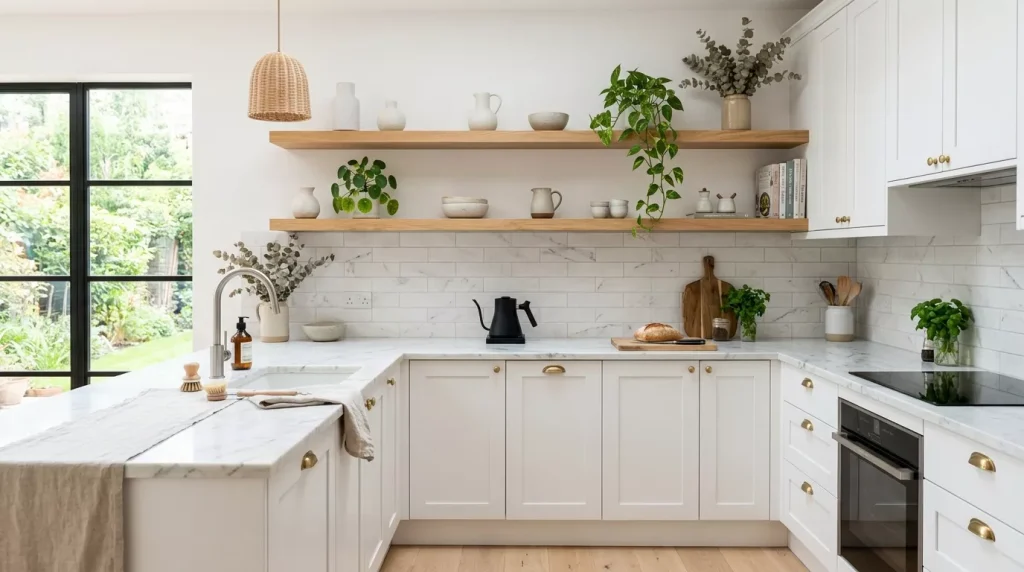
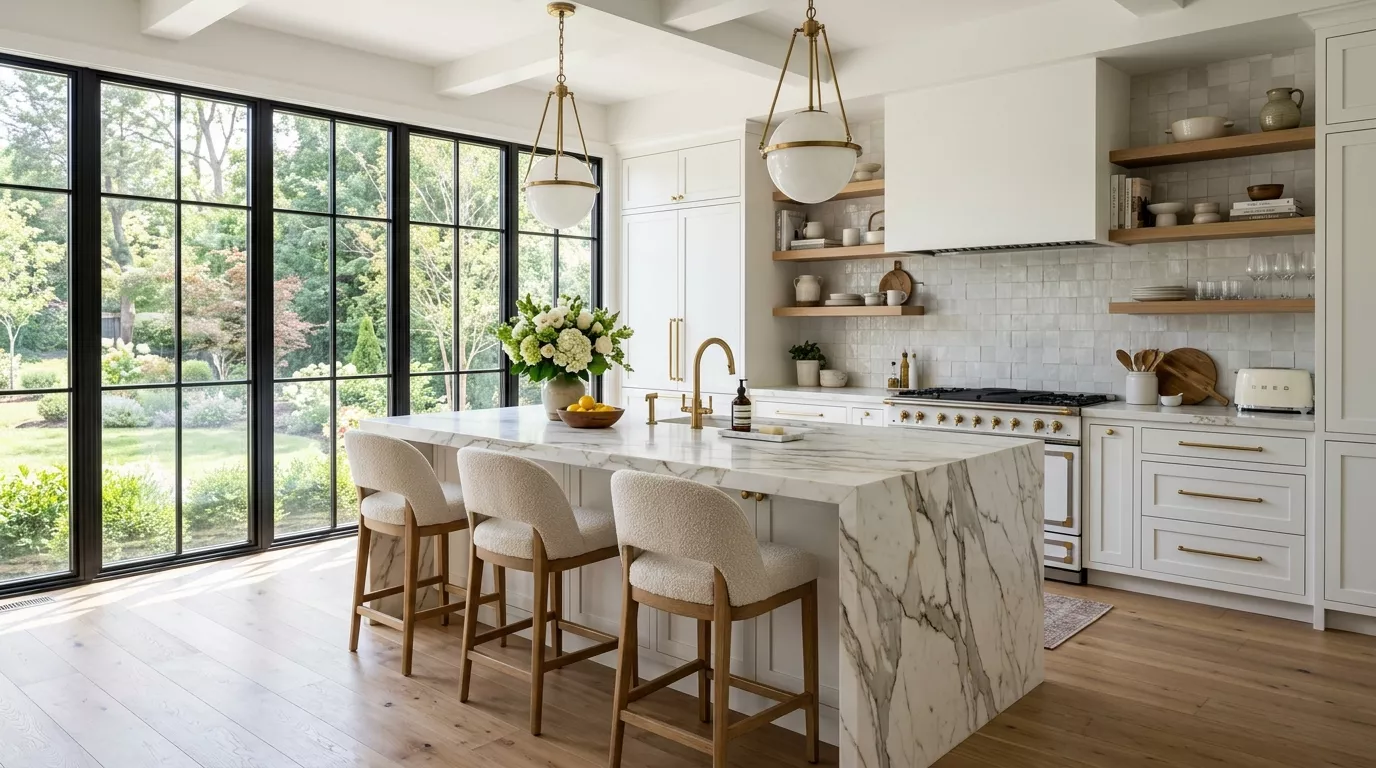
White remains the most popular shaker cabinet choice — and with good reason. A white shaker kitchen feels fresh, bright, and perennially clean. It reflects light in a way that makes even smaller kitchens feel more open, and it provides the most neutral backdrop for countertops, backsplashes, and hardware to stand out.
The key decision within the white family is tone: warm white (with yellow, cream, or pink undertones) feels softer and more traditional. Cool white (with grey or blue undertones) reads as crisper and more contemporary. The right choice depends on your kitchen’s natural light — warm light suits warm whites; cool light suits cool whites.
Best hardware pairings: Chrome, brushed nickel, unlacquered brass, matte black
Navy and Deep Blue Shaker Cabinets
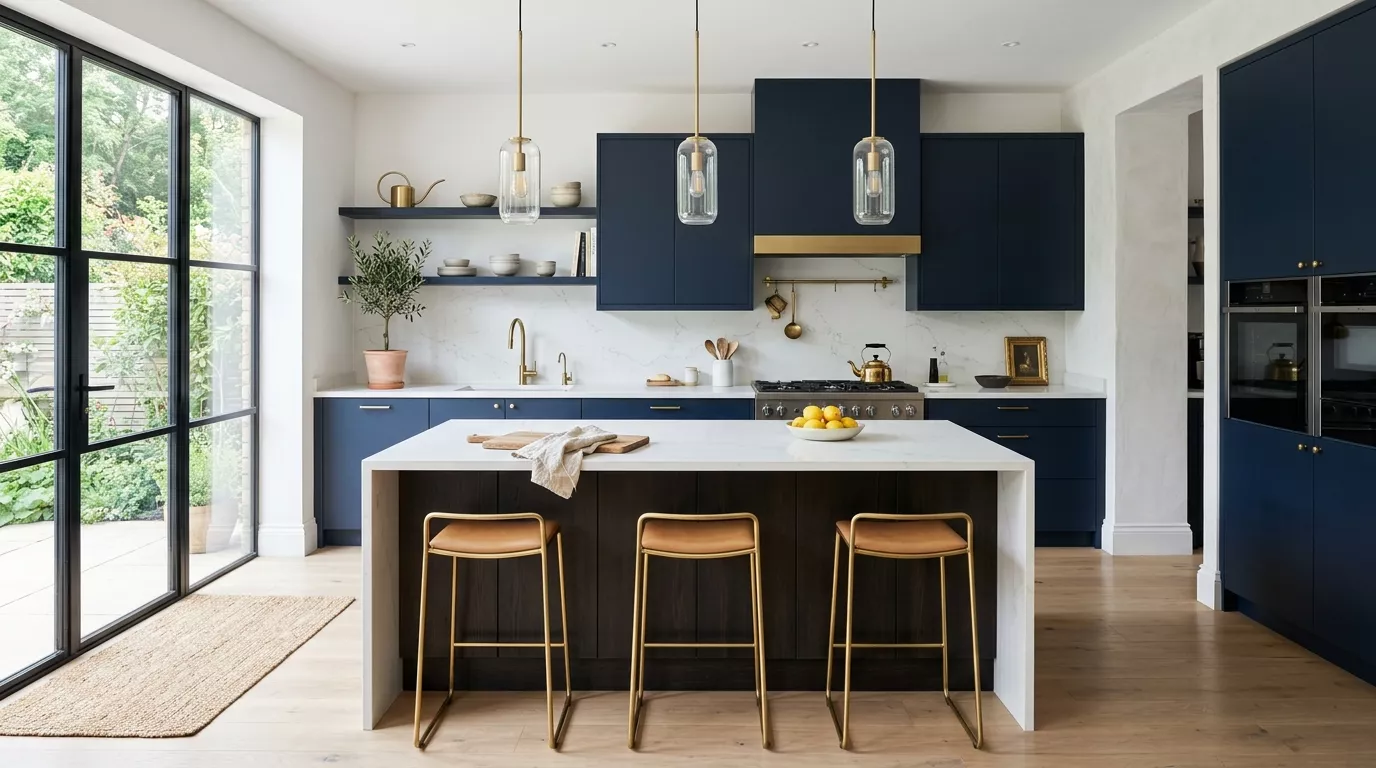
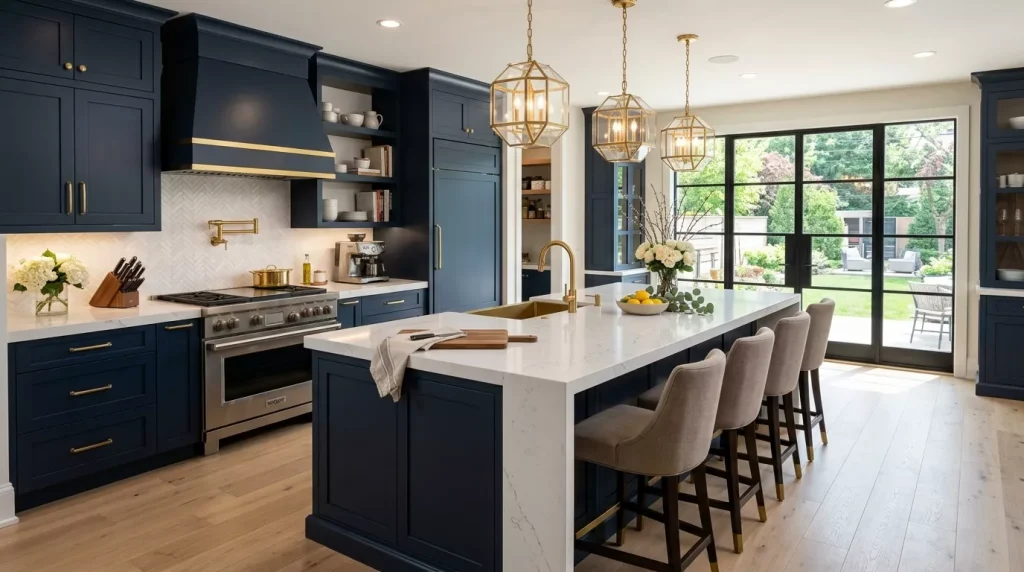
Deep navy shaker cabinets have had a significant moment in kitchen design over the past several years, and it’s a trend that hasn’t lost its appeal because it’s rooted in something genuinely classical — the idea of a kitchen that feels as sophisticated as any other room in the house.
Navy works particularly well on lower cabinets or kitchen islands when paired with white or cream upper cabinets. The contrast creates visual hierarchy that breaks the kitchen into deliberate zones without requiring any structural change.
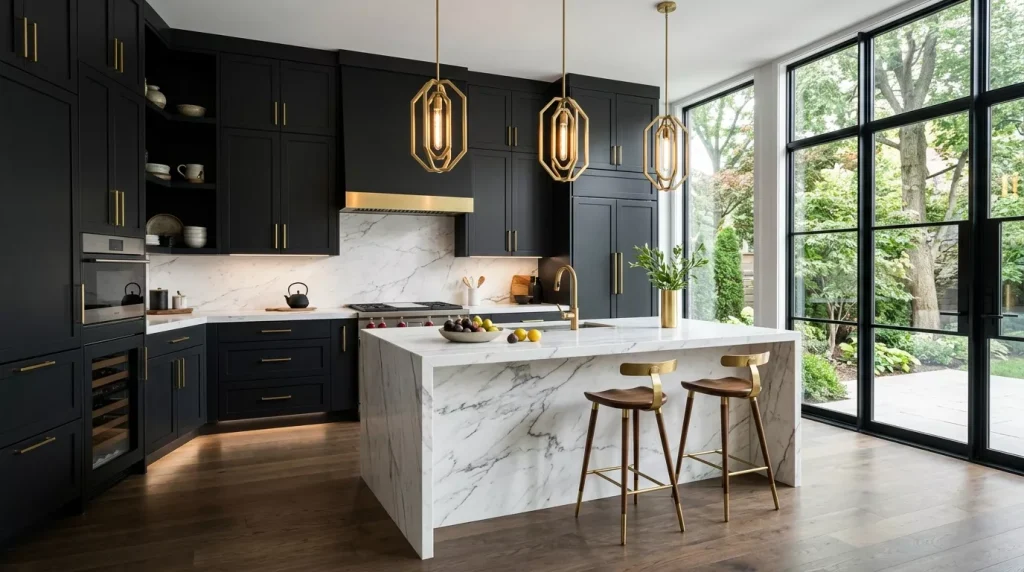
Best hardware pairings: Brushed gold, polished brass, chrome, matte black
Sage Green and Dusty Green Shaker Cabinets
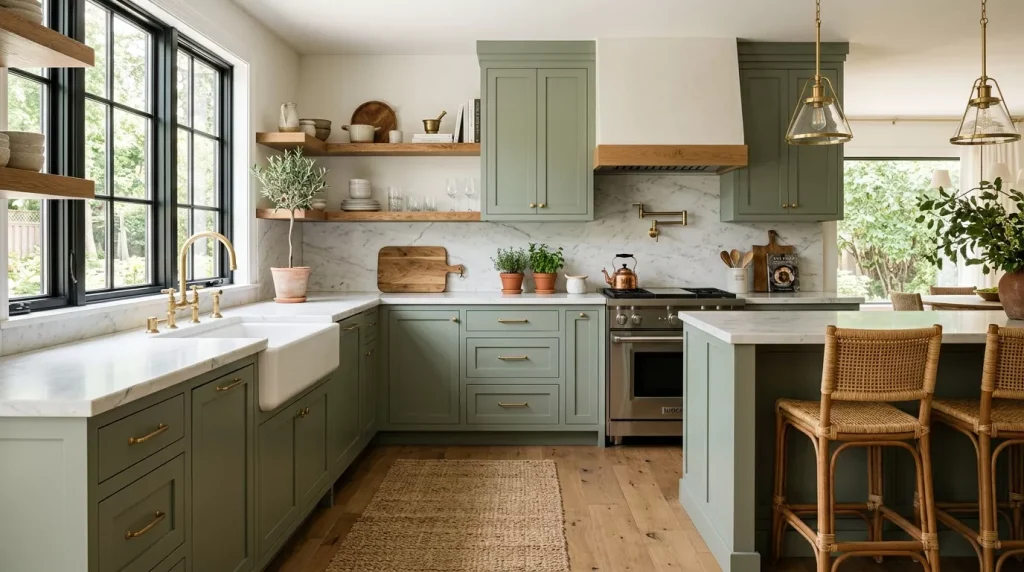
Green kitchens — particularly muted, dusty, or sage-toned greens — have become one of the most beloved color directions in kitchen design. The color connects the kitchen to the natural world in a way that few other choices can, and sage green in particular has a versatility that swings between rustic farmhouse and refined contemporary depending on how it’s paired.
Against natural wood countertops or butcher block, sage green shaker cabinets feel warm and organic. Against white marble or quartz, they feel fresh and elevated. Against a subway tile backsplash, they look classically English.
Best hardware pairings: Unlacquered brass, matte black, warm bronze, brushed gold
Warm Grey and Greige Shaker Cabinets
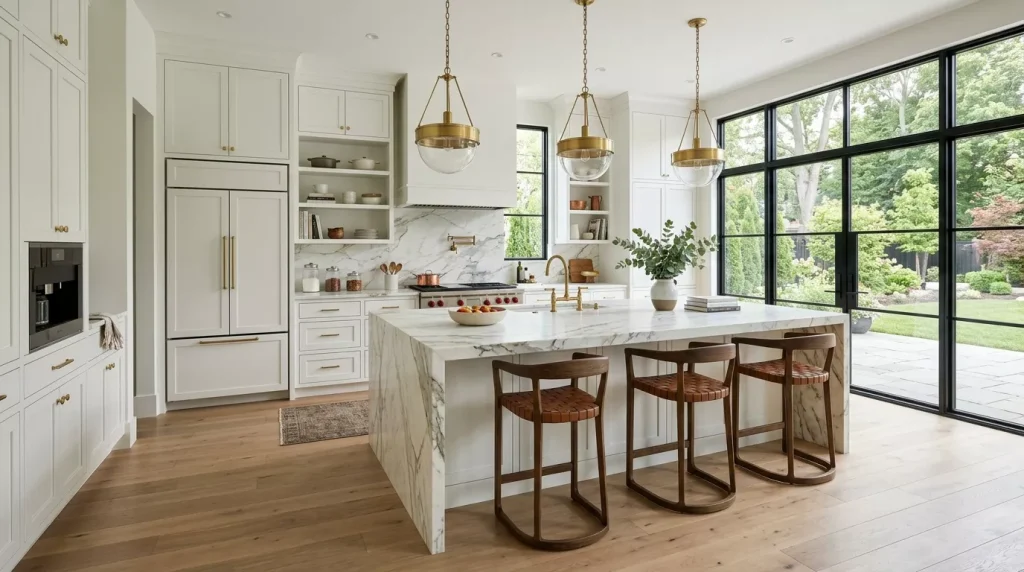
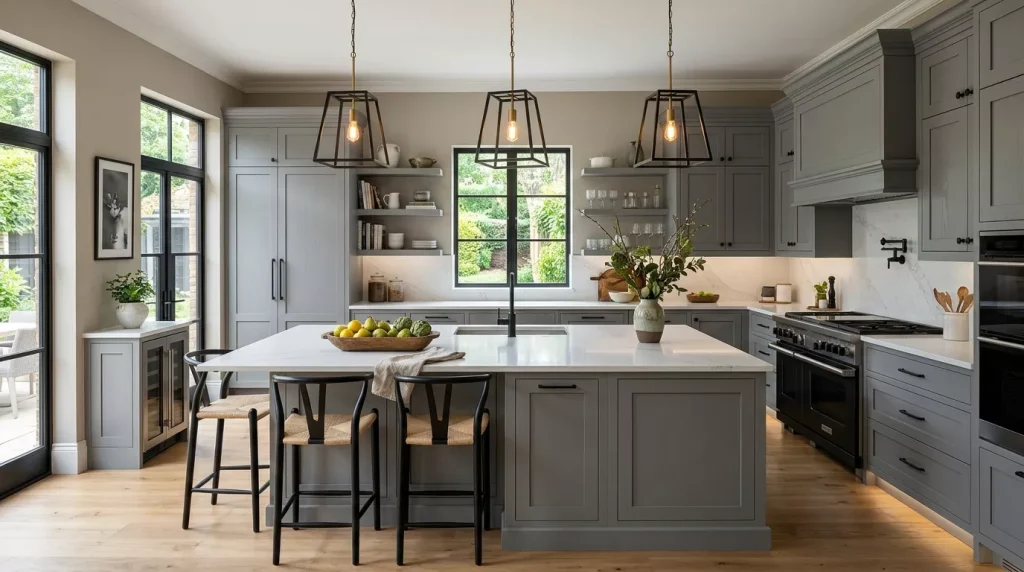
Grey shaker cabinets peaked in popularity a few years ago, but warm grey and greige (grey-beige blend) tones have proven far more lasting than the cooler, bluer greys of the mid-2010s. Warm grey reads as sophisticated and collected — neither as stark as white nor as committed as a bold color.
For homeowners who want a kitchen that feels elevated without taking a strong color position, warm grey is one of the safest and most reliably successful choices.
Best hardware pairings: Brushed nickel, warm brass, chrome, matte black
Natural Wood and Two-Tone Shaker Cabinets
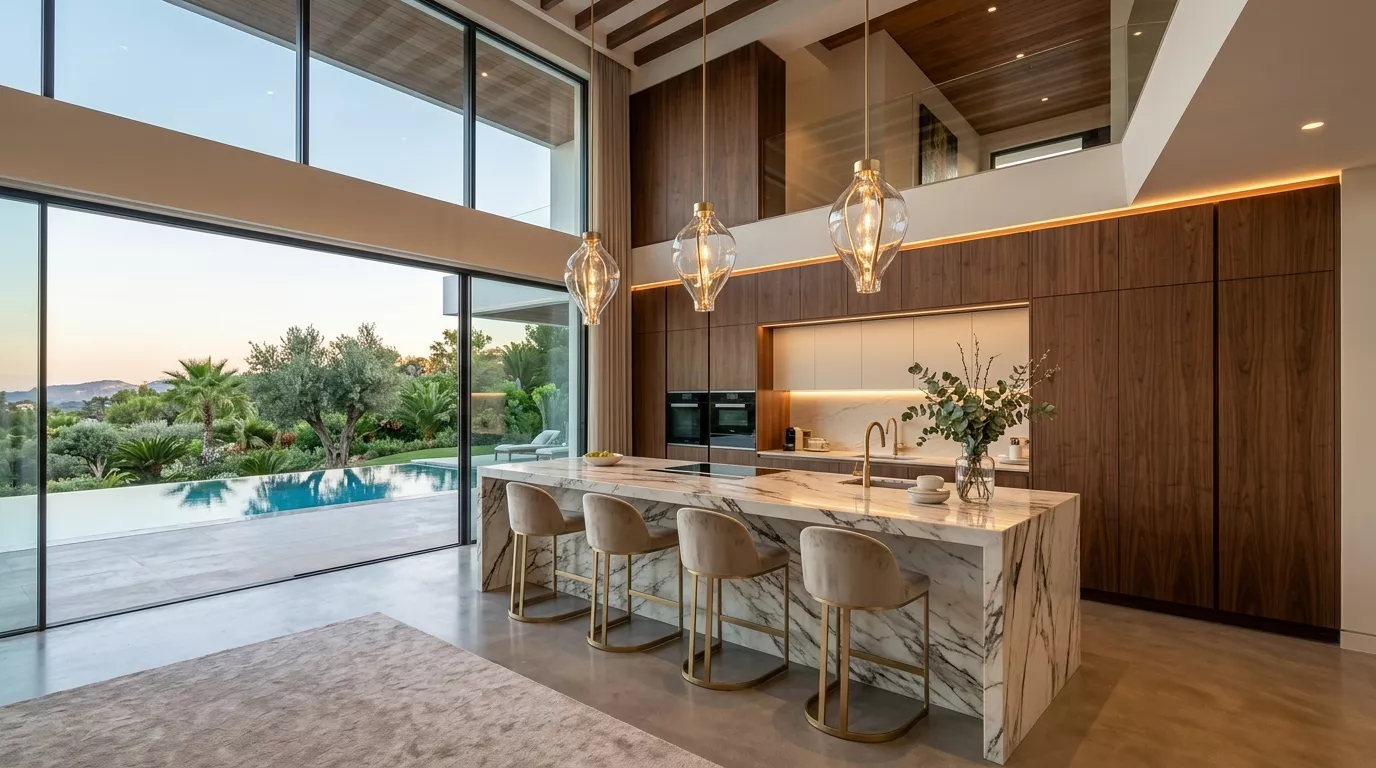
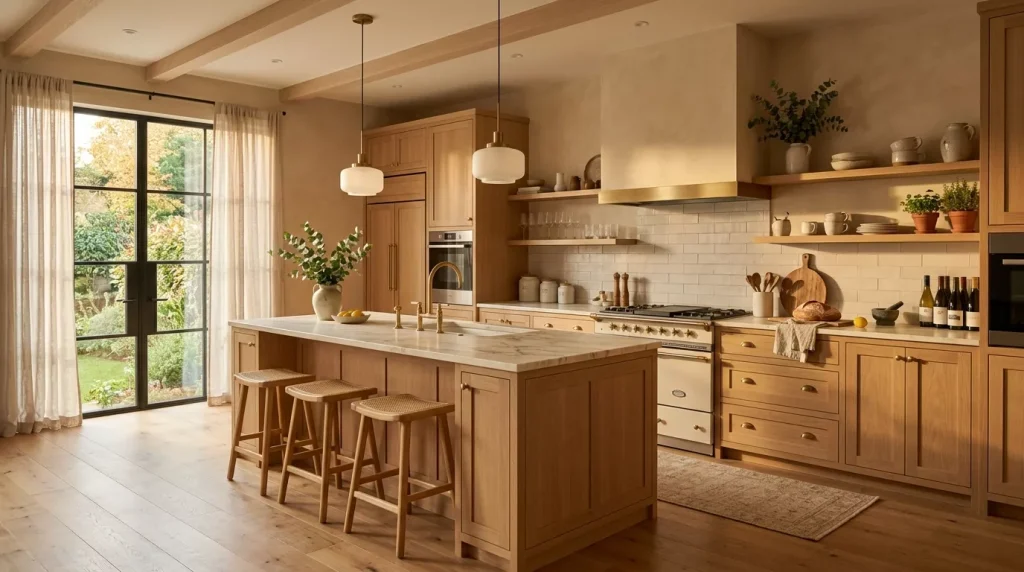
Unfinished or stained wood shaker cabinets bring genuine warmth and organic character to a kitchen that painted cabinets — however beautiful — can’t fully replicate. Walnut, oak, and maple in various stain depths are the most common choices.
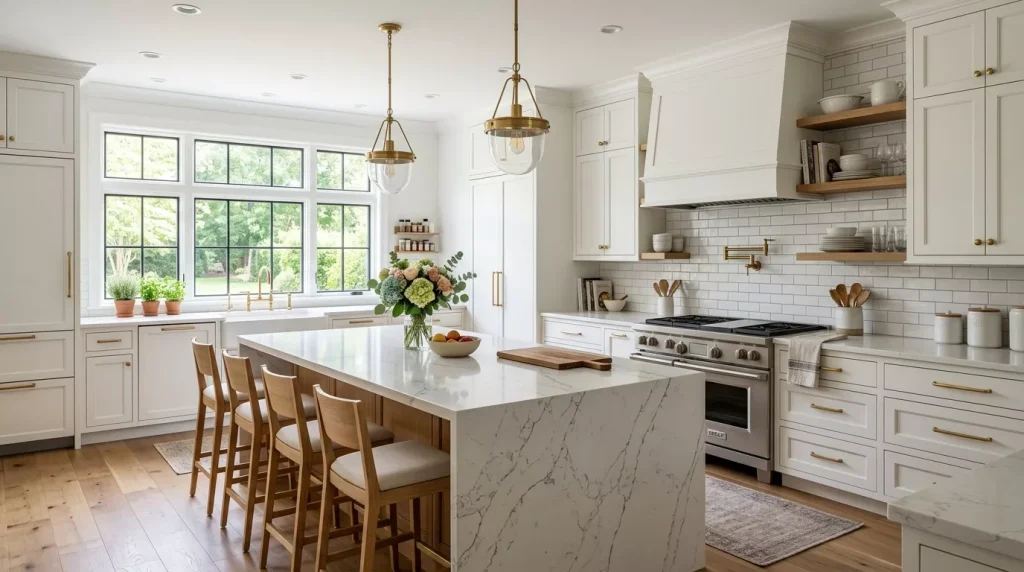
Two-tone kitchens — most commonly white or cream uppers paired with a colored or wood-finished lower cabinet — are one of the most dynamic expressions of the shaker style. The visual separation grounds the kitchen, creates architectural interest, and allows for color flexibility that a single-finish kitchen can’t offer.
Best hardware pairings: Matte black, oil-rubbed bronze, warm brass
Step-by-Step Guide: Planning Your Shaker Cabinet Kitchen
Step 1 — Establish Your Budget Range First
Shaker cabinets span an enormous price range — from stock flat-pack options at a few hundred dollars to semi-custom and full-custom builds at several thousand per linear foot. Establishing your realistic budget before you fall in love with a specific finish or brand prevents painful recalibrations later.
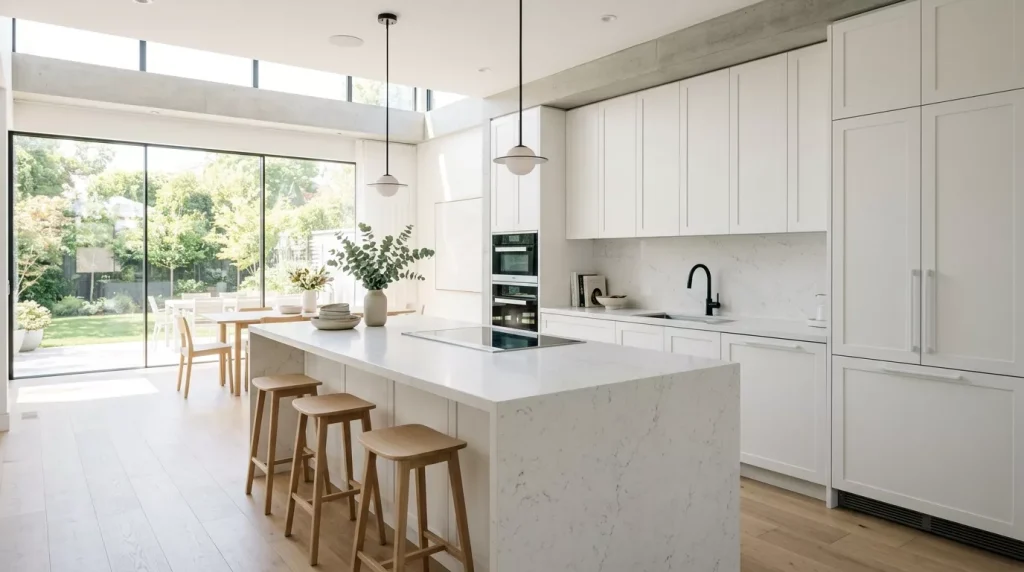
As a general orientation:
| Cabinet Type | Description | Approximate Cost per Linear Foot |
|---|---|---|
| Stock (RTA) | Ready-to-assemble, limited sizes | $60–$150 |
| Semi-custom | More sizes and finishes, faster lead time | $150–$400 |
| Custom | Any size, any finish, any wood species | $500–$1,200+ |
Step 2 — Choose Your Cabinet Material
Shaker cabinets are available in several core material constructions:
- Solid wood: Most durable, most expensive, most responsive to humidity changes
- Plywood box with solid wood door: The industry sweet spot — stable plywood box with a real wood door
- MDF (medium-density fiberboard) painted: Excellent paint adhesion and smooth finish, but heavier and more susceptible to moisture damage than plywood
- Thermofoil: A vinyl film over MDF — budget-friendly but peels over time, especially near heat sources
For most homeowners, a plywood box construction with solid wood or high-quality MDF doors is the best balance of cost, durability, and appearance.
Step 3 — Decide on Door Inset vs. Overlay
This is a detail that significantly affects the final look of the kitchen:
- Full overlay: The door covers nearly all of the cabinet frame — a cleaner, more contemporary look with minimal visible frame between doors
- Partial overlay: The door covers part of the frame, with a visible gap between adjacent doors — more traditional and slightly less refined-looking
- Inset: The door sits flush inside the cabinet frame — the most refined and furniture-like look, also the most expensive and least forgiving of wood movement
For most contemporary shaker kitchens, full overlay is the most popular and practical choice.
Step 4 — Select Your Hardware
Cabinet hardware is the jewelry of a kitchen — small in scale but outsized in impact. For shaker cabinets specifically, hardware choices tend to fall into a few dominant directions:
Pulls (bar or cup handles):
- Elongated bar pulls in matte black: clean, modern, versatile
- Cup pulls in brass or bronze: farmhouse and vintage character
- Rounded bar pulls in brushed nickel: transitional and safe
Knobs:
- Round knobs in solid brass: traditional and warm
- Geometric ceramic knobs: eclectic and artisan
The scale of hardware matters as much as the finish. Undersized pulls on large cabinet doors look fussy and proportionally wrong. Match the pull length to the drawer width — a standard 4–5 inch pull for small drawers, 10–18 inch pulls for large drawers, and centered knobs for standard doors.
Step 5 — Choose Your Countertop to Complement the Cabinets
The countertop is the most visually prominent horizontal surface in the kitchen. It needs to work with the cabinet color, the backsplash, and the flooring simultaneously.
| Cabinet Color | Recommended Countertop | Effect |
|---|---|---|
| White/cream | Calacatta marble or quartz | Classic, high-contrast elegance |
| Navy | Warm white marble or light quartz | Bold cabinet, refined counter |
| Sage green | Butcher block or honed limestone | Organic, warm, natural |
| Warm grey | Carrara marble or grey quartz | Tonal harmony, sophisticated |
| Natural wood | White quartz or concrete | Contrast and balance |
| Black | White Carrara or brass-veined marble | Dramatic and high-impact |
Step 6 — Plan Your Backsplash as the Bridge
The backsplash connects cabinet and countertop into a cohesive composition. For shaker kitchens, the most consistently successful backsplash options are:
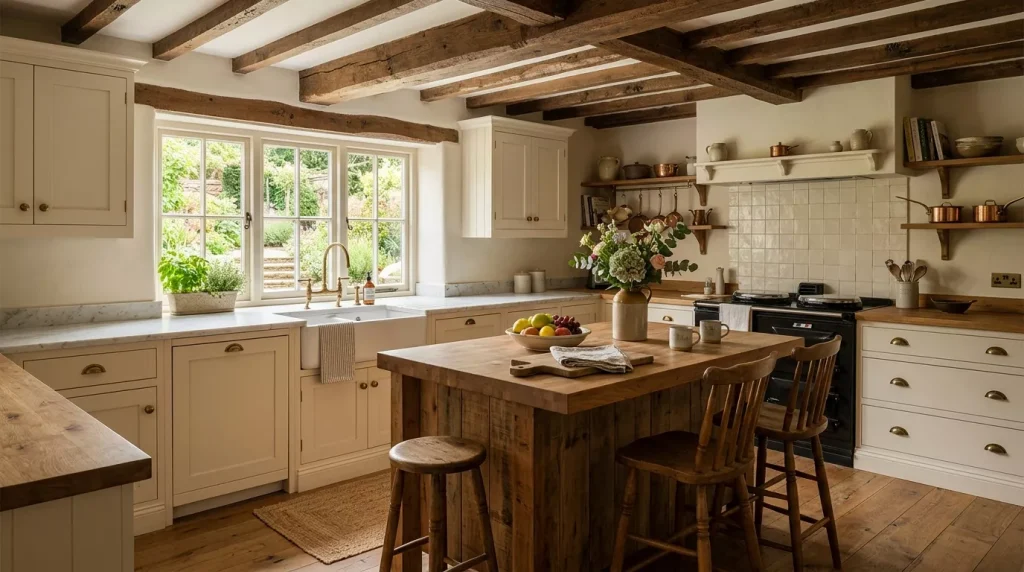
- Subway tile — the natural partner for shaker cabinets, having emerged from the same era of honest, utilitarian design
- Zellige tile — handmade Moroccan tile with natural variation; beautiful with sage green, navy, and warm cabinet tones
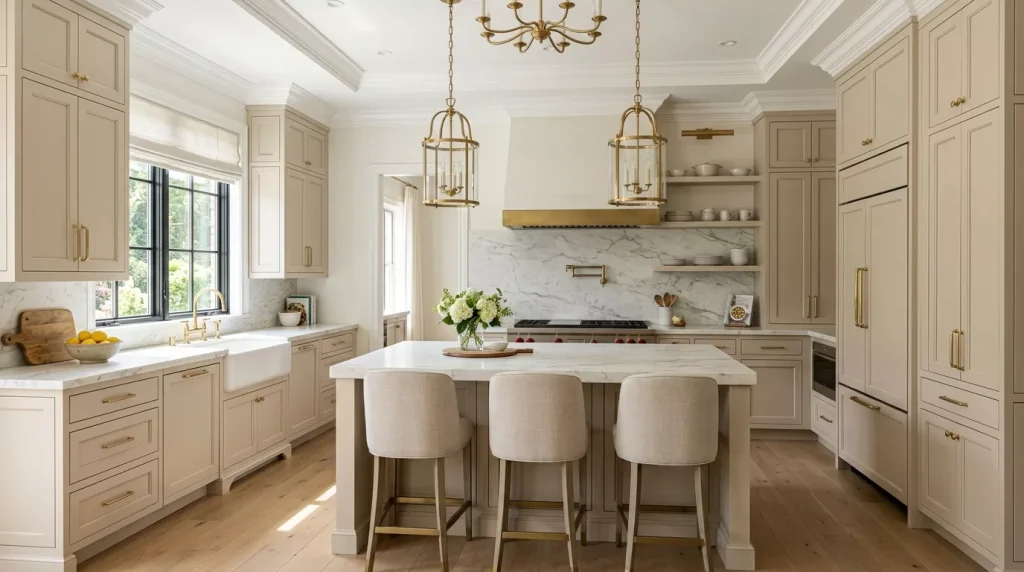
- Marble slab — seamless continuation of the countertop material; luxurious and clean
- Brick-pattern tile — rustic and warm, particularly good for farmhouse and cottagecore shaker kitchens
- Shiplap or tongue-and-groove paneling — white paneled backsplash for a cottage or Scandinavian quality
Shaker vs. Flat-Front vs. Raised-Panel: Which Is Right for You?
| Feature | Shaker | Flat-Front | Raised Panel |
|---|---|---|---|
| Visual character | Structured simplicity | Minimal, architectural | Formal, traditional |
| Era association | Timeless, 18th century onward | Modern, contemporary | Victorian to mid-20th century |
| Versatility | Very high — any style | High — modern contexts | Lower — traditional settings |
| Resale appeal | Very high | High in modern homes | Lower in contemporary market |
| Showing dirt/dust | Recessed panel collects more | Easiest to clean | Most detail to clean |
| Cost range | Low to very high | Low to high | Moderate to high |
| Best kitchen styles | Any | Minimalist, contemporary | Traditional, Victorian |
Pros and Cons of Shaker Cabinet Kitchens
Pros
- Timeless design. Shaker cabinets have been in continuous production and demand for over a century. They are as unlikely to look dated in ten years as they did in the last ten.
- Versatile across styles. No other cabinet door profile crosses as many design aesthetics as convincingly — from farmhouse to minimalist modern to traditional to eclectic.
- Wide availability. Shaker cabinets are available at every price point, in every size, and from every manufacturer — making them accessible regardless of budget.
- Repaints easily. Painted shaker cabinets can be professionally repainted when you want a new look — far less expensive than replacing the cabinets entirely.
- Strong resale value. Prospective home buyers consistently respond positively to shaker kitchens, making them a renovation investment with reliable return.
Cons
- The recessed panel collects grime. The inner edges of the recessed panel profile are a natural gathering point for grease, cooking residue, and dust — they require deliberate cleaning attention that flat-front cabinets don’t.
- Can look generic without strong detail choices. Because shaker is so widely used, an unremarkable color, mediocre hardware, and inexpensive materials can produce a kitchen that looks like every other builder-grade shaker kitchen rather than something distinctive.
- Mid-range execution looks cheap. A beautiful shaker kitchen relies heavily on quality of construction, paint finish, and hardware. Budget-end shaker cabinets with visible MDF in the corners and thin vinyl pulls can look noticeably inexpensive.
- Can feel plain in a large kitchen. In a very large kitchen, the visual repetition of many identical shaker door panels can feel monotonous without the relief of glass-front doors, open shelves, or architectural variation to break it up.
Common Mistakes in Shaker Cabinet Kitchen Design
1. Choosing the Wrong White
Not all whites work in all kitchens. A warm white in a north-facing kitchen with cool natural light looks grey and dingy. A cool, bright white in a warm, south-facing kitchen can feel clinical. Test paint swatches at full A4 size on your actual cabinet doors and observe them at different times of day before committing.
2. Under-Scaling the Hardware
Tiny knobs on wide shaker door panels look proportionally wrong — the hardware disappears and the door reads as unfinished. Match pull length to drawer width. On a 30-inch wide drawer, a 4-inch pull looks lost; a 10–12 inch bar pull looks deliberate and finished.
3. Skimping on the Box Construction
You can often save money on the door and fronts, but never on the box. The cabinet box is the structural backbone of the kitchen — it’s what the door hangs on, what the shelves rest in, and what determines how the kitchen functions over years of use. Thin particleboard boxes warp, peel, and fail significantly faster than plywood.
4. Forgetting Upper Cabinet Height
Standard upper cabinets stopping 12–18 inches below the ceiling leave an awkward gap that collects dust and makes the kitchen feel unfinished. Running upper cabinets to the ceiling — or filling the gap with trim or crown molding — always looks more resolved and maximizes storage simultaneously.
5. Using Too Many Finishes
A kitchen with chrome faucet, brass hardware, stainless appliances, black fixtures, and nickel lighting all present at once doesn’t read as eclectic — it reads as unresolved. Commit to two metal finishes maximum and carry them intentionally throughout the space.
6. Ignoring the Triangle (Work Triangle)
New cabinet layouts should always respect the work triangle — the relationship between sink, stove, and refrigerator. Beautiful cabinets in an inefficient layout produce a kitchen that looks great in photos and frustrates everyone who actually cooks in it.
Quick Tips for a Better Shaker Kitchen
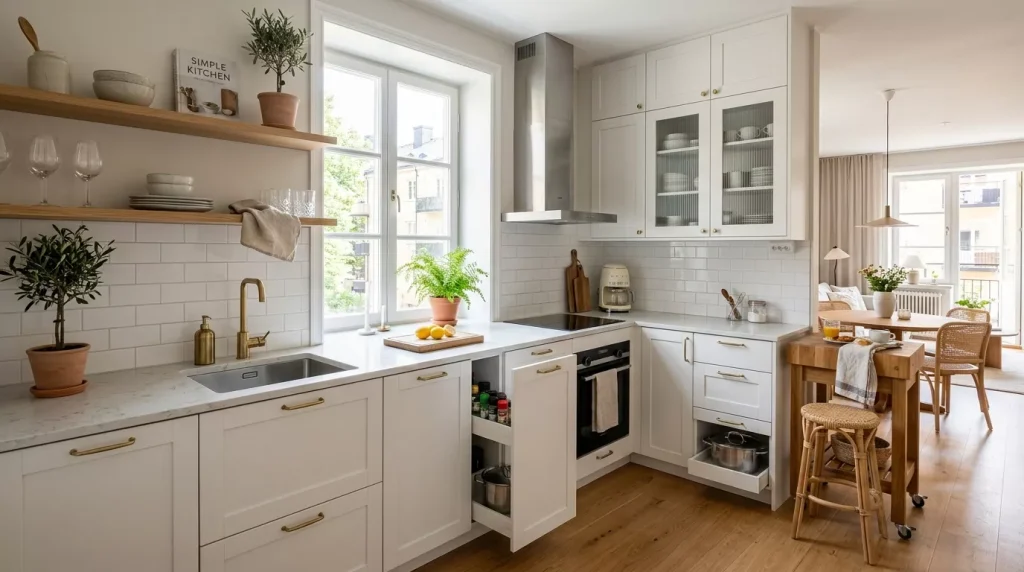
Tip 1: Use glass-front shaker doors on a few upper cabinets to break the visual repetition of solid doors in a larger kitchen. The recessed panel detail repeats in the cabinet frame around the glass — so the shaker character is maintained while the visual rhythm gets welcome relief.
Tip 2: Don’t overlook the interior of your cabinets. Lining the interior backs with a complementary color, a contrasting paint, or a subtle wallpaper makes open shelving and glass-front cabinets feel far more intentional.
Tip 3: Paint the inside of the shaker panel recess a slightly deeper tone than the door face. This creates shadow and depth that makes the cabinet profile read more richly — a detail used by professional kitchen designers that most homeowners don’t know about.
Tip 4: Add leg details to the base of your island or cabinet run. Shaker-style furniture traditionally featured furniture-style legs at the base — incorporating this detail bridges the kitchen from cabinetry toward furniture, elevating the overall look.
Tip 5: In a white shaker kitchen, use warm white rather than stark white near any natural wood tones or brass fixtures. The slight warmth prevents the contrast from reading as a mistake and holds the palette together.
Tip 6: Avoid matching the countertop and backsplash in exactly the same material and color. The kitchen benefits from deliberate contrast between horizontal and vertical surfaces — even a subtle tonal difference prevents the whole thing from reading as flat.
FAQs: Shaker Cabinet Kitchen Ideas
Q1. Are shaker cabinets going out of style?
Not in any meaningful sense. Design trends come and go in cycles, and while specific color choices within shaker kitchens shift (grey had its moment, green is very current), the shaker door profile itself has been in continuous production and consistent demand since the 18th century. It isn’t a trend — it’s a design standard. It works because of its restraint and versatility, not because of fashion. A well-executed shaker kitchen in a classic color with quality hardware will look as relevant in 15 years as it does today.
Q2. What is the most popular color for shaker kitchen cabinets?
White and off-white tones remain the single most common choice globally, particularly in North America and the United Kingdom. Within the color category, warm whites and creams have been gaining ground over stark, cool whites, which can feel cold and clinical in kitchen environments. Beyond white, navy blue, sage green, and warm grey are consistently the most popular color alternatives — all three have strong design precedent and genuine longevity beyond the current trend cycle.
Q3. What hardware looks best on shaker cabinets?
The most universally flattering hardware for shaker cabinets depends on the cabinet color and overall kitchen style, but the most reliably successful options are: brushed brass or unlacquered brass pulls (warm and transitional, works beautifully with cream, sage, and navy), matte black bar pulls (modern and crisp, works with almost any cabinet color), and brushed nickel (safe and versatile, particularly good with grey and white). The key is choosing one hardware finish and using it consistently across all cabinet doors, drawers, and coordinating fixtures.
Q4. Can shaker cabinets work in a small kitchen?
They work excellently in small kitchens, with a few style adjustments. In a compact space, lighter cabinet colors — white, light grey, warm cream — maximize light reflection and make the room feel more open. Full-overlay shaker doors minimize the visible frame between doors, which reduces visual busyness in a tight space. Avoiding glass fronts or open shelves in a very small kitchen keeps the look cleaner and less cluttered. Hardware in a light or reflective finish (brushed nickel, chrome) also helps a small shaker kitchen feel more spacious.
Q5. What countertop goes best with white shaker cabinets?
The most classic and consistently successful pairing for white shaker cabinets is a white or light grey marble or quartz countertop — Calacatta or Carrara marble patterns provide movement and natural character without introducing a competing color. For a warmer alternative, butcher block or a warm stone countertop (honed travertine, beige limestone) adds organic character that pure white-on-white doesn’t achieve. For a bolder approach, a dark countertop — black granite, dark grey quartz, or soapstone — creates high contrast that makes the white cabinets read as sharper and more intentional.
Q6. Is it worth painting existing cabinets in a shaker style or buying new ones?
If your existing cabinets have a shaker-profile door, repainting is an excellent and cost-effective refresh — professional cabinet painting produces a result that is visually close to new. If your existing cabinets have a different door profile (raised panel, flat front, or ornate), repainting doesn’t change the profile — you’re better served by replacing the door fronts only (which is possible and cost-effective) while keeping the existing cabinet boxes if they’re structurally sound. Full cabinet replacement makes the most sense when the box construction is poor, the layout needs to change, or the existing cabinets have significant water or structural damage.
Conclusion: The Shaker Kitchen That Works Is Worth Getting Right
There’s something genuinely satisfying about a shaker cabinet kitchen done well. It doesn’t try to impress with novelty or flourish — it earns its place through proportion, quality, and a design logic that has proven itself over centuries. When the color is right, the hardware is considered, the countertop connects rather than competes, and the construction is solid, the result is a kitchen that feels complete and confident in a way that more decorative styles rarely achieve with the same consistency.
The decisions that matter most aren’t the ones most people agonize over first. It’s not the color — that can change. It’s the construction quality of the cabinet box, the scale of the hardware, the proportional relationship between upper and lower cabinets, and the quality of the paint finish. Get those fundamentals right, and every color and hardware choice you make on top of them will look better than it would in a less considered context.
Start with your measurements and your budget. Use the step-by-step guide in this article to work through each decision in order. And let the shaker cabinet do what it was designed to do — get out of the way and let the room speak for itself.