Dark Academia Home Decor Aesthetic Ideas to Transform Your Living Space

If you’ve ever walked into a room and felt like you’d stepped straight into an old European library — warm amber light, worn leather armchairs, towering bookshelves, and the quiet hum of centuries-old stories — then you already know what dark academia home decor is all about.
This aesthetic has moved far beyond Tumblr mood boards and Pinterest saves. It’s now a fully realized interior design movement that blends classical intellectualism with moody, atmospheric warmth. And the beautiful thing? You don’t need a Victorian townhouse or a bottomless budget to make it work.
This guide covers everything you need — the key features, room-by-room breakdowns, a step-by-step plan, honest pros and cons, and the most common mistakes people make. Whether you’re starting fresh or just want to layer some scholarly charm into your existing space, you’re in the right place.

What Is the Dark Academia Home Decor Aesthetic?
Before jumping into specific ideas, it’s worth understanding what “dark academia” actually means as an aesthetic — because it’s so much more than painting your walls dark green.
Dark academia is rooted in a romantic obsession with classical knowledge: literature, philosophy, ancient history, and the arts. Visually, it draws from Victorian and Edwardian Europe — candlelit libraries, stone universities, dusty archives, and the quiet intensity of someone deep in scholarly pursuit.

The aesthetic isn’t cold or clinical. It’s warm, layered, and deeply personal. It prioritizes depth over simplicity, character over trend, and atmosphere over convenience. Think oil paintings on dim walls, leather-bound journals on a mahogany desk, dried botanicals in dark glass vases, and candles burning low on a brass holder.
Key thematic elements include: intellectual curiosity, autumn nostalgia, classical art, mortality as beauty, and an almost reverent relationship with the written word.
12 Key Features of Dark Academia Home Decor
Think of this as your master checklist. These are the core building blocks of an authentic dark academia space — and even incorporating six or seven of them will dramatically shift the energy of any room.

- Rich, Dark Color Palette — Deep forest greens, oxblood red, mahogany brown, charcoal, and navy form the foundation. These colors feel warm and enveloping, not heavy, when paired correctly with good lighting.
- Antique and Vintage Furniture — Wooden writing desks with carved legs, wingback chairs in aged leather, tall ornate bookshelves. The older and more character-filled, the better.
- Books as Living Decor — Not neatly arranged for show, but stacked with cracked spines visible, piled on side tables, tucked into corners. Books are the soul of the aesthetic.
- Layered Warm Lighting — Harsh overhead lighting is the enemy. Amber-toned lamps, flickering candles, brass wall sconces, and Edison filament bulbs replace clinical brightness with atmospheric glow.
- Dark Wood Throughout — Walnut, mahogany, and aged oak tones in flooring, shelving, and furniture add gravitas and warmth that simply cannot be faked.
- Classical Art and Portraits — Framed oil paintings, anatomical illustrations, botanical prints, and pencil portrait sketches hung close together in gallery-wall arrangements that feel curated and collected.

- Globes and Antique Maps — A vintage-style globe on a writing desk, an aged map pinned to the wall, or an old atlas left open on a side table — these speak to curiosity and exploration.
- Velvet and Heavy Textiles — Deep jewel-toned velvet cushions, thick curtains that puddle on the floor, Persian-style rugs, and wool blankets layered generously create texture and warmth.
- Leather Accents — A leather journal, a desk blotter, a leather-armed chair. Even quality faux leather works — the look is more about tone and texture than material origin.
- Dried Botanicals and Dark Florals — Dried roses, eucalyptus, dark-leafed plants, and moody botanical arrangements in dark glass or ceramic vases. Nature filtered through a melancholy, beautiful lens.
- Vintage Stationery and Desk Objects — Wax seals, inkwells, old typewriters, quill pens, and leather-bound notebooks. These aren’t just props — they build a narrative in your space.
- Ornate Mirrors and Heavy Frames — Bronze or aged gold frames with intricate carved details. Antique mirrors with slight tarnishing or foxed edges are even better than new replicas.

Dark Academia Color Palette: Setting the Mood Before Anything Else
The color palette is where dark academia home decor begins — and where most people either get it exactly right or lose the plot entirely. You can’t build this aesthetic on white walls and neutral tones. It simply won’t work.
Here’s a practical guide to the colors that define the aesthetic:
| Color Family | Specific Shades | Best Used For |
|---|---|---|
| Forest Green | Dark hunter, olive, sage | Walls, velvet upholstery, curtains |
| Burgundy / Oxblood | Deep wine, brick red | Accent walls, rugs, upholstery |
| Warm Brown | Mahogany, chocolate, walnut | Wooden furniture, leather pieces |
| Charcoal / Slate | Warm dark grey | Statement walls, picture framing |
| Cream / Ivory | Aged white, antique linen | Book pages, trim, bed linen |
| Gold / Brass | Warm metallic tones | Lamp fixtures, frames, hardware, trims |

A word of warning: avoid anything that reads as “fresh” or “modern clean.” No bright whites, no pastels, no cool-toned greys. Dark academia thrives on warmth, depth, and the kind of color that looks like it has history.
Room-by-Room Dark Academia Decor Ideas
Here’s where it gets genuinely useful. Theory is great — practical application is better. Let’s walk through the three rooms where this aesthetic makes the biggest impact.

Dark Academia Living Room: The Intellectual Gathering Space
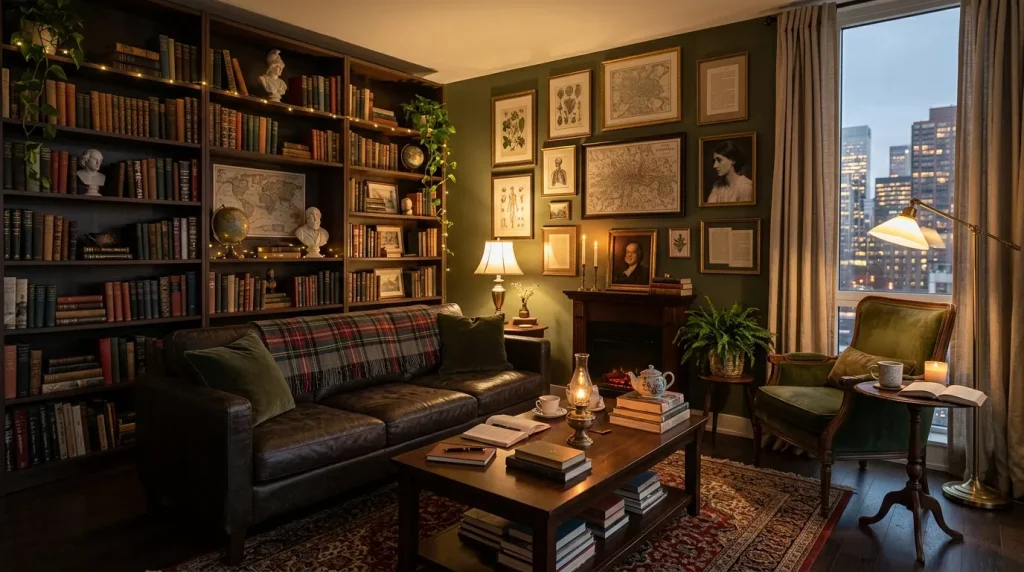
The living room in a dark academia home isn’t just somewhere to watch TV. It’s a salon — a space for ideas, conversation, and long quiet evenings.
- Anchor the room with a deep green or burgundy sofa in velvet or worn leather
- Lay a Persian-style rug beneath it — vintage finds here beat anything new
- Install floor-to-ceiling bookshelves if your ceiling height allows, or use tall freestanding units
- Create a gallery wall mixing botanical prints, map fragments, vintage portraits, and academic illustrations
- Add a chess set, a large antique globe, or a stack of oversized art books as the coffee table focal point
- Layer your lighting: floor lamp by the sofa, candles on the mantle, warm string lights tucked behind shelves

The room should feel like it belongs to someone consumed by curiosity — not someone who bought a “starter set” online.
Dark Academia Bedroom: Waking Up Inside a Novel
Your bedroom should feel like a quiet chapter. Intimate, enveloping, and slightly otherworldly.
- Choose a dark wall color — forest green, deep terracotta, or charcoal
- A bed with a tall wooden headboard or a canopy frame sets the scene perfectly
- Heavy linen or velvet curtains that pool slightly on the floor
- Stack books on your bedside table beside a brass lamp
- Hang dried botanical arrangements and a large, slightly tarnished mirror nearby
- Add a reading chair in one corner — even a small one changes the whole function of the room

Keep technology discreet. Hide chargers in decorative boxes. The bedroom should feel like an escape from the modern world, not an extension of it.
Dark Academia Study or Home Office: The Heart of the Aesthetic
If there’s any room where dark academia home decor feels entirely natural, it’s the study. This is the aesthetic’s spiritual home.
- A large wooden writing desk — the most important investment in this room
- A leather chair, or something with a genuinely classic silhouette
- A green-shaded desk lamp, a leather blotter, a ceramic pen holder
- Books organized with intention — by subject, by color, or in a deliberately “mid-research” arrangement
- A corkboard with maps, clippings, and sketches pinned to it
- A small chalkboard adds academic personality without feeling childish

Dark Academia vs. Gothic vs. Cottagecore: Key Differences
A lot of people blend these aesthetics without realizing they’re pulling in contradictory directions. Here’s a clear comparison to help you stay intentional:
| Feature | Dark Academia | Gothic | Cottagecore |
|---|---|---|---|
| Core Mood | Intellectual, warm, scholarly | Mysterious, dramatic, dark | Whimsical, innocent, natural |
| Color Palette | Deep greens, browns, burgundy | Black, grey, deep purple | Cream, blush, soft sage |
| Key Elements | Books, maps, candles, art | Skulls, wrought iron, ravens | Florals, baskets, wildflowers |
| Furniture Style | Victorian academic, antique | Ornate gothic, dark-draped | Rustic cottage, farmhouse |
| Lighting Feel | Warm amber, candlelit | Cold, dramatic, shadowy | Soft natural, diffused |
| Overall Atmosphere | Cozy and contemplative | Edgy and theatrical | Dreamy and pastoral |

Dark academia is warmer and more intellectual than gothic, and considerably darker and moodier than cottagecore. All three share a love of the past — but they’re after very different emotional experiences.
Step-by-Step Guide to Decorating a Dark Academia Room
Starting a new aesthetic can feel overwhelming. This eight-step process keeps you focused and intentional:
Step 1 — Pick One Anchor Room Don’t overhaul your entire home at once. Choose one room — ideally the living room or study — and go deep there first. Doing one room well is worth ten rooms done halfway.
Step 2 — Paint or Transform the Walls Dark wall color is the single highest-impact change you can make. Choose forest green, charcoal, or deep burgundy. Renting? Use removable textured wallpaper in dark tones.
Step 3 — Source Furniture Secondhand Hit estate sales, antique fairs, and secondhand marketplaces. You’re after solid wooden furniture with age and personality — not flat-pack replicas. Patience here pays off.
Step 4 — Layer In Heavy Textiles A Persian rug, velvet cushions, heavy curtains, and a wool throw — these layers create the tactile warmth the aesthetic demands. Don’t skip them.

Step 5 — Build a Book Collection Visit secondhand bookshops, library sales, and charity shops. You don’t need to have read everything on your shelves. The collection itself is a statement.
Step 6 — Replace Harsh Lighting Remove any fluorescent or bright white bulbs. Replace them with 2700K warm-white LED bulbs, and add multiple layered light sources: lamps, candles, and sconces.
Step 7 — Layer In Decorative Details Globes, antique frames, inkwells, dried flowers, vintage maps — add these gradually over weeks, not in one shopping haul. Slow accumulation looks more authentic.
Step 8 — Edit Ruthlessly Dark academia is layered, not cluttered. If something breaks the mood — a plastic item, a too-bright accent, a clearly modern piece — remove it. The editing is as important as the adding.
Spotlight Feature: The Dark Academia Reading Nook
If one feature perfectly encapsulates dark academia home decor, it’s the reading nook — and it deserves its own spotlight.
A reading nook isn’t just a chair near a window. In dark academia style, it’s a fully realized atmospheric sanctuary, designed to make the act of reading feel like a ritual.
How to Build Yours:

- Choose a corner or alcove — even a small one works beautifully
- Place or install a tall bookshelf immediately beside or wrapping around the seat
- Add a deep upholstered armchair or a built-in bench with thick cushions in velvet or worn leather
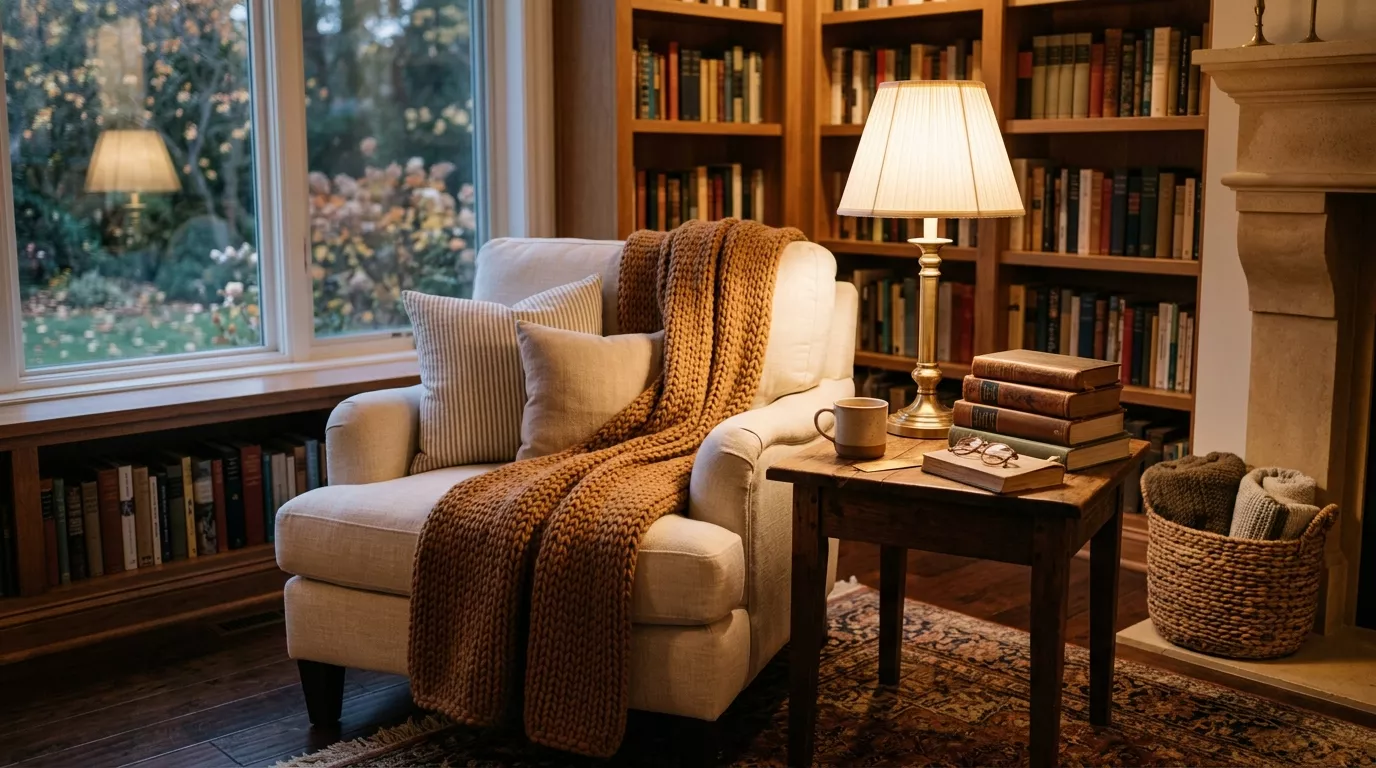
- Layer with a wool blanket, a velvet cushion, and a plaid throw — warmth is the goal
- Add a floor lamp or a small side table lamp with an amber-toned bulb
- Hang one framed botanical print or a map above the shelf at eye level
- Keep a small ottoman or trunk nearby for journals, candles, and a teacup
The reading nook becomes your non-negotiable retreat. It’s the corner where your phone stays face-down, where the world shrinks to just the light, the book, and the warmth. It is, without question, the most personally impactful single addition in any dark academia home.
Pros and Cons of Dark Academia Home Decor
Like any aesthetic, dark academia isn’t universally perfect. Here’s an honest breakdown:
Pros:
- Creates a deeply warm, cozy, and enveloping atmosphere
- Timeless — it won’t feel dated the way trend-driven aesthetics do
- Highly personal and expressive — every room tells a story
- Encourages reading, writing, and intellectual engagement
- Often budget-friendly when sourcing secondhand
- Works in small spaces with the right choices
- Each layer you add enriches the whole — it rewards investment over time
Cons:
- Can feel heavy or claustrophobic in poorly lit or very small rooms
- Dark walls without adequate warm lighting turn oppressive quickly
- Sourcing genuine vintage pieces requires significant time and patience
- Not ideal for households with very young children — fragile decor everywhere
- Easy to tip from “layered and intentional” into “cluttered and chaotic”
- Modern items constantly need to be hidden or replaced
- Dust is a relentless enemy — all those books and textiles collect it
Tips for Getting Dark Academia Decor Just Right
These small insights make a real difference — especially when you’re building the aesthetic for the first time:
- Start with books before furniture: A room filled with interesting books immediately reads as scholarly, regardless of everything else around it.
- Don’t fear darkness: People consistently hesitate to paint walls dark. Do it anyway. Dark walls make rooms feel more intimate, not smaller.
- Mix genuinely old with new-old deliberately: A modern lamp in a classic brass silhouette beside a real Victorian desk looks intentional, not inconsistent.
- Engage the other senses: Dark leather has a smell. Candles have warmth. Dried herbs have fragrance. This aesthetic rewards multisensory thinking.
- Visit antique fairs and estate auctions: You’ll find here what simply doesn’t exist in retail — at prices far more reasonable than curated boutiques.
- Choose plants with drama: Snake plants, maidenhair ferns, and dark-leafed varieties suit the aesthetic. Tropical bright-green plants break the mood.
- Embrace imperfection loudly: A ring-stained desk, a tarnished lamp, a cracked book spine — these are features. Don’t sand them away or polish them out.
Common Mistakes to Avoid with Dark Academia Home Decor
Save yourself time, money, and aesthetic regret by avoiding these very common pitfalls:
- Too dark, too little light: Painting walls near-black without compensating with warm layered lighting doesn’t create atmosphere — it creates a depressing room.
- Buying cheap “gothic” mass-produced items: Plastic skulls and machine-printed “vintage” maps feel immediately fake. They undermine everything else you’re doing.
- Ignoring the floor: A rug is non-negotiable. An unrugged bare floor in a dark academia room looks unfinished no matter how good everything else is.
- Cluttering without narrative: Every item should feel like it belongs to the story of the room. Random accumulation is hoarding, not layering.
- Using pure black as a base: This is not gothic decor. Pure black is rarely used in dark academia — deep browns, greens, and burgundies do the actual heavy lifting.
- Skipping textiles entirely: Walls and furniture alone cannot create the tactile warmth this aesthetic demands. Layered fabrics are essential, not optional.
- Rushing the entire transformation: This aesthetic builds authentically over time — much like a personal library. One great piece is always better than ten mediocre ones bought in a weekend haul.
Frequently Asked Questions (FAQs)
Q1: Is dark academia home decor expensive to achieve?
Not at all — at least not if you’re willing to be patient. Thrift stores, estate sales, antique markets, and secondhand online platforms are where the best dark academia pieces live. A genuine secondhand mahogany writing desk from an estate sale often costs less than a flat-pack new one and looks infinitely more authentic. The key ingredient is time, not money.
Q2: Can I use dark academia decor in a small apartment?
Absolutely — and in some ways, smaller spaces suit this aesthetic better. Dark colors in compact rooms create intimacy and coziness rather than feeling cramped. Use vertical space aggressively with tall bookshelves, keep furniture proportional, and invest heavily in warm lighting to prevent the space from feeling oppressive. Small dark academia rooms can feel like a cozy jewel box.
Q3: What’s the real difference between dark academia and gothic home decor?
Gothic decor leans heavily into drama, darkness, and supernatural themes — skulls, cold lighting, wrought iron, black florals, and theatrical atmosphere. Dark academia is warmer, more intellectual, and scholarly — rooted in books, candlelight, classical art, and academic pursuit. Gothic is theatrical and edgy; dark academia is contemplative and warm. They share some visual DNA but serve very different emotional purposes.
Q4: How do I start if I’m on a tight budget?
Paint is your single best first move — it’s the highest-impact, lowest-cost transformation available. Then systematically visit thrift stores and charity shops for books, vintage frames, and wooden furniture. Use Facebook Marketplace and eBay for larger antique-style pieces. Build gradually. A dark academia room built slowly over six months looks far more authentic than one assembled in a single weekend shopping spree.
Q5: What lighting temperature works best for dark academia rooms?
Stick to bulbs rated between 2700K and 3000K — warm white to soft white. These emit amber-toned light that flatters the dark colors and creates the candlelit quality the aesthetic requires. Avoid anything labeled “cool white,” “daylight,” or above 4000K — they strip the warmth from the room and kill the atmosphere completely. Layer multiple sources rather than relying on a single overhead fixture.
Q6: Can dark academia decor work in a family home with children?
It can, with some adaptation. Focus the aesthetic on adult spaces — a home office, a reading room, the master bedroom. In shared family spaces, use more durable versions of the key elements: hardwood furniture instead of fragile antiques, washable velvet rather than delicate fabrics, mounted art rather than freestanding pieces. The aesthetic adapts — it just requires a little pragmatism.
Q7: Do I need to own a lot of books to pull off dark academia style?
Quality trumps quantity — a curated shelf of sixty books with interesting spines arranged thoughtfully looks better than two hundred books crammed in randomly. That said, books are genuinely central to the aesthetic, not optional decor. Start collecting from secondhand shops. They don’t all need to be titles you’ve read. The presence of books signals that the room belongs to someone who thinks.
Conclusion: Build the Space Your Curiosity Deserves
Dark academia home decor is more than an interior trend — it’s a declaration of who you are and what you value. It says you find beauty in old things, meaning in books, and comfort in the kind of warmth that only candlelight and aged wood can provide.
The aesthetic isn’t about perfection. It’s about building a space that feels genuinely alive — where every object has a reason to exist, every corner invites you to slow down, and every evening feels like the opening pages of something you won’t want to put down.
Don’t try to build it all at once. Start with one room. Paint one wall. Buy one secondhand book with an interesting spine. Light one candle. Let it grow organically, piece by piece — because the best dark academia spaces aren’t decorated. They’re accumulated.
Your next step: pick one element from this guide and implement it this week. Your scholarly sanctuary starts with a single, intentional choice. Now go make it.