Navy Blue Bathroom Ideas to Elevate Your Space

Navy Blue Bathroom Ideas to Elevate Your Space

Walk into a navy blue bathroom and you immediately feel something shift. There’s a sense of depth, confidence, and richness that very few other colors can create in such a compact space. Navy blue bathroom ideas have exploded in popularity over the last few years — and not just in high-end design magazines. Homeowners at every budget level are discovering that this deep, dramatic hue is one of the most transformative choices you can make for a bathroom renovation.

What makes navy so special in a bathroom context is its versatility. It can read as coastal and breezy, moody and sophisticated, classic and preppy, or sleek and ultra-modern — all depending on how you pair it and how much of it you use.
But getting it right requires more than just slapping dark paint on the walls. This guide walks you through the best navy blue bathroom ideas, the smartest color combinations, what to avoid, and how to execute the look room by room so the final result feels intentional, beautiful, and completely livable.
Why Navy Blue Works So Well in Bathrooms
A lot of people hesitate with dark colors in a bathroom, especially a smaller one. The conventional wisdom says small spaces need light colors. But that rule is far more outdated than most people realize.

Navy blue doesn’t actually make a room feel smaller — it makes it feel more intimate. There’s a significant psychological difference between a space that feels cramped and a space that feels cocooning. Navy leans heavily into the second category, turning a modest bathroom into something that feels more like a private retreat than a purely functional room.
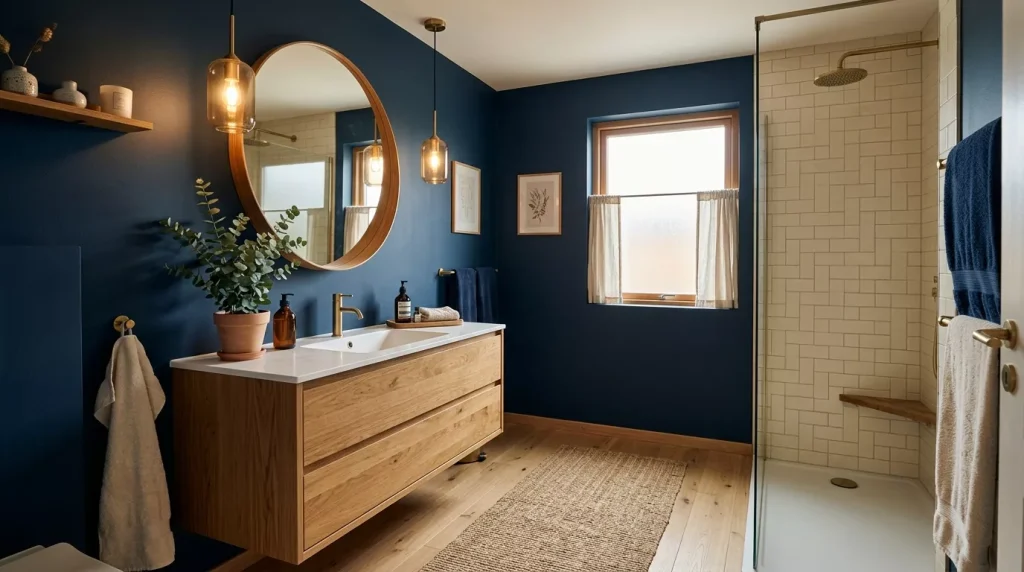
It also works beautifully with the materials naturally found in bathrooms — white ceramic, polished chrome, warm wood, marble, and brushed brass all look incredible against a deep navy backdrop. Very few colors give you that range of complementary materials to work with.
And unlike trendy colors that date quickly, navy is genuinely timeless. It has roots in classical European design, American coastal architecture, and modern luxury interiors alike. A navy bathroom you design today will still look sophisticated a decade from now.

Navy Blue Bathroom Ideas for Every Style
There’s no single way to do a navy blue bathroom. Here are the most popular stylistic approaches — each with its own character and execution.
Classic and Traditional Navy Blue Bathroom
This is the version most people picture first — and for good reason. Navy paired with crisp white creates one of the most enduring combinations in interior design.
In a traditional navy bathroom, you’ll typically find:

- White subway tiles on the walls paired with navy-painted or navy-tiled lower half
- Pedestal sink or undermount basin in white ceramic
- Polished chrome or oil-rubbed bronze fixtures for a refined finish
- Framed mirrors and classic cabinetry in white or soft gray
- Black and white hex tile floors for a period-appropriate, high-contrast base
This style works particularly well in older homes, brownstones, and houses with architectural character. It leans into history rather than fighting it, and the result always looks genuinely elegant rather than trying-too-hard.
Modern and Minimalist Navy Blue Bathroom
For cleaner, more contemporary spaces, navy blue works differently — as a statement of restraint rather than ornament.
Modern navy bathrooms tend to feature:
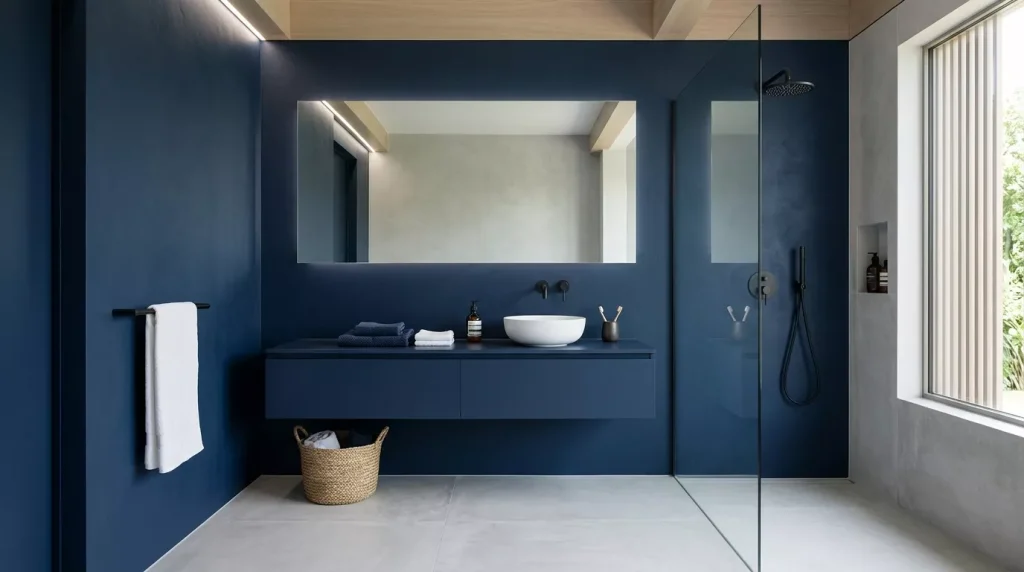
- Large-format navy matte tiles in a floor-to-ceiling application, grout lines minimal
- Floating vanity in white lacquer or warm walnut with concealed plumbing
- Brushed gold or matte black hardware — the warmth or darkness contrasting beautifully with cold navy
- Frameless glass shower screens to keep sight lines open
- Recessed lighting or LED strip lighting tucked into niches and under vanity lips
The secret here is restraint. A modern navy bathroom should feel like it has something to say and knows when to stop talking. One bold navy wall, the right fixture choices, and a lot of intentional empty space — that’s the formula.
Coastal and Nautical Navy Blue Bathroom
Navy has unmistakable oceanic associations, and leaning into that creates bathrooms with an easy, breezy, deeply pleasant energy.
Coastal navy bathrooms work best with:

- Natural textures — woven baskets, driftwood frames, jute rugs, linen towels
- Warm white or sand-toned walls as the base, navy used selectively in tiles, vanity, or towels
- Shiplap paneling or beadboard in white for that coastal architecture feel
- Rope details, shell accents, and natural wood mirrors
- Soft brass or antique bronze fixtures rather than cold chrome
This approach is particularly popular in beach houses, vacation properties, and family bathrooms. It’s warm, unpretentious, and immediately relaxing — which is exactly what a bathroom should feel like.
Bold and Dramatic Full-Navy Bathroom
For the brave and the committed, a fully immersive navy bathroom — walls, ceiling, and cabinetry all in a deep blue — creates an effect that’s genuinely breathtaking.

This is the “jewel box” approach. Rather than trying to make the space feel larger, you lean completely into the depth and richness of navy and let the room become a fully enveloping experience.
To make this work:
- Use matte or satin finishes to absorb light rather than reflect it harshly
- Introduce warm metallics (gold, brass, champagne) to prevent coldness
- Ensure strong lighting — wall sconces flanking a mirror, plus overhead lighting — so the room doesn’t feel oppressive
- Add white or cream fixtures (bathtub, toilet, basin) so the plumbing doesn’t disappear into the wall
- Bring in natural materials — marble, wood, stone — as texture anchors

Done right, a full-navy bathroom is arguably the most photogenic room in the house. It’s also genuinely luxurious in a way that’s hard to achieve with lighter palettes.
Best Color Combinations for Navy Blue Bathrooms
Choosing what to pair with navy is where many people get stuck. Here’s a clear breakdown of the most successful combinations:
| Pairing Color | Mood Created | Best Finish | Ideal Style |
|---|---|---|---|
| Crisp White | Classic, clean, sharp | Ceramic, lacquer | Traditional, coastal |
| Warm Brass / Gold | Luxurious, warm, editorial | Brushed or satin | Modern, glam, eclectic |
| Matte Black | Sleek, bold, graphic | Powder-coated | Contemporary, industrial |
| Warm Wood Tones | Natural, grounded, organic | Oiled or matte | Scandinavian, coastal |
| Soft Gray | Cool, understated, refined | Stone or matte | Minimalist, transitional |
| Marble White + Veining | High-end, classic, timeless | Polished or honed | Luxury, traditional |
| Sage Green | Unexpected, natural, fresh | Matte tile or paint | Eclectic, boho |
| Copper / Rose Gold | Warm, modern, unexpected | Brushed metal | Contemporary, glam |
| Terracotta | Earthy, bold, global | Matte ceramic | Eclectic, Mediterranean |
| Bright White + Chrome | Clean, medical-fresh contrast | Polished ceramic | Modern, minimal |
The one combination to be careful with: Navy + cool gray in equal proportions. Both colors pull toward the cold end of the spectrum, and without a warm anchor — a wood tone, brass fixture, or warm white element — the room can feel clinical and flat.

Navy Blue vs. Other Bold Bathroom Colors
Navy is one of several dark, dramatic color choices for bathrooms. How does it stack up against the competition?
| Color | Warmth | Versatility | Timelessness | Difficulty Level |
|---|---|---|---|---|
| Navy Blue | Cool-neutral | Very high | Very high | Medium |
| Forest Green | Medium-warm | High | High | Medium |
| Charcoal / Dark Gray | Cool | High | High | Low |
| Black | Cold | Medium | Medium-high | High |
| Deep Burgundy | Warm | Medium | Medium | High |
| Sage Green | Warm | High | Medium-high | Low |
| Slate Blue | Cool | Medium | Medium | Low |
Navy sits in the sweet spot: genuinely versatile, undeniably timeless, and workable across many styles without being as unforgiving as pure black. Forest green is its closest competitor in terms of trendiness and versatility, but navy holds its ground as the more classic and established choice.

Pros and Cons of Navy Blue in the Bathroom
Knowing exactly what you’re signing up for helps you make the decision with confidence.
✅ Pros
- Deeply timeless — Navy has been a design staple for centuries. It will not date the way trendier colors do.
- Dramatically transforms any space — Even one navy accent wall or a navy vanity can completely change a bathroom’s character.
- Pairs beautifully with luxury materials — Marble, brass, chrome, natural wood, and ceramic all look exceptional against navy.
- Creates an intimate, spa-like mood — The depth of the color encourages a sense of calm and cocoon-like comfort.
- Works at every budget level — A can of navy paint costs the same as any other paint. The impact is disproportionate to the cost.
- Hides water spots and condensation marks better than white or very pale walls.

❌ Cons
- Can feel oppressive without proper lighting — Navy absorbs light, so bathrooms with insufficient natural or artificial light may feel dark rather than moody.
- Strong color commitment — Repainting over navy requires extra primer coats. It’s not an easy choice to reverse.
- Dust and lint show more easily on dark surfaces — navy towels and dark vanities will show white lint visibly.
- Can clash with warm-toned existing elements — If your bathroom has peach-toned tiles or warm orange wood cabinets already installed, navy may create tension rather than harmony.
- Needs careful balance — Without thoughtful contrast elements, an all-navy bathroom can feel flat. The planning stage matters more than with lighter palettes.

Step-by-Step Guide to Designing a Navy Blue Bathroom
Whether you’re doing a full renovation or a soft refresh, this process will help you arrive at a cohesive, beautiful result.
Step 1: Assess Your Light Source Before committing to navy, spend time in your bathroom at different times of day. Note how much natural light you get and from which direction. South and west-facing bathrooms handle full navy beautifully. North-facing bathrooms with little natural light should use navy more selectively — on a single wall, the vanity, or through accessories — rather than as a full envelope.
Step 2: Choose Your Navy Tone Not all navy is the same. Some lean toward blue (brighter, cooler), some lean toward purple (richer, warmer), and some lean toward gray-navy (more muted and sophisticated). Get paint swatches and tile samples and view them in your actual bathroom light before committing.

Step 3: Decide on Your Coverage Level Are you going full navy (all walls, ceiling possibly) or partial navy (accent wall, lower half, vanity only)? Set this boundary before you start shopping for fixtures, because it determines how much contrast you’ll need to introduce.
Step 4: Choose Your Warm Contrast Element Every navy bathroom needs at least one warm anchor. This might be brushed brass fixtures, a warm wood vanity, terracotta tiles, or warm white towels. Decide what this warm element will be and make it consistent throughout the room.
Step 5: Select Your Fixtures and Hardware Fixtures are the jewelry of a bathroom. With navy walls, you have clear choices: polished chrome for a classic sharp contrast, brushed brass or gold for warmth and luxury, or matte black for a bold modern statement. Pick one finish and use it consistently across all hardware in the room.

Step 6: Plan Your Lighting Navy walls absorb light. Compensate with layered lighting: overhead for general illumination, wall sconces flanking the mirror for task lighting, and optional accent lighting in niches, under the vanity, or inside a shower. Warm-toned bulbs (2700K–3000K) are almost always more flattering with navy than cool-white LEDs.
Step 7: Introduce Texture and Accessories Last Once the bigger decisions are made — wall color or tile, fixtures, vanity — bring in the layering elements: towels, a bath mat, a mirror, plants, artwork, soap dishes. These are your fine-tuning tools. Use them to warm up, cool down, or add personality to the core palette.
Common Mistakes in Navy Blue Bathroom Design
Learn from what goes wrong so your own project avoids these frustrations.
❌ Using glossy navy paint without testing first Glossy paint amplifies every imperfection in the wall. In a navy application, glossy walls can look streaky and harsh. Satin or eggshell finishes are almost always the better choice for navy walls.
❌ Pairing navy with cool-white fluorescent lighting Cool-white bulbs turn navy into a flat, bluish-gray that looks institutional. Always use warm-toned LED bulbs (2700K) with a navy color scheme.
❌ No warm accents whatsoever Pure navy with chrome fixtures and white tiles alone can look sterile and cold. Even one warm element — a brass soap dispenser, a wood-framed mirror, a warm-toned bath mat — changes the entire mood.
❌ Matching too many navy shades Navy towels with navy tiles with navy walls can create a muddied, tonally indistinct look. Let one navy element be the dominant player and vary the others through texture and material rather than trying to match exactly.
❌ Forgetting the ceiling Most people paint the ceiling white by default. In a bold navy bathroom, this can create a jarring lid effect. Consider painting the ceiling the same shade or a shade lighter than the walls for a more immersive, cohesive result — especially in the “jewel box” approach.
❌ Overcrowding small navy bathrooms In a small bathroom, navy needs space to breathe. Too many accessories on surfaces make the room feel cluttered rather than curated. Pare down to a few intentional pieces and let the navy do the heavy lifting.
Pro Tips for a Stunning Navy Blue Bathroom
These fine-tuning insights make the difference between good and genuinely exceptional.
- Use large-format tiles to minimize grout lines. The more visible the grout, the more broken up a navy tile installation looks. Large tiles keep the surface cleaner and more dramatic.
- A navy vanity in an otherwise white bathroom is one of the most accessible and affordable ways to introduce the color without full commitment. It anchors the room immediately.
- Open shelving in a navy bathroom should display white, warm wood, or brass-toned objects. Dark accessories on dark shelving disappear into the wall.
- Bring in one piece of unexpected texture — a woven pendant shade, a handmade ceramic tray, a rattan mirror frame — to soften what might otherwise be a very polished-feeling space.
- Mirrors amplify the impact of navy walls significantly. A large mirror doesn’t just add light — it doubles the visual depth of the navy and makes the room feel more layered and considered.
- Add a plant. Deep green foliage against navy walls is one of the most naturally beautiful combinations in interior design. Even one small fern or trailing plant on a shelf makes a significant visual difference.
Conclusion: Make Navy Blue Work for You
Navy blue bathroom ideas are as practical as they are beautiful. This is a color that delivers drama without requiring an enormous budget, works across almost every design style, and stands the test of time in a way that few bold colors can claim. Whether you’re painting one accent wall, retiling a shower surround, or committing to a full jewel-box transformation, navy blue gives back more than you put in.
The key is to plan thoughtfully: get your lighting right, choose a warm contrast element, commit to one fixture finish, and give the color enough space to make its statement. Avoid the common traps — cool lighting, no warmth, over-crowded surfaces — and you’ll end up with a bathroom that feels like a genuine luxury retreat.
Start small if you need to. A navy vanity, a set of deep blue towels, or even a navy bath mat can test the feeling before you commit to tiles and paint. But once you see how immediately and powerfully this color transforms a space, chances are you’ll be ready to go deeper.
FAQs: Navy Blue Bathroom Ideas
Q1: Does navy blue make a bathroom feel smaller?
Not necessarily — and often the opposite is true. Dark colors like navy don’t shrink a space; they change its character. A navy bathroom tends to feel more intimate and cocooning, which many people find more luxurious than the stark openness of a white bathroom. That said, if your bathroom is genuinely very small and lacks windows, using navy on all four walls may feel oppressive. In that case, use navy on a single feature wall or on the vanity only, and keep other surfaces lighter.
Q2: What fixtures look best in a navy blue bathroom?
The three most popular choices are brushed brass (warm, luxurious, and highly complementary), matte black (sleek, modern, and graphically striking), and polished chrome (classic, clean, and sharp). Brushed brass is currently the most popular pairing with navy because it introduces warmth into what is otherwise a cool color scheme. Whichever finish you choose, stick to one throughout the entire bathroom — mixing fixture finishes in a navy space tends to look inconsistent rather than eclectic.
Q3: What paint finish should I use for navy bathroom walls?
Satin or eggshell are generally the best finishes for navy bathroom walls. They’re wipeable and moisture-resistant — which you need in a bathroom — without being so glossy that they highlight wall imperfections or create harsh light reflections. Matte finish is beautiful in a photography or magazine context but isn’t practical for bathrooms due to moisture and cleaning requirements. Full gloss, while dramatic, is unforgiving of wall texture inconsistencies.
Q4: Can I use navy blue in a small bathroom?
Yes, absolutely. The key is where you apply it and how you handle the light. In a small bathroom, a navy vanity against white walls is a classic approach that adds drama without weight. A single navy accent wall (usually the one your eye lands on when entering) can transform the space entirely. If you’re bold enough to go all-navy in a small bathroom, compensate aggressively with lighting — bright, warm layered lighting will keep it from feeling dark or claustrophobic.
Q5: What floor tiles work best with navy blue bathroom walls?
White hexagon tiles or black-and-white hex tiles are the most classic and beautiful choices with navy walls — they create a period-appropriate, high-contrast foundation. Warm wood-effect tiles soften navy beautifully in a more contemporary setting. Pale marble-look tiles in cream or soft gray add luxury without competing with the walls. What to avoid: very dark floor tiles with very dark navy walls, which collapse the contrast and make the room feel flat.
Q6: Is navy better than forest green for a bold bathroom?
Both are excellent choices, but they create distinctly different atmospheres. Navy leans cool, sophisticated, and classic — it has stronger associations with luxury hotels and high-end design. Forest green leans warmer and more organic — it feels botanical and earthy in a way navy doesn’t. Navy is arguably more versatile and slightly more timeless. Forest green is more on-trend right now. If you want longevity, navy is the safer choice; if you want something that feels fresh and current, forest green is strong competition.
Q7: What’s the best way to add warmth to a navy bathroom?
The most effective warmth-adding elements in a navy bathroom are: brushed brass or warm gold fixtures, a wood-toned vanity or shelving, warm white or cream-toned accessories and linens, terracotta or warm-toned ceramic accents, and warm-spectrum LED lighting. You only need one or two of these elements — overdoing the warmth tips the balance and fights against navy’s natural cool sophistication. A single warm wood mirror frame paired with brass taps often does the whole job beautifully.