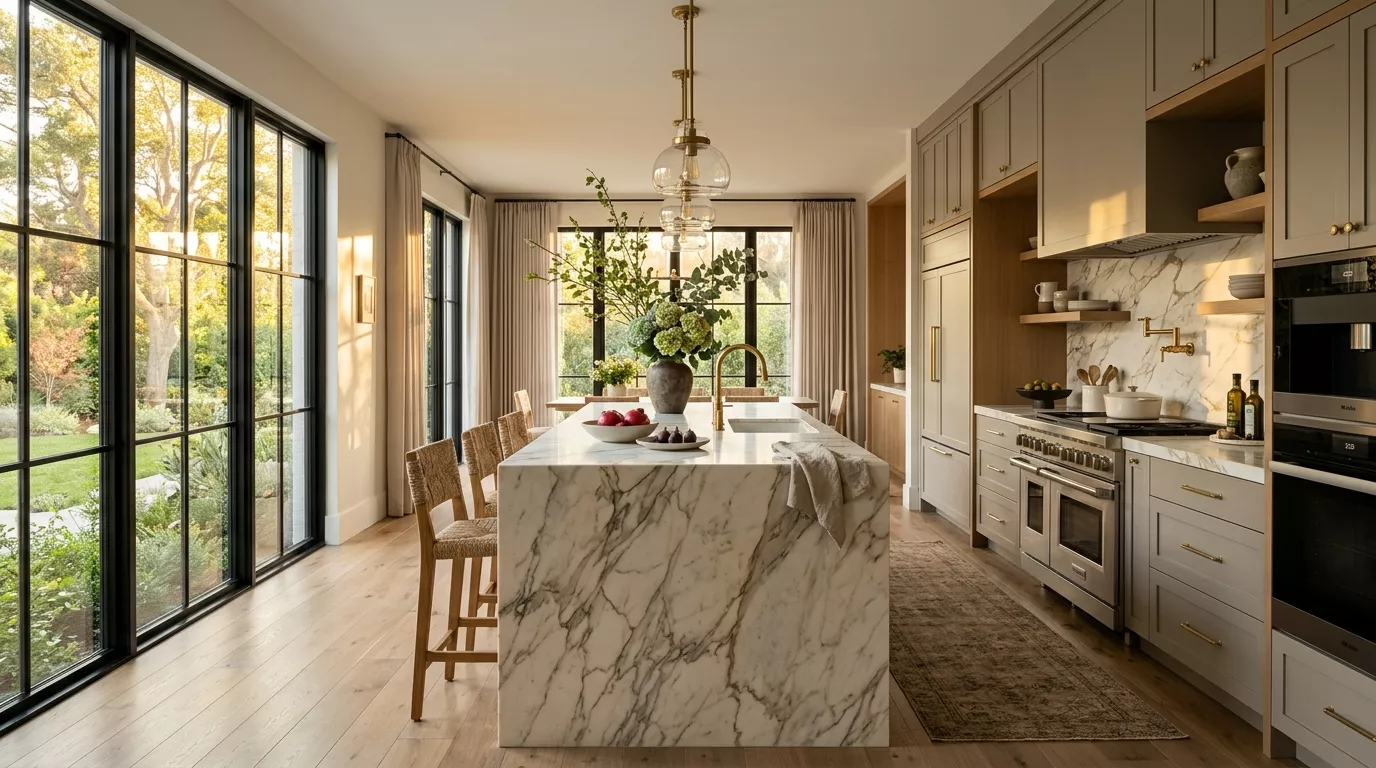
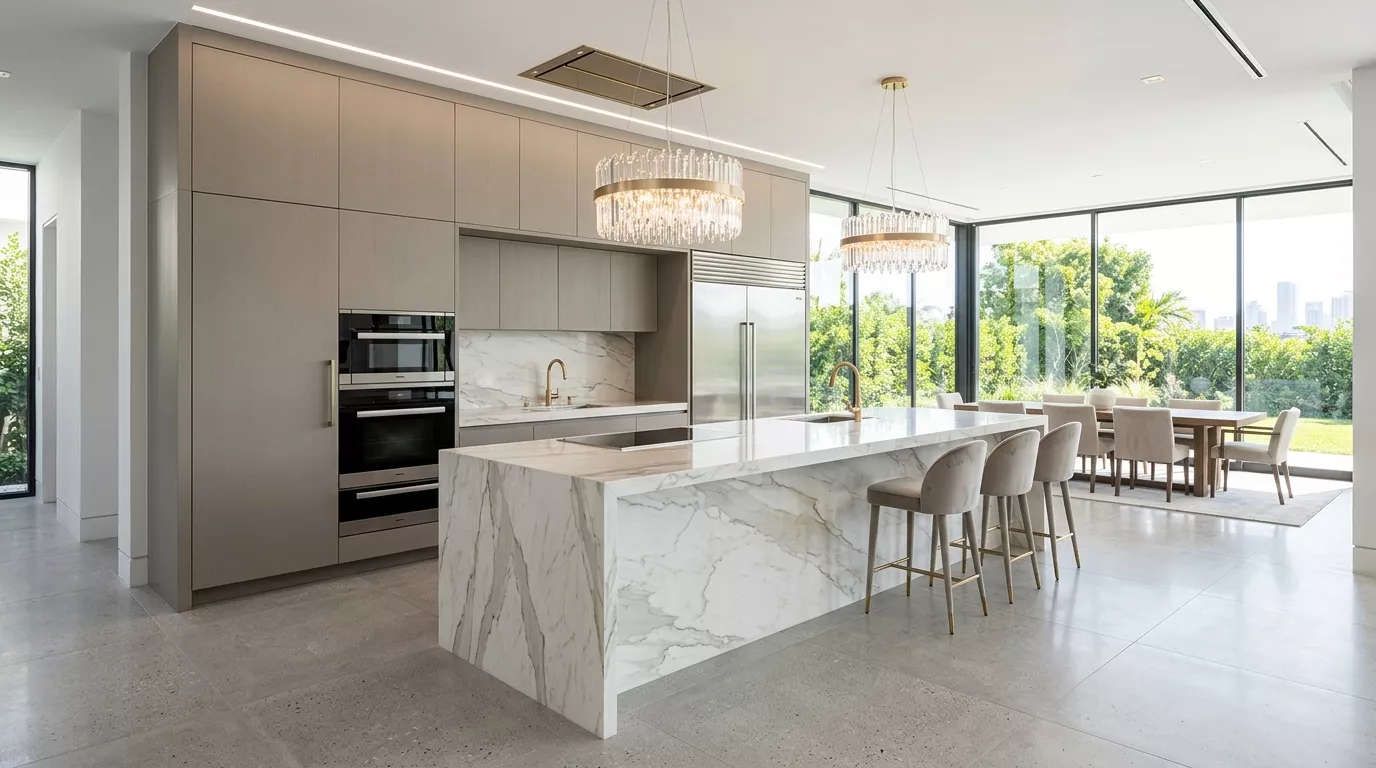
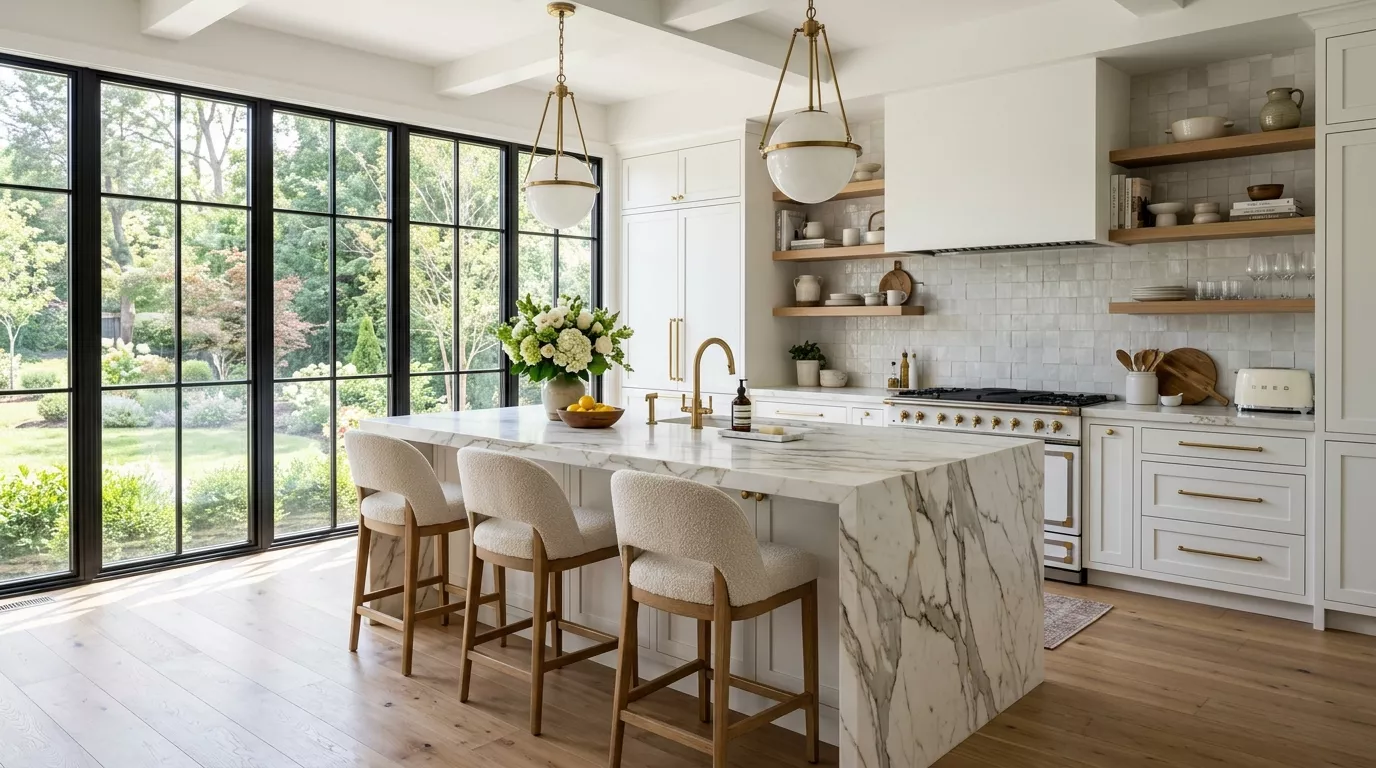
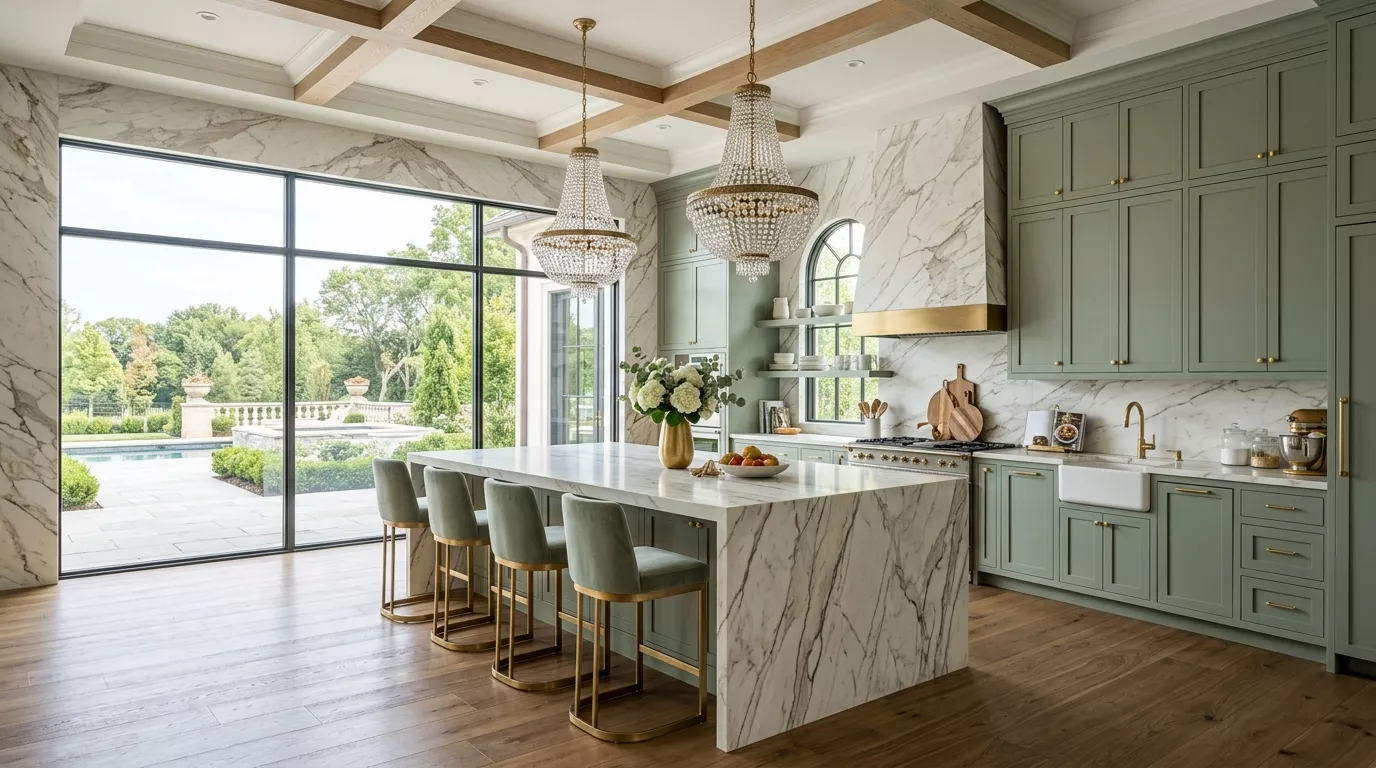
Flat Front Cabinet Ideas for a Modern Kitchen

Flat Front Cabinet Ideas for a Modern Kitchen: Design Guide & Inspiration
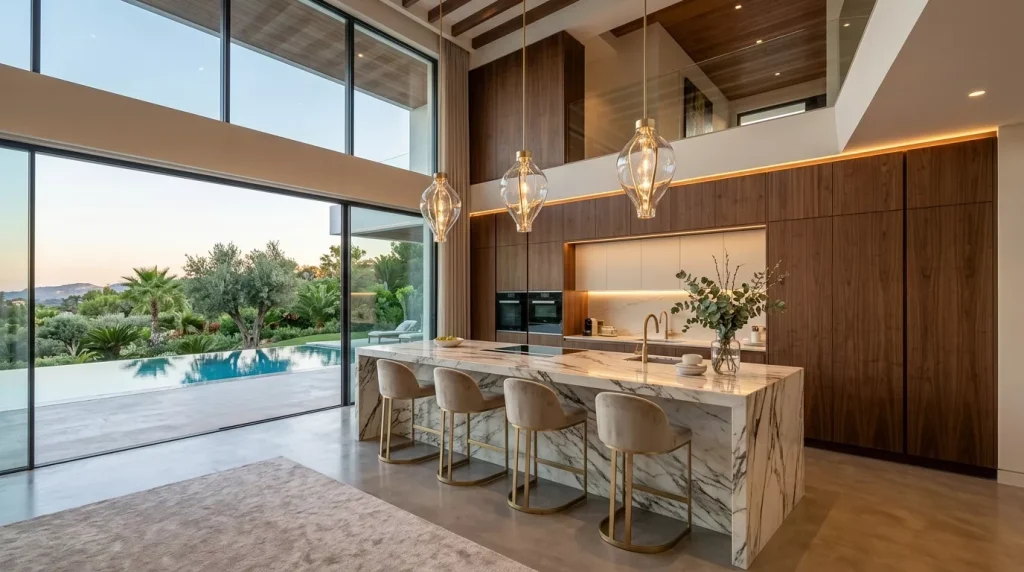
Clean lines. No ornamentation. A surface that makes a statement through simplicity rather than decoration. If you’ve been drawn to kitchens that feel genuinely modern without trying too hard, there’s a reasonable chance flat front cabinet ideas were at the center of what you admired. The flat front — also called a slab door cabinet — is the defining choice in contemporary kitchen design, and it earns that position not just through aesthetics but through a design logic that rewards good material choices, precise installation, and a clear sense of color and finish direction.
This guide walks through every dimension of the flat front cabinet — from the different door types and finish options to hardware choices, planning steps, and the honest pros and cons that nobody mentions in the showroom. Whether you’re planning a full kitchen renovation or simply replacing cabinet doors, you’ll find specific, practical guidance here for your specific situation.
What Are Flat Front Cabinets and Why Are They So Popular Right Now?
A flat front cabinet door is exactly what the name describes — a completely flat, featureless door surface with no recessed panels, raised profiles, routed details, or ornamentation of any kind. The door is a single, smooth plane of material.
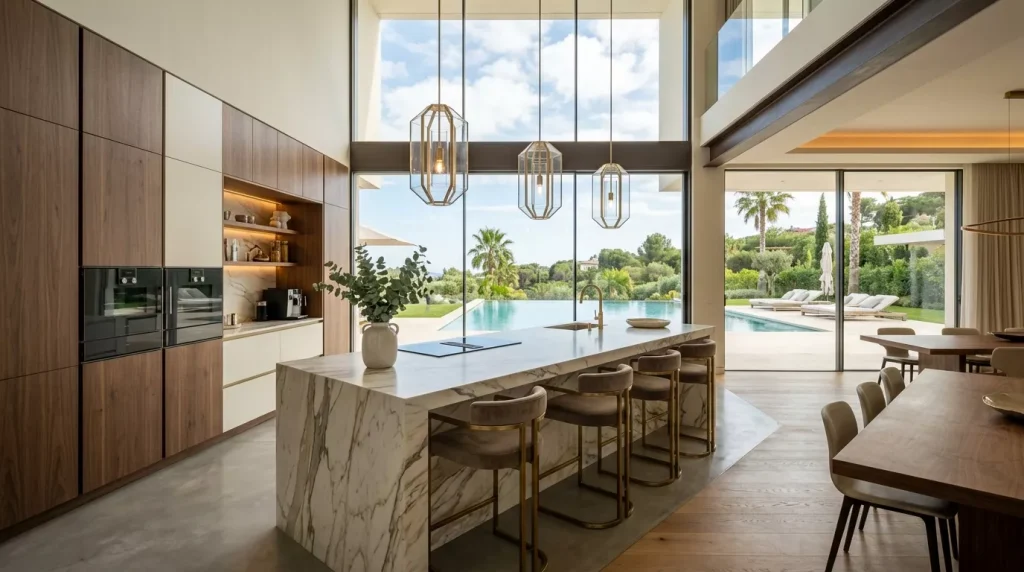
That seems like a limitation at first. But in design, restraint is often the more demanding — and more rewarding — direction. When the door itself offers no embellishment, every other decision carries more weight: the material quality, the finish texture, the hardware placement, the precision of the gaps between doors. There’s nowhere to hide imperfect craftsmanship, which means that well-executed flat front cabinets look extraordinarily refined.
The style traces directly to European modernist design traditions — particularly German and Scandinavian kitchen design from the mid-20th century — where the philosophy of “form follows function” produced cabinets stripped of historical decoration and built around honest materials and clean geometry.
What’s driving flat front cabinet popularity today is the broader cultural shift toward minimalism, open-plan living, and kitchens that feel more like architectural spaces than decorated rooms. A flat front cabinet kitchen doesn’t compete with everything around it — it recedes and lets the countertop, backsplash, and space itself do the talking.
Types of Flat Front Cabinet Doors
Not all flat front cabinets are identical. There are meaningful differences in construction, overlay style, and material that shape both the look and the cost significantly.
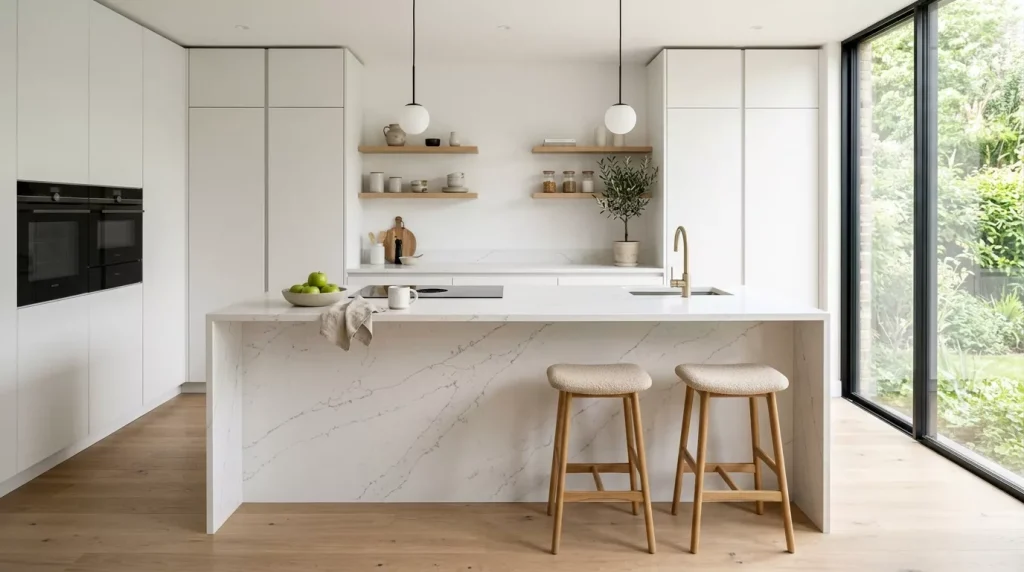
1. Full Overlay Slab Door
The full overlay slab door covers almost the entire cabinet frame — with only hairline gaps visible between adjacent doors. This is the cleanest, most contemporary-looking configuration, producing a nearly seamless facade across the kitchen.
Full overlay requires precision in both manufacturing and installation — the gaps between doors must be consistent (typically 3–5mm) for the result to look intentional rather than imprecise. It’s the most popular configuration for high-end contemporary kitchens and is now widely available in both custom and semi-custom cabinet lines.
2. Inset Flat Front Door
An inset door sits flush inside the cabinet frame rather than overlapping it. The visible frame surrounds the door, creating a recessed panel effect that reads as more furniture-like and refined than overlay configurations.
Inset flat front doors require the tightest manufacturing tolerances of any cabinet construction — the door must sit perfectly flush without binding, swinging freely through the full range of motion. The result, when done well, is one of the most elegant cabinet presentations in contemporary kitchen design. The cost reflects this complexity: inset cabinets are typically 20–30% more expensive than equivalent overlay configurations.
3. Handleless (Integrated Profile) Flat Front Door
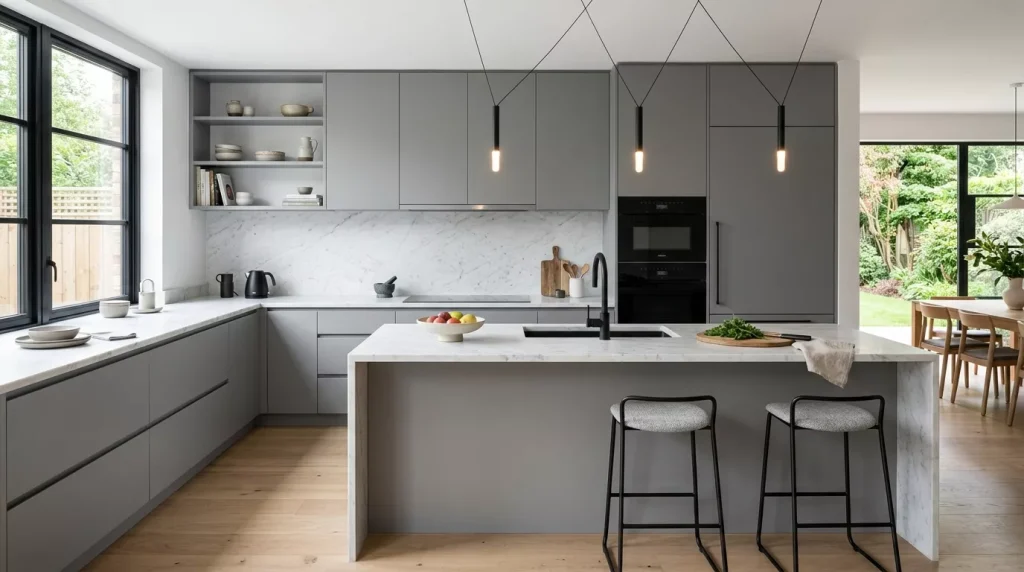
The handleless flat front cabinet takes the minimalist logic of the slab door one step further — eliminating hardware entirely by incorporating a routed recess or an integrated aluminum profile into the door’s top or bottom edge. You open the cabinet by hooking your fingers into this channel rather than grasping a separate handle.
This configuration produces the most visually seamless kitchen surface possible — an uninterrupted plane of cabinet material from one end of the kitchen to the other. It’s the dominant choice in architectural and high-design contemporary kitchens.
Integrated profile types:
- J-pull (J-channel): A horizontal aluminum channel recessed into the top edge of the door — clean, crisp, and simple
- Gola rail: A continuous aluminum profile running the full width of all upper or lower cabinets simultaneously — creates an unbroken linear detail at the same height across the kitchen
- Push-to-open (tip-on): A touch-activated mechanism that opens the cabinet with a gentle push — no hardware or channel at all, producing a completely flat, uninterrupted surface
4. Two-Part Flat Front Door (Banded or Framed)
Some flat front cabinets incorporate a thin border or band of contrasting material around the perimeter of the slab door — typically a metal or contrasting wood edge. The door is still flat (no raised or recessed panel) but the banding adds a layer of visual detail that prevents the design from feeling entirely featureless.
This configuration bridges the gap between a completely plain slab and a shaker profile — offering a hint of definition without abandoning the flat front’s fundamental character.
Flat Front Cabinet Color and Finish Ideas
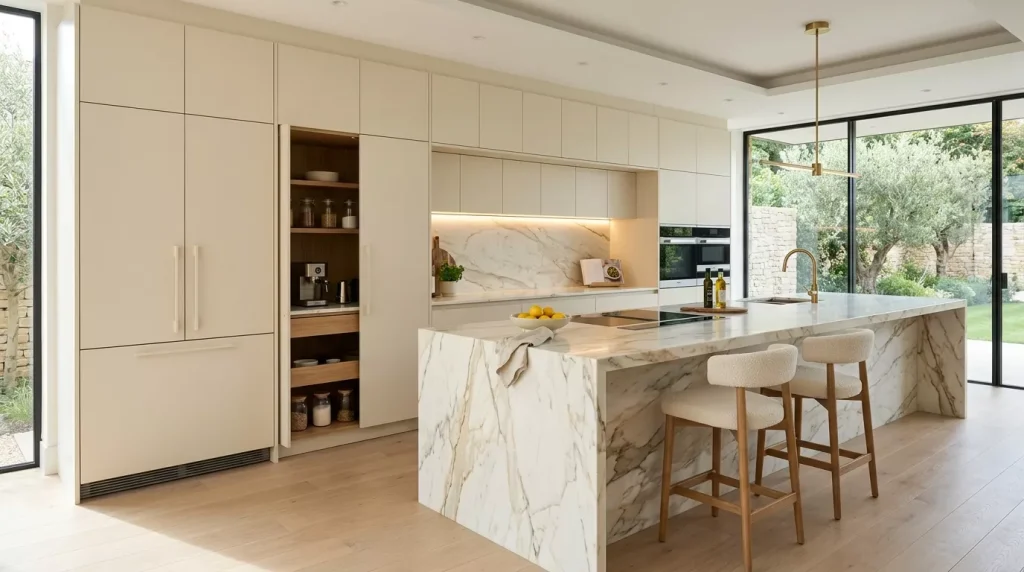
Color and finish are where flat front cabinets express the most design personality — the absence of door detail means the surface itself carries all the visual weight.
White and High-Gloss White
White flat front cabinets in a high-gloss lacquer finish are one of the most iconic contemporary kitchen images in existence — the seamless, reflective white surface bounces light around the room and creates a kitchen that feels open, clinical in the best sense, and uncompromisingly modern.
The trade-off with high-gloss white is maintenance — the reflective surface shows fingerprints, smudges, and minor scratches with significantly more visibility than matte alternatives. In a household with children, frequent cooking, or generally high kitchen traffic, this can become a real frustration.
High-gloss white works most successfully in larger kitchens with good natural light, where the reflective quality is an asset rather than a liability.
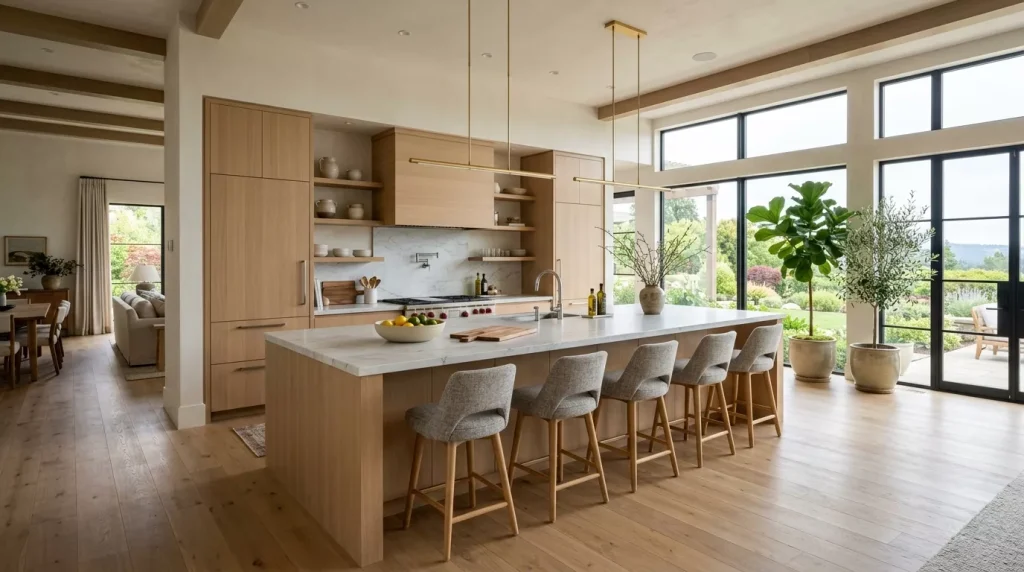
Matte White and Off-White
Matte white and warm off-white flat front cabinets retain the light-reflecting benefit of white without the fingerprint-revealing quality of high gloss. The matte surface absorbs light slightly rather than bouncing it directly — the effect is softer and more approachable, less clinical, and significantly more forgiving in daily use.
Warm off-white (with cream or yellow undertones) produces a kitchen that feels warmer and more residential than stark white — particularly effective in kitchens that also incorporate natural wood elements or warm metal hardware.
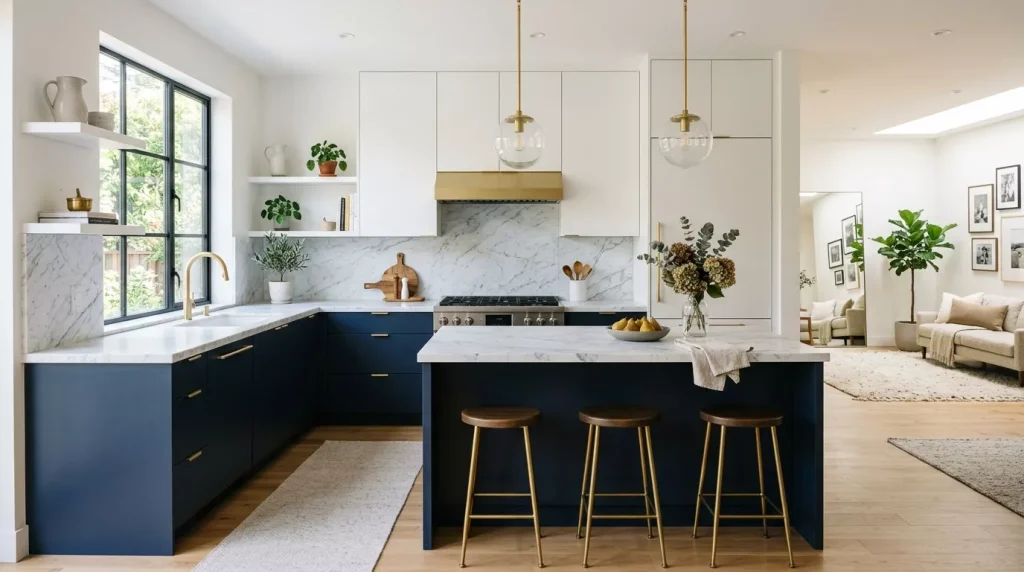
Deep Navy and Midnight Blue
Navy flat front cabinets have earned their place as one of the most reliably successful bold color choices in contemporary kitchen design. The depth of navy interacts with the perfectly flat door surface to create a rich, moody quality that jewel tones applied to more detailed door profiles don’t quite replicate.
Navy flat front cabinets work best on lower cabinets or islands when paired with white or cream upper cabinets — the contrast creates visual hierarchy that gives the kitchen architecture without structural change. Pairing with warm brass or unlacquered brass hardware produces a classic and sophisticated result.
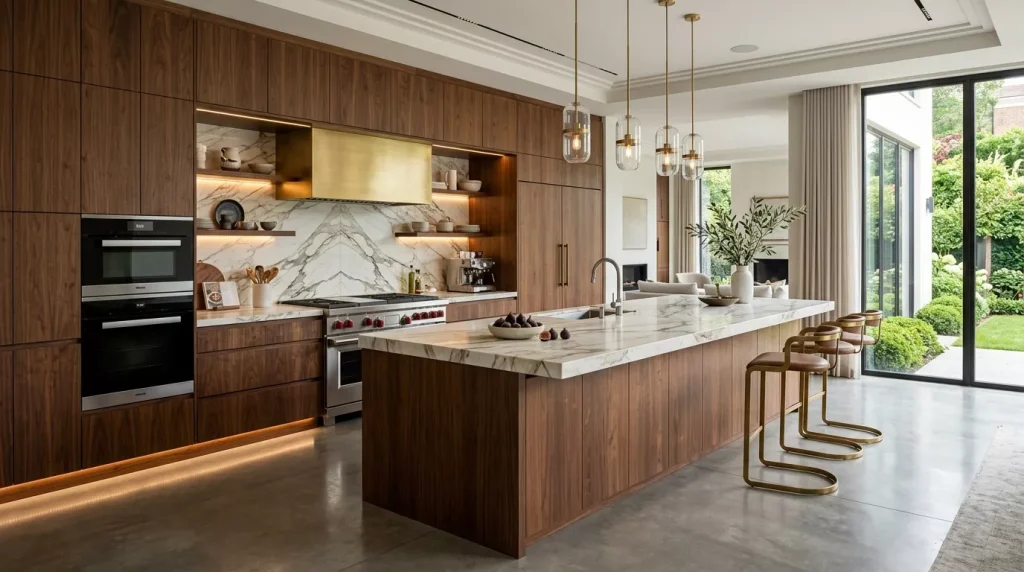
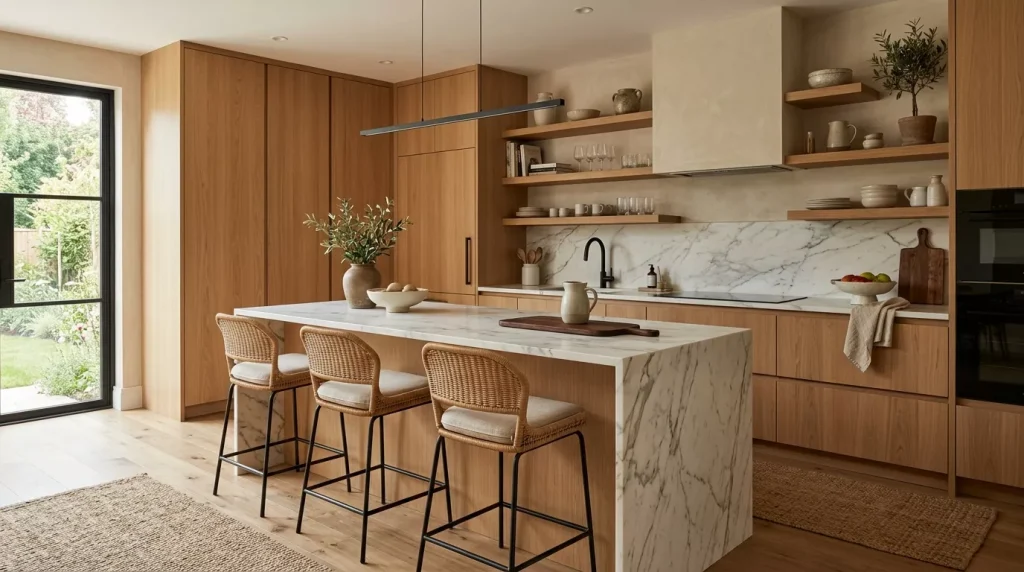
Warm Wood Grain Finishes
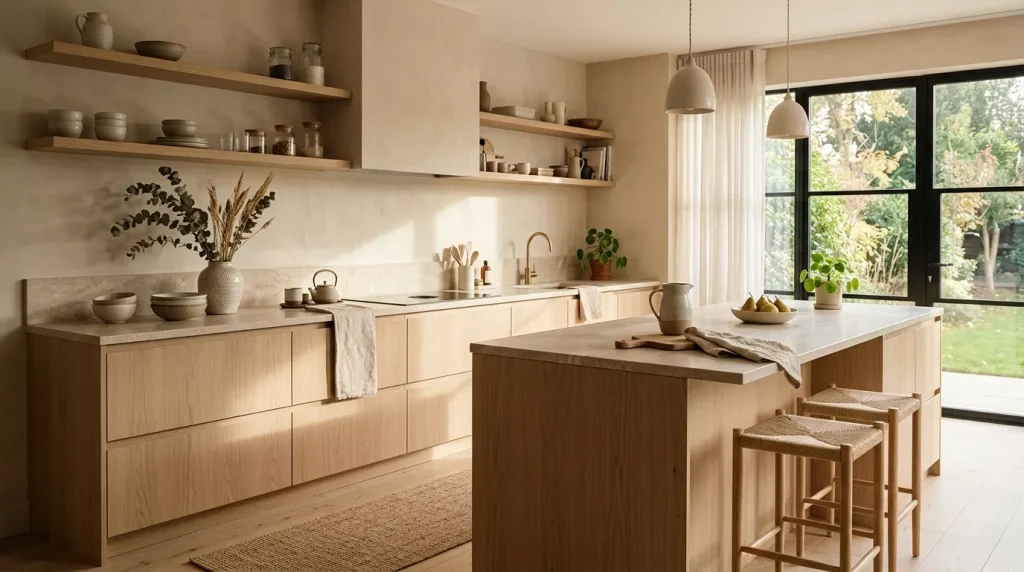
Wood grain flat front cabinets — either in real veneer or high-quality melamine reproduction — bring organic warmth to contemporary kitchen design that paint finishes alone rarely achieve. Walnut, oak, and ash veneer flat front cabinets are particularly popular in Scandinavian and Japandi-influenced kitchens, where the combination of natural material and minimal form is the defining aesthetic language.
The flat door profile amplifies the wood grain’s natural beauty rather than interrupting it with routed edges or raised profiles — the grain reads continuously across the full door surface, which is precisely the effect that makes wood flat front cabinets so visually distinctive.
Charcoal, Graphite, and Black
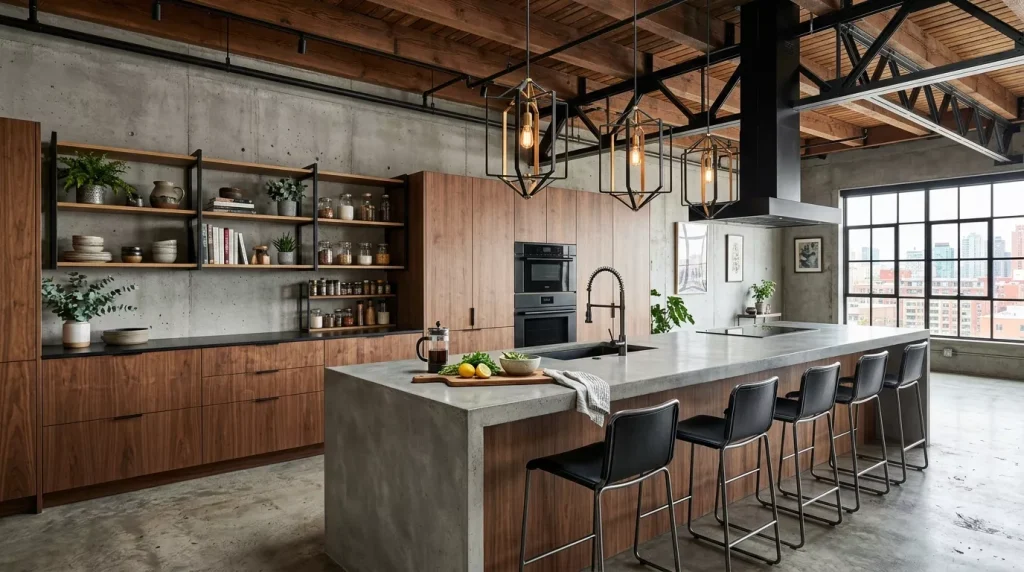
Dark flat front cabinets — charcoal, graphite, or matte black — produce kitchens of considerable drama and architectural presence. Against light countertops (white quartz or light marble), a dark flat front kitchen creates high contrast that reads as confident and distinctive.
Full dark flat front kitchens — dark upper and lower cabinets — work best in larger, well-lit spaces where there’s sufficient natural light to prevent the room from feeling oppressively heavy. In smaller or lower-light kitchens, dark lower cabinets paired with lighter uppers is the more practical and usually more successful configuration.
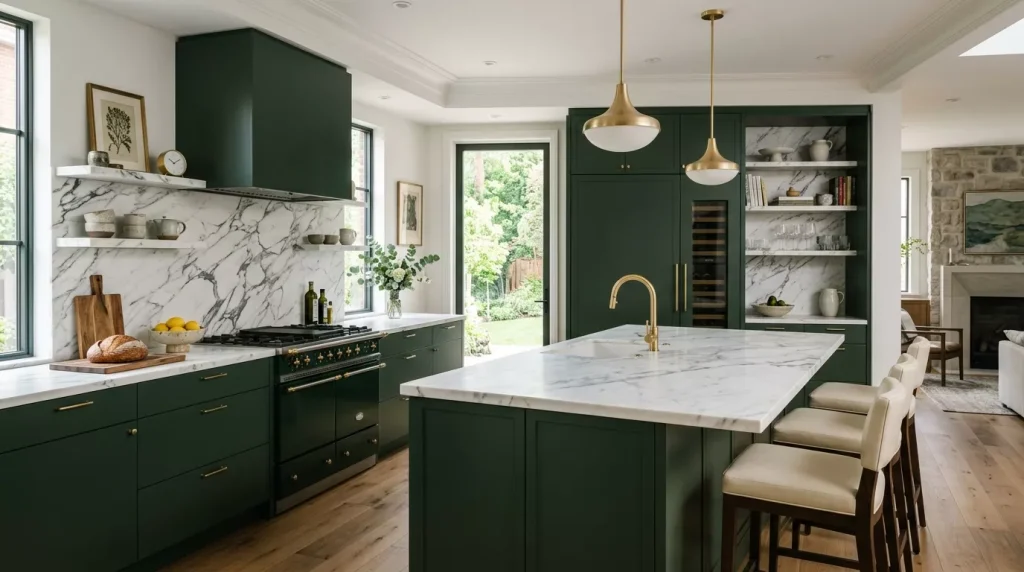
Two-Tone Configurations
Two-tone flat front kitchens — typically upper cabinets in one color and lower cabinets or the island in a contrasting color — represent one of the most dynamic expressions of the flat front style. The completely clean door profile means the color transition happens as an uninterrupted line across the kitchen, producing a precise and intentional-looking result.
Popular two-tone combinations:
- White upper / navy lower — fresh and sophisticated
- White upper / wood lower — warm and Scandinavian in quality
- Light grey upper / matte black lower — contemporary and grounded
- Cream upper / sage green lower — warm, natural, on-trend
- White upper / terracotta lower — earthy and distinctive
Hardware Ideas for Flat Front Cabinets
The hardware choice for flat front cabinets matters more than for almost any other cabinet style. Because the door surface offers no visual detail of its own, the hardware becomes the door’s only defining feature — or, in a handleless kitchen, its deliberate absence.
| Hardware Style | Visual Effect | Best Finish | Works With |
|---|---|---|---|
| Bar pull (long) | Graphic, modern | Matte black, brushed brass | All flat front styles |
| Minimal round knob | Quiet, understated | Brushed nickel, matte black | Inset flat front |
| J-pull / C-pull | Clean, integrated | Brushed aluminum, matte black | Full overlay flat |
| Gola profile rail | Seamless, architectural | Anodized aluminum, brushed steel | Contemporary, handleless |
| Push-to-open | No hardware visible | N/A | Minimalist, ultra-modern |
| Edge pulls (thin) | Minimal, refined | Black, brushed brass | Modern transitional |
The scale of hardware relative to door size matters enormously. Long bar pulls (12–18 inches) on full-height pantry doors look proportional and deliberate. The same pulls on small upper cabinets look oversized and awkward. Match pull length to the cabinet dimension and the choice will almost always look right.
Step-by-Step Guide: Planning a Flat Front Cabinet Kitchen
Step 1 — Clarify Your Design Direction First
Flat front cabinets span from stark ultra-modern to warm Japandi depending entirely on color and material choices. Before looking at a single cabinet, decide the specific feeling you’re after. Three descriptive words written down before you start will prevent the decision fatigue that comes from browsing an enormous range of options without a filter.
Step 2 — Decide on Door Construction: Overlay or Inset
This decision shapes both the budget and the final look significantly:
| Configuration | Visual Character | Cost Level | Tolerance Requirement |
|---|---|---|---|
| Full overlay | Seamless, clean | Moderate | High |
| Inset flat front | Refined, furniture-like | High | Very high |
| Partial overlay | Less contemporary | Low-moderate | Moderate |
For most contemporary kitchens aiming for a genuinely modern result, full overlay is the most practical and most budget-appropriate choice.
Step 3 — Choose Cabinet Box Construction
The door gets the attention, but the cabinet box determines structural longevity:
- Plywood box: Best construction — stable, moisture-resistant, strong joint points
- MDF box: Good for painted kitchens — smooth and paintable, but heavier and moisture-sensitive
- Particleboard box: Budget option — less durable, more moisture-susceptible, shorter lifespan
For a flat front kitchen where the design investment is significant, plywood construction throughout is the recommended specification.
Step 4 — Select Material and Finish for the Door
| Door Material | Durability | Maintenance | Visual Quality | Cost |
|---|---|---|---|---|
| High-gloss lacquer | Good | High (shows marks) | Very high | High |
| Matte lacquer | Very good | Low | Very high | High |
| Two-pack polyurethane | Excellent | Low | Very high | High |
| Melamine (matte) | Good | Very low | Good | Moderate |
| Real wood veneer | Good | Medium | Excellent | High |
| Thermofoil | Moderate | Low | Moderate | Low-moderate |
For flat front kitchens where the unadorned surface carries all the visual weight, invest in the best door material your budget allows. A beautifully finished matte lacquer door or real wood veneer reads immediately as higher quality than a budget thermofoil — and in a flat front kitchen, that distinction is very visible.
Step 5 — Plan Hardware or Handleless Integration
Decide early whether you want handles, integrated profiles, or push-to-open — because the choice affects cabinet door specification, internal mechanism requirements, and installation details. Handleless systems require specific door profile machining; push-to-open requires specific hinge and catch hardware. These can’t easily be retrofitted after manufacture.
Step 6 — Choose Your Countertop and Backsplash as Complements
Flat front cabinets work best when the countertop and backsplash are selected to complement rather than compete. Some reliable principles:
- Against white flat front cabinets: Calacatta quartz, warm-toned stone, or honed black granite creates the strongest contrast
- Against dark flat front cabinets: Light white or warm cream countertops balance the drama
- Against wood grain flat fronts: White quartz, concrete, or light stone keeps the wood as the visual center
- For the backsplash: Large format tile, slab backsplash in the countertop material, or minimal subway tile all maintain the kitchen’s clean geometry without introducing competing visual complexity
Flat Front vs. Shaker vs. Raised Panel: Which Is Right for You?
| Feature | Flat Front | Shaker | Raised Panel |
|---|---|---|---|
| Visual character | Minimal, contemporary | Structured simplicity | Formal, ornate |
| Cleaning ease | Easiest (no grooves) | Medium (panel edge) | Hardest (most detail) |
| Design longevity | Very high | Very high | Lower in modern context |
| Era association | Modern, mid-century | Timeless, 18th century+ | Victorian to mid-20th |
| Hardware flexibility | Highest | High | Limited to traditional |
| Resale appeal | Very high in modern homes | Universal | Traditional homes only |
| Cost range | Low to very high | Low to very high | Moderate to high |
| Best kitchen style | Contemporary, minimalist | Transitional, any | Traditional, formal |
Pros and Cons of Flat Front Cabinets
Pros
- Easiest to clean of any cabinet style. No grooves, no routed edges, no panel recesses to collect grease and cooking residue. A single wipe cleans the entire door surface — a meaningful advantage in a room where cooking and daily use create ongoing cleaning demands.
- Timeless within modern design. Unlike specific trend-driven choices, the flat door profile has been a cornerstone of modernist design for nearly a century. A well-executed flat front kitchen doesn’t date the way more decorative or trend-specific cabinet styles can.
- Amplifies material quality. In a flat front kitchen, the quality of the door material reads immediately and fully — there’s nothing to distract from it. This means excellent material choices look exceptional; it also means budget material choices are more exposed than they would be on a more detailed door style.
- Maximum hardware flexibility. Every hardware style — from invisible push-to-open to graphic long bar pulls — works with a flat front door. The neutral surface accommodates any hardware direction without conflict.
- Suits open-plan and contemporary architecture. In modern homes where the kitchen is visible from living and dining areas, flat front cabinets integrate into the broader spatial aesthetic more naturally than ornamented styles.
Cons
- Unforgiving of imprecision. Because there’s no visual detail to redirect the eye, installation imperfections — uneven gaps, slightly misaligned doors, inconsistent horizontal levels — are immediately visible. Flat front kitchens require higher installation precision than detailed door styles.
- Can feel cold without warm elements. An all-flat-front, all-white kitchen without wood tones, warm metals, or textural elements can feel clinical and emotionally flat. The style genuinely benefits from counterbalancing warmth through material and color choices.
- Mark visibility on gloss finishes. High-gloss flat front doors show fingerprints and minor surface marks more visibly than matte finishes or textured surfaces. Households with children in particular often find this a daily frustration.
- Limited personality on its own. The flat front door is inherently a backdrop — it needs the kitchen’s other elements (countertop, backsplash, hardware, lighting, color) to be well-considered to feel finished. Without those elements, a flat front kitchen can read as empty rather than minimal.
Common Mistakes with Flat Front Cabinets
1. Choosing High Gloss Without Considering Daily Life
High-gloss white flat front cabinets look extraordinary in design photos — and reveal every fingerprint, smudge, and minor scratch in the reality of daily kitchen use. Before committing to a gloss finish, honestly assess how the kitchen is used and by whom. For households with children, heavy cooking, or simply more relaxed maintenance habits, a matte or satin finish delivers almost the same visual quality with a fraction of the upkeep.
2. Going Handleless Without Thinking About Usability
Push-to-open and integrated profile handleless systems are beautiful — but they’re not equally practical for all users. Push-to-open mechanisms can be frustrating with wet or greasy hands. Very young children and older adults sometimes find integrated channel pulls less intuitive than traditional handles. Consider usability for all household members before choosing a fully handleless configuration.
3. Pairing Flat Front Cabinets with Busy Backsplash Patterns
The visual logic of flat front cabinets is restraint — removing complexity from the door surface to let other elements speak. A highly patterned or ornate backsplash directly behind a flat front kitchen doesn’t complement the cabinet’s character; it competes with it. Simple, large-format, or tonal backsplash choices maintain the kitchen’s design coherence.
4. Under-Investing in the Door Material
A flat front door with a budget thermofoil or thin melamine finish in a poorly applied color looks noticeably cheap in a way that the same material on a shaker door might not. The unadorned door surface reads very directly on material quality. Stretch the budget toward door finish quality before anything else.
5. Ignoring Lighting Design
Flat front kitchens without good lighting look flat — literally. The same kitchen with thoughtful task lighting under upper cabinets, pendant lighting over an island, and warm ambient lighting reads as significantly more resolved and more beautiful. Lighting in a flat front kitchen isn’t an afterthought; it’s what gives the surfaces dimension.
6. Choosing the Wrong Gap Width Between Doors
The gap between adjacent flat front doors should be consistent and intentional — 3mm to 5mm is the standard for contemporary installations. Gaps that are too wide look sloppy; gaps that are too narrow risk doors binding against each other with seasonal wood movement. Specify this detail explicitly when ordering and verify it during installation.
Quick Tips for Better Flat Front Cabinet Results
Tip 1: In a fully white flat front kitchen, introduce warm material contrast deliberately — a wood island countertop, warm brass hardware, or a stone backsplash with warm veining prevents the kitchen from feeling sterile.
Tip 2: Use a consistent horizontal datum line across all flat front upper cabinet bases, all lower cabinet tops, and all handleless profiles. This alignment is what gives a flat front kitchen its architectural quality — break it and the kitchen feels assembled rather than designed.
Tip 3: In a two-tone flat front kitchen, use the color transition line to create architectural interest. Aligning the color change with the underside of upper cabinets, or with a floating shelf datum, gives the transition a reason to exist beyond pure decoration.
Tip 4: Matte black hardware on white flat front cabinets is a combination of almost universal reliability — the graphic contrast is strong without being aggressive, and it suits the flat front’s character at every budget level.
Tip 5: Request a door sample before ordering a full kitchen. Flat front door finishes — particularly matte lacquers and wood veneers — look significantly different in a physical sample under your kitchen’s specific light conditions than they do on screens or in showrooms under retail lighting.
Tip 6: For handleless kitchens, specify soft-close hinges and drawer runners as non-negotiable. In a push-to-open kitchen where every motion is deliberate and visible, a door or drawer that closes with a bang — rather than softly and silently — disrupts the kitchen’s entire sensory experience.
FAQs: Flat Front Cabinet Ideas
Q1. Are flat front cabinets more expensive than shaker cabinets?
Not inherently — the price difference lies primarily in the door material and manufacturing complexity rather than the door profile itself. A basic flat front door in a standard melamine finish can be less expensive than an equivalent shaker door. A flat front door in a hand-applied matte lacquer or real wood veneer is significantly more expensive than most shaker alternatives. The higher cost in flat front kitchens typically comes from the more precise installation required (consistent gaps, perfect alignment), the quality of finish chosen, and the handleless systems or integrated profiles that many contemporary flat front kitchens incorporate.
Q2. What is the difference between flat front and slab cabinet doors?
The terms are essentially interchangeable — both refer to a completely flat, featureless door with no recessed panel, raised profile, or routed detail. Some sources use “flat front” to describe the general category and “slab door” specifically for very thick, solid doors (common in European-style cabinetry), but in everyday use and in most kitchen design contexts, flat front and slab door mean the same thing. The key distinguishing characteristic of both, regardless of terminology, is a single smooth plane of material with no decorative surface treatment.
Q3. How do I make flat front cabinets look less cold or clinical?
The flat front door’s visual character is inherently restrained, which can read as cold if not balanced with warmer elements. The most effective counterbalancing choices: natural wood tones (either in the cabinet finish itself, in the countertop, or in the flooring), warm metal hardware finishes (brass, bronze, unlacquered copper), warm-toned paint colors on the cabinets themselves (cream, warm grey, sage, terracotta rather than cool white or grey-blue), tactile countertop materials (honed stone, butcher block), and warm ambient lighting rather than harsh cool overhead light. Any two or three of these elements introduced into an otherwise restrained flat front kitchen shifts its emotional temperature significantly.
Q4. Can flat front cabinets work in a traditional home?
The short answer is yes, with the right color and hardware choices — but it requires more deliberate bridging between the cabinet’s inherent modern character and the home’s traditional architectural context. The most successful approaches in traditional homes: choosing warm, muted colors rather than stark contemporary choices (cream, warm grey, soft green rather than white or black), using traditional hardware styles (round knobs, cup pulls) rather than minimalist bar pulls or handleless systems, and incorporating natural wood elements that connect to the home’s existing material palette. The flat front profile in a warm, carefully considered color and hardware combination can sit comfortably in a traditional home — the key is recognizing that the door itself is modern and compensating for that through the choices around it.
Q5. What countertop works best with flat front cabinets?
The most universally successful countertop pairing for flat front cabinets is a stone or stone-look quartz — either in a light tone to contrast with darker cabinets or in a warm-veined tone to add life to lighter ones. Calacatta and Carrara marble (or their quartz equivalents) work beautifully with white or light flat front cabinets. Dark soapstone or honed black granite creates strong contrast with light flat fronts. Butcher block or raw concrete introduces warmth and texture that paint-finish flat front cabinets particularly benefit from. The general principle: the countertop should introduce something the flat front door doesn’t have — either stronger color contrast, natural texture, or organic pattern.
Q6. Are flat front cabinets easy to repair if scratched or chipped?
Repair feasibility depends on the door finish. Matte lacquer and two-pack polyurethane finishes can be spot-repaired by a skilled finisher, though achieving a completely invisible repair is challenging and depends on the paint color and sheen level. High-gloss finishes are harder to repair invisibly because the reflective surface reveals the repair boundary clearly. Wood veneer can be locally refinished by a skilled craftsperson. Thermofoil and melamine edges are the most vulnerable to damage and the hardest to repair cleanly — chips at corners or edges typically require door replacement rather than spot repair. For high-traffic kitchens, matte finishes and durable door materials (two-pack lacquer, real veneer) are both more resistant to damage and more repairable when damage does occur.
Conclusion: Flat Front Cabinets Reward Every Decision Made with Care
A well-executed flat front cabinet kitchen is one of the most consistently beautiful and most enduringly modern spaces in residential design — precisely because the restraint of the door profile puts every other decision into sharp focus. The countertop, the hardware, the color, the lighting, the installation precision — all of it matters more in a flat front kitchen than in a cabinet style where surface detail provides visual cover.
That’s demanding. But it’s also what makes a well-planned flat front kitchen so satisfying to live in. There’s nothing accidental about it. Every material, every finish, every hardware choice was either right or it wasn’t — and when it’s all right, the result is a kitchen that looks as good on day five hundred as it did on day one.
Use the planning guide in this article to work through each decision in order. Start with your design direction, choose your door construction and material before thinking about color, and treat the hardware decision with the seriousness it deserves in a style where it carries this much visual weight.
Start today with a door sample request from two or three manufacturers you’re considering. Hold those samples under your kitchen’s actual light conditions, alongside the countertop material you’re considering, and let that physical experience guide the final decision. That fifteen-minute exercise will tell you more than a hundred hours of screen browsing — and it’s where every great flat front kitchen ultimately begins.